
Does “No” Always Mean “No”?
Graph of the Week
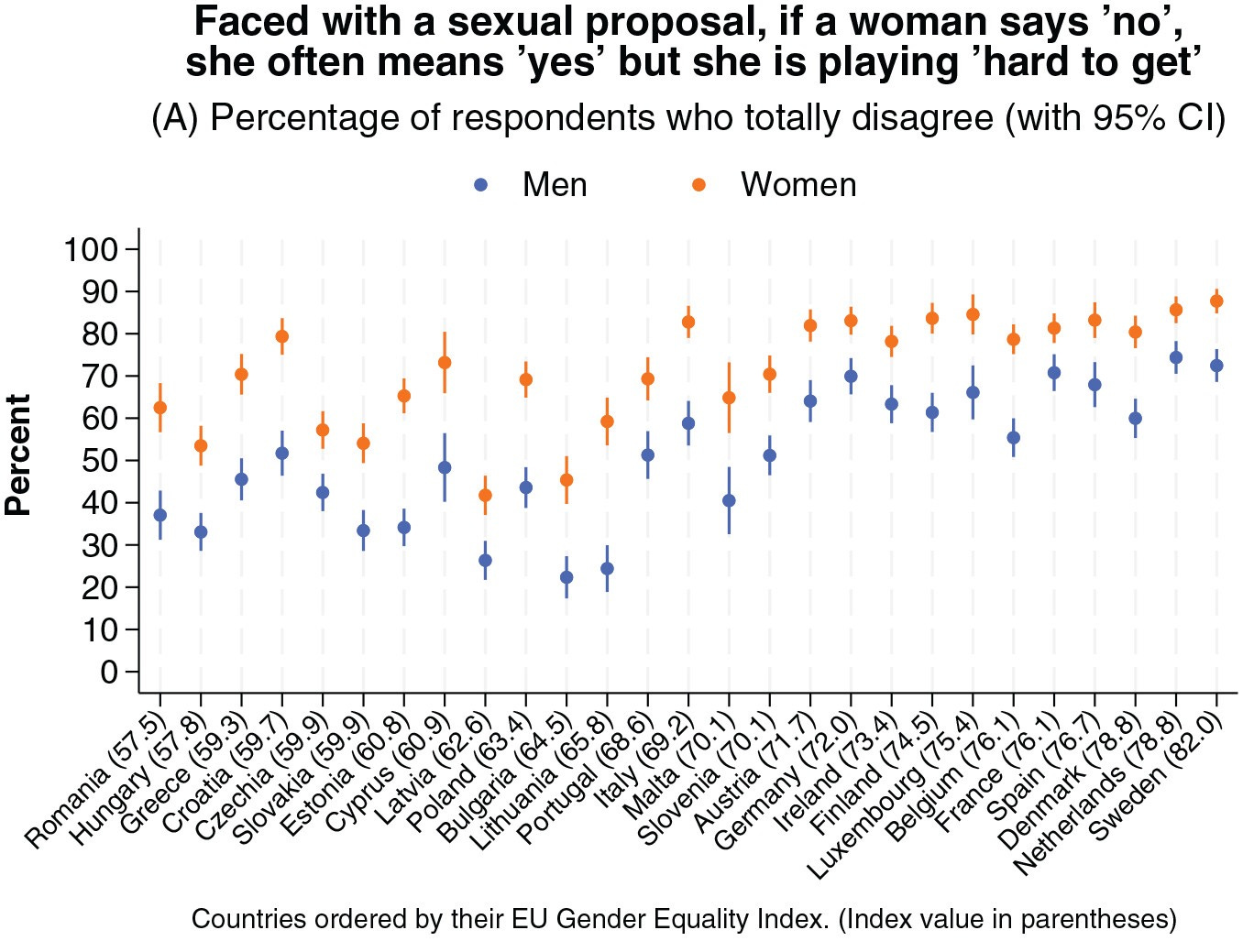
This week’s graph, courtesy of an open access academic paper, illustrates the percentage of men and women in European countries who “totally disagree” with the following statement: “Faced with a sexual proposal, if a woman says ‘no’, she often means ‘yes’ but she is playing ‘hard to get’.
The question was asked to over 25,000 individuals who were living in 27 European countries in February of 2024. The researchers segregated the data by sex and country. On the x-axis, the researchers organized the data (from left to right) based on the country’s score on the EU Gender Equality Index. The country’s score on this index is listed in parentheses after the country’s name.
Key Points
The percentage of respondents who totally disagreed with the statement differed by sex and country.
In every country, a greater proportion of women than men totally disagreed with the statement.
In no country, did all women or all men totally disagree with the statement.
The proportion of women who totally disagreed with the statement differed by country. In countries like Italy, Austria, Germany, Ireland, Finland, Luxembourg, Belgium, France, Spain, Denmark, the Netherlands, and Sweden, approximately 80% or more of women totally disagreed with the statement. However, in countries like Latvia, Bulgaria, Hungary, Slovakia, Estonia, and Lithuania, 40% to 65% of women totally disagreed with the statement.
The proportion of men who totally disagreed with the statement also differed by country. In countries like Italy, Austria, Germany, Ireland, Finland, Luxembourg, France, Spain, Denmark, the Netherlands, and Sweden, 60% to 75% of men totally disagreed with the statement. However, in countries like Romania, Hungary, Slovakia, Estonia, Latvia, Bulgaria, and Lithuania, 20% to 40% of men totally disagreed with the statement.
For a given country, the gap between the blue circle (men) and the salmon-colored circle (women) illustrates the extent to which men and women differ in their views on the question. For example, large gaps between men’s and women’s views on this question existed in Estonia (~30% gap) and Lithuania (~35% gap), whereas smaller gaps existed in Germany (~15%), France (~10%), the Netherlands (~10%), and Sweden (~15%).
Individuals who lived in countries that scored higher on the EU Gender Equality Index tended to totally disagree with the statement more often than individuals who lived in countries that scored lower on the EU Gender Equality Index.
Source
Nennstiel R, Moser S. (2025). “Does “No” Always Mean No? Gender Differences in Consent Perceptions across the EU.” Socius 11:1-4.
Bonus Commentary
The results from the survey illustrate that many Europeans believe that a woman saying “No” to a sexual proposal sometimes reflects her playing “hard to get.” European women were more likely than European men to reject this idea, but even in countries where feminism and “gender equality” initiatives are pervasive, notable proportions of women (e.g., 10-20%) still did not completely agree with the premise that “No” always means “No.” In some countries, the proportion of women who did not completely agree with the premise that “No” always means “No” was as high as 50%.
Substantial variation in beliefs about this topic exists across countries, with men from places like Sweden and the Netherlands more likely than women in Latvia and Bulgaria to believe that “No” means “No.” Such results suggest that men adopt the beliefs and practices of women in their own countries. Moreover, such results imply that an average man and average woman from specific countries are incompatible when it comes to interpreting whether a woman is playing “hard to get.” For example, if an average Bulgarian man and an average Swedish woman are on a date, or meet organically in public, the two of them are not going to fully understand each other if the woman says “No” to his sexual proposal(s). He will be confused by her actions, and she will be confused by his actions.
The results also reveal that women are in not universal agreement about this topic, with many women acknowledging that a woman saying “No” sometimes reflects her playing “hard to get.” This ambiguity in sexual communication places men in a bind. The man is expected to play the role of sexual mind reader. Consequently, because 10-60% of women admit that “No” does not always mean “No,” some men adopt a default position of assuming that the woman might be interested even if she initially says “No.” The reason for this default position is because an average man’s opportunities for sex are more limited than the average woman’s opportunities for sex. Thus, the man does not want to miss a potential opportunity to pass on his genes if the opportunity is available to him, even if one in theory (i.e., using contraception). Thus, until 100% of women agree that “No” means “No,” men will continue to assume that sometimes “No” does not mean “No.”
Related Content at The Nuzzo Letter


SUPPORT THE NUZZO LETTER
If you appreciated this content, please consider supporting The Nuzzo Letter with a one-time or recurring donation. Your support is greatly appreciated. It helps me to continue to work on independent research projects and fight for my evidence-based discourse. To donate, click the DonorBox logo. In two simple steps, you can donate using ApplePay, PayPal, or another service. Thank you!

There's another angle to this - when I was a young man (a very long time ago) women would answer, reflexively, 'no' because to do otherwise was to risk being branded as promiscuous.
So it would be interesting to look at respondent age in those survey results.
It's an interesting study that could have been more interesting if they had changed the wording of the question. They ask “Faced with a sexual proposal, if a woman says ‘no’, she often means ‘yes’ but she is playing ‘hard to get’.
A better question would be to change the word "often" to "sometimes". “Faced with a sexual proposal, if a woman says ‘no’, she sometimes means ‘yes’ but she is playing ‘hard to get’.
I believe that using the word "often" overstates the prevalence of the practice. But many men have encountered a "sometimes" girl, and the results of such a study would have been much more interesting