
Weekly Roundup
Jul 27 - Aug 2, 2026
LEADING ARTICLE
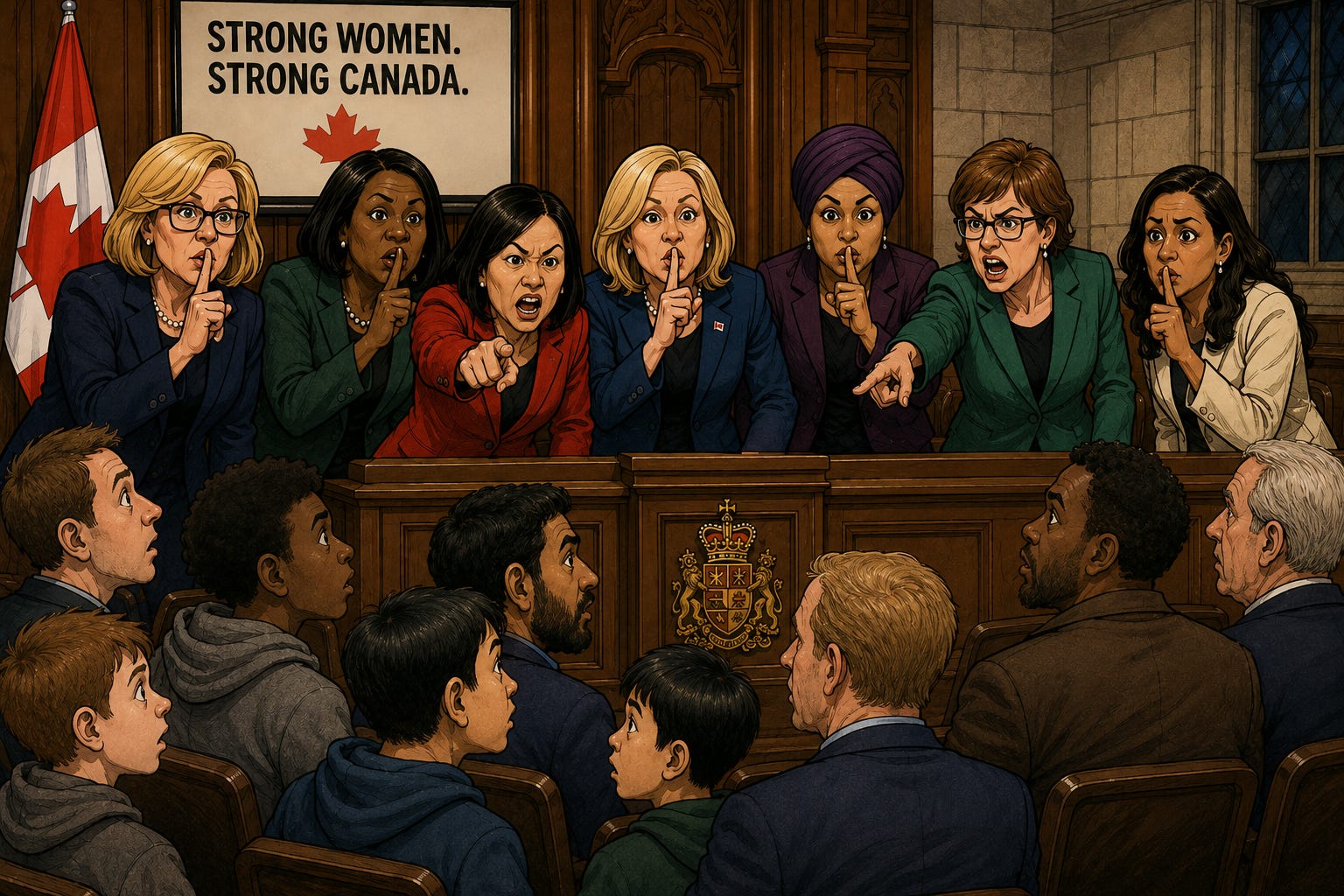
Whine and Poses: Feminists “Confront Antifeminist Ideologies”
The Fiamengo File
Even with their money and muscle on full display, feminists cry victim in a recent government report.
WEEKLY VOICE
THE NUZZO LETTER IN THE NEWS
GenderSpeak: Weaponizing Gender Against Sex
Brownstone Institute
(Note: This article, which is also available on Substack at Malone News, references data published at The Nuzzo Letter.)
ARTICLES AND ESSAYS
Sex/Gender
Men’s Health and the Rise of Female Supremacism
Stop Abusive and Violent Environments (SAVE)
‘Have you considered helping boys?’ The other gender gap
LA Times (Lisa Britton)
6 Ways To Help The Man You Love Without Mothering Him
Evie Magazine
Women do more water chores due to ‘neocolonial gender blind spot,’ UCLA study says
The College Fix
UMinn scholars launching transgender doll project for 4-year-olds
The College Fix
Health Sciences
NCHS Health E-Stat
Health Center Visit Rates, by Age and Sex — United States, 2024
Morbidity and Mortality Weekly Report
Results: In 2024, visit rates to health centers were similar among girls (318.0 per 1,000 population) and boys (327.7) aged 0–17 years. However, visit rates were significantly higher among women aged 18–34 years (484.4) and aged 35–54 years (516.6) compared with men in the same age groups (176.5 and 271.5, respectively). The observed difference by sex was not statistically significant among adults aged ≥55 years.
Education
Just 12% of Americans Say Four-Year Colleges Are Affordable
Gallup
Americans say four-year colleges cost too much, yet most parents still want their children to get a degree.
Family Structure, a Key Factor Hidden Plain Sight: The Case for Federal Reporting in Education
Institute for Family Studies
Professors push ‘antiracism’ therapy to train ‘white allies’ at psychology conference
The College Fix
UBuffalo dental school forces freshmen through DEI training on ‘structural marginalization’
The College Fix
Do No Harm
(Nuzzo note: Do No Harm has announced the creation of the Center for Accountability in Medicine. The Center’s website will contain critiques of bad research. Here is an excerpt from the website: “The charge at the Center for Accountability in Medicine is to promote excellence, transparency, and integrity in healthcare by exposing flawed science and ideological capture in medical research. We will methodologically dissect new studies in high impact journals that touch upon DEI or gender ideology, to provide a rigorous, independent review that is sorely needed.”)
RUBBISH BIN

House of Commons, Canadian Parliament
The problem of complicity and complicit masculinities (in critical studies on men and masculinities)
NORMA: International Journal for Masculinity Studies
(My brief comment on this article is available on X here.)
Advancing social justice in healthcare publishing: a call to action
BMJ Leader
(My brief comment on this article is available on X here.)
Teaching and Learning in Medicine
Abstract: Through a Critical Whiteness lens, we examined the extent to which the measures developed, or selected, to evaluate the effectiveness of the antiracist curricula also reflected a commitment to (or understanding of the importance of) disrupting white supremacist norms with respect to what and how measures should be used. We were curious to understand if development teams critically audited the content of their measures, scoring rubrics, and/or feedback loops for embedded norms associated with whiteness, ensuring that even the measures (beyond the interventions themselves) served justice rather than reinforcing whiteness as the invisible standard. Findings revealed that while measurement is happening, it is (a) often limited in psychometric rigor (i.e., validity and reliability evidence); (b) infrequently includes any actual behavioral changes (12% of studies); (c) rarely includes the input of patients in the development process; and (d) is absent of any critical theoretical orientation. In fact, the dominant patterns in measure development and use across the antiracist medical education interventions we identified revealed a persistent centering of whiteness—visible in the prioritization of white normative standards, the marginalization of minorized voices in design and validation, the absence of explicit justice-oriented theoretical frameworks, and outcome measurement focused on institutional and professional comfort. To ensure our measurement processes have the same justice-orientation as our interventions, we propose three principles, or guidelines, for measure design/development (critical theory integration, centering rights-holders with marginalized identities, and justice-aligned validity evidence).
Hybrid Masculinity Reconsidered, or Towards a Masculinity Theorizing Without Guarantees
Men and Masculinities
Abstract: This paper critically engages with hybrid masculinity, a concept that has gained considerable traction within masculinity studies. While it has primarily been theorized as a strategy through which privileged men maintain power while appearing progressive, this paper proposes a more open-ended approach. By revisiting postcolonial and youth cultural theories, it reconceptualizes hybrid masculinity beyond a mechanism for the reproduction of privilege, expanding it into a theory of social change. “Hybrid masculinity” is understood here as the mixing of gendered elements, and “hybrid masculinity blocs” as the articulation of cultural and economic interests to maintain or resist the hegemonic gender order. Through a case study of Swedish parental leave politics, the paper explores their counter-hegemonic potential and advocates for a feminist masculinity politics without predetermined outcomes.
The Erotic Wound: Sexual Racism and Queer Resistance in Digital Spaces
Canadian Review of Sociology
Abstract: This article proposes the erotic wound as a sociological concept to examine how queer people of colour (QPOC) experience sexual racism in digital intimacy, and—equally—to demonstrate how they actively contest, rework, and transform its effects through engagement in digital counterpublics. Drawing on qualitative content analysis of 37 online narratives from personal blog posts, essays, news reports, Reddit threads, TikTok and YouTube videos, we identify four interlocking dynamics: racial filtering and exclusion, racial fetishization, hypervisibility and erasure, and digital acts of resistance in subaltern counterpublics. Together, these dynamics reveal that the erotic wound is both an affective injury—producing anxiety, exhaustion, and diminished self-worth—and a social harm sustained by durable inequality, intersectional power relations, and performative scripts of desire in the neoliberal architectures of digital platforms. We draw on feminist andqueer scholarship, and Shiloh Whitney’s theory of byproductive affective labour to explain how the wound intervenes in the body through the very relational encounter it organizes, and on Michel Serres’s theory of noise and mediation (via Crocker) to show how platforms actively generate, rather than merely transmit, racialized patterns of exclusion and fetishization. Yet the erotic wound is not only diagnostic of harm; it is generative of social worlds. Through digital counterpublics, QPOC convert private harms into public critique, produce alternative imaginaries of desire and belonging, and propose new architectures of intimacy free from racial hierarchy. Foregrounding counterpublics as a primary site of collective world-making is not a secondary contribution of this article but its central one, alongside the theorization of harm. By conceptualizing the erotic wound as simultaneously diagnostic and generative, this study advances sociological understandings of how desire becomes both a site where sexual racism is reproduced and a terrain where it is contested and reimagined.
SUPPORT THE NUZZO LETTER
If you appreciated this content, please consider supporting The Nuzzo Letter with a one-time or recurring donation. Your support is greatly appreciated. It helps me to continue to work on independent research projects and fight for my evidence-based discourse. To donate, click the DonorBox logo. In two simple steps, you can donate using ApplePay, PayPal, or another service. Thank you!

If you prefer to donate to a specific project, please see the Go Fund Me page for my current research on sex differences in muscle strength in children.

I am not a QPOC, but even if I were… seriously!?