
Weekly Roundup
Jul 6 - 12, 2026
LEADING ARTICLE
PRE-PRINT: Research Square
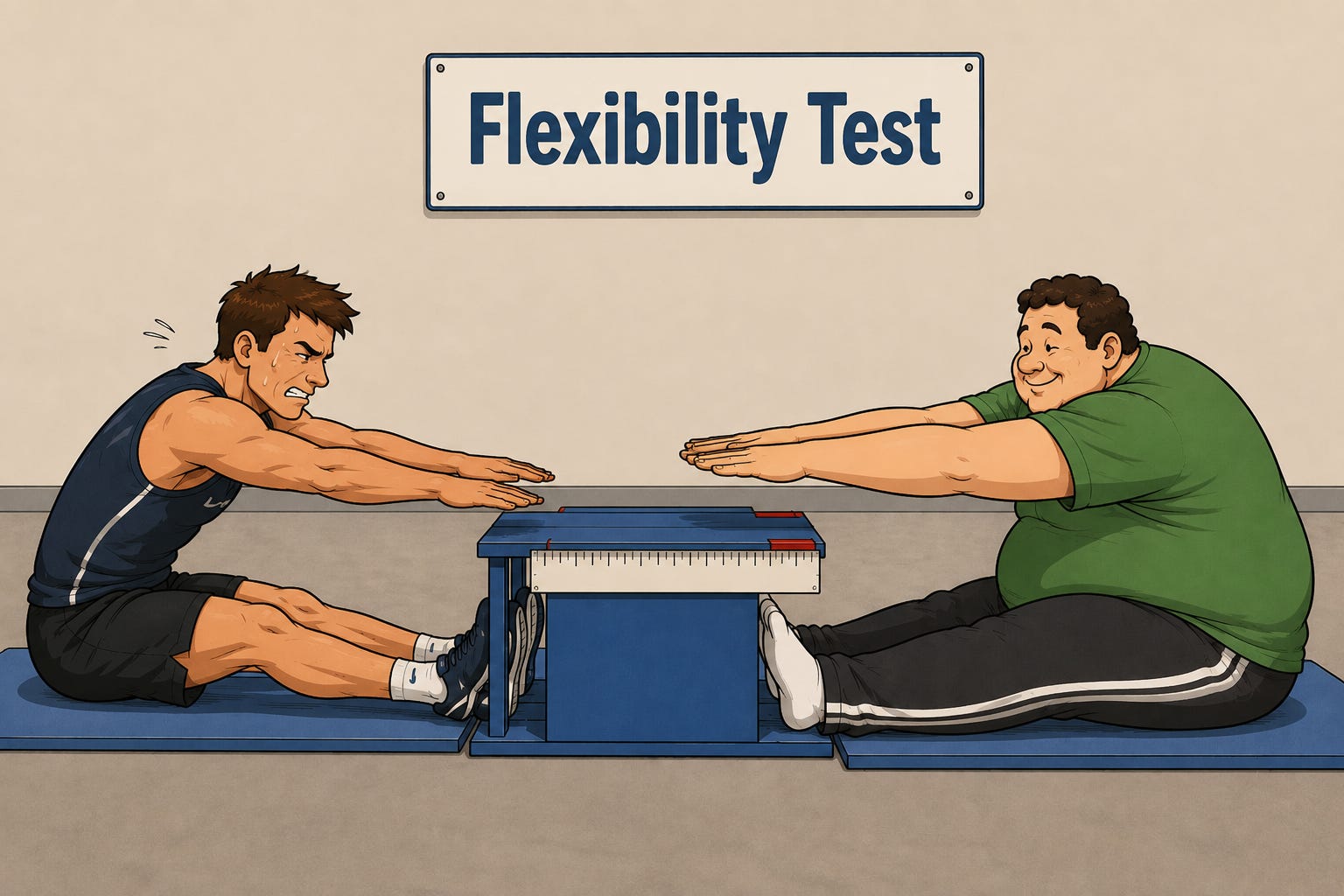
Abstract: Background: Flexibility is considered a key component of health-related physical fitness. However, current evidence provides little support for flexibility as an independent predictor of health. Objective: To systematically review and meta-analyse prospective cohort studies examining the association between baseline flexibility and future health outcomes in adults. Methods: MEDLINE, Embase, Emcare, CINAHL Complete, and SPORTDiscus were systematically searched from January 2005 to April 2025. Prospective cohort studies investigating associations between objectively measured flexibility or joint range of motion and subsequent health outcomes in apparently healthy adults (≥18 years) were included. Risk of bias was assessed using the CLARITY Group at McMaster University tool. Certainty of evidence was assessed using the Grading Recommendations, Assessment, Development and Evaluation framework. Results: Forty-five studies (n=48 020; 45.2% female, mean age 47.6±19.4 years, median follow-up 6.0 years [range 0.5–29 years]) were included, with outcomes classified into eight domains. Greater flexibility was associated with a lower risk of future self-reported pain and disability (RR=0.99; 95%CI: 0.98–1.00) and a lower risk of future mobility limitations and frailty (RR=0.98; 95%CI: 0.96–1.00). Flexibility was not associated with cardiometabolic disease, musculoskeletal disease, or injury. Associations with mortality, falls, and physical activity were synthesised narratively due to insufficient data. The certainty of evidence ranged from very low-to-low. Conclusion: Current evidence provides limited support for flexibility as an independent predictor of health outcomes in adults. However, the very low-to-low certainty of evidence suggests that this may reflect methodological limitations of existing studies rather than a true absence of association. High-quality prospective studies are needed to clarify the prognostic value of flexibility for health outcomes.
(My brief comment on this article is available on X here.)
WEEKLY VOICE
ARTICLES AND ESSAYS
Sex/Gender
“Fairness for Everyone?” Then Why Are Only Boys Being Lectured?
Men Are Good
Why Does Feminism Want Women Fat?
The Fiamengo File
Academics and advocates have been hiding the truth about obesity for decades.
The Central Nebraska Connection to a Supreme Court Decision
Forward Nebraska
(My brief comment on this article is available on X here.)
How Others Judge You in Moments of Conflict
Rob Henderson’s Newsletter
Education
What Does It Mean to Be a Women’s College If Men Can Enroll?
Minding the Campus
Salem College says it ‘accepts applications from students who were assigned female at birth or who identify as women.’
Skeptic Research Center
Identity Politics Is Burying Science
Daily Wire
Scientific research and discovery are too important to be sacrificed to the political demands of DEI and angry activists.
Health Sciences
In 20 Different Cancers, Men More Likely to Be Diagnosed at a Later Stage
Medpage Today
Psychotherapy populations that are overlooked due to sociopolitical bias
Current Opinion in Psychology
Abstract: Sociopolitical bias has exerted a profound yet underexamined influence on clinical research and psychotherapeutic practice. This bias has shaped which questions are asked, which populations are studied, and which forms of distress are recognized as legitimate, thereby potentially marginalizing individuals whose mental health needs fall outside prevailing ideological or cultural frameworks. As a result, large segments of the population remain overlooked in the clinical literature, underserved in therapeutic practice, and unsupported by existing mental health infrastructure. The scope of this problem is immense, encompassing numerous overlooked clinical populations that together likely comprise millions of individuals. This paper’s goals are threefold: to review the scope of sociopolitical bias in both psychotherapeutic practice and the academic clinical psychology literature; to address the overlooked populations most affected in the field; and to communicate the worthiness of a research program dedicated to filling these critical gaps. This should be an urgent priority for clinical researchers, therapists, and public funding agencies alike.
Drug Overdose Deaths in Hotels and Motels — United States, 2022–2024
Morbidity and Mortality Weekly Report
Abstract: In 2024, at least 2,327 drug overdose deaths that were unintentional or of undetermined intent occurred in hotels and motels. Location-specific overdose data might help guide distribution of overdose prevention resources. During 2022–2024, at least 9,651 drug overdose deaths occurred in U.S. hotels and motels; more than one half (56.2%) occurred in the same county where the decedent lived. A potential bystander (a person who was physically nearby and had an opportunity to intervene) was present for 34.7% of deaths, but a timely response was delayed or did not occur in 63.5% of these deaths. Substance use by the bystander was a reason for 29.7% of nonresponses or delayed responses. Enhancing drug overdose prevention strategies in hotels and motels, including providing information about local treatment options and opioid overdose reversal medication distribution and education, might help prevent overdose deaths in these settings.
RUBBISH BIN

Young women are identifying as less straight; young men, not so much
The Conversation
(Nuzzo note: The data in this article are interesting, but note how the authors conclude the article by blaming and shaming men, which is why I have tossed it in the Rubbish Bin. My comment is available on X here.)
University of Melbourne hiring women and ‘trans’ men only for $200K job
The Noticer
(Nuzzo note: I have uploaded a copy of the job advertisement for the historical record, as the link to the job advertisement will eventually expire.)

Women-only job advertisement for Lecturer / Senior Lecturer at Monash University
Monash University
(Nuzzo note: I have uploaded a copy of the job advertisement for the historical record, as the link to the job advertisement will eventually expire.)
Sky News
(Nuzzo note: Prior to the Sky News story, I reported on these grants on X here.)
PINE: a geopoetic work about menopause and wildfires
Gender, Place & Culture
Decolonising sexual pleasure: elevating Global South narratives in sexual health
Culture, Health & Sexuality
Abstract: This paper seeks to challenge the dominance of Global North frameworks in international work on sexual and reproductive health and rights (SRHR), arguing that decolonising this work requires centring Global South knowledge, lived experience, and culturally grounded understandings of sexuality, including sexual pleasure. Decolonisation is here understood as dismantling inequitable power relations, shifting epistemic authority away from Global North institutions, and prioritising Indigenous, local, and self-determined practices. Writing from within Global North academic institutions, we offer a reflexive critique that acknowledges the tension of advocating for decolonial change from inside the very systems that are under examination. We examine how dominant models have shaped SRHR research, policy, and practice, often limiting responsiveness to, and engagement with, Global South communities. Drawing on examples from Māori communities, Somalia, and West Africa, we demonstrate how culturally driven approaches that integrate pleasure and wellness can challenge inequality, broaden understandings and measures of sexual health, and open pathways to sexual liberation. In doing this, the commentary contributes to that reimagining by using real-world examples to show what becomes possible when pleasure and Global South narratives are centred – transforming how knowledge is produced, how research questions are framed, and how interventions are designed and implemented.
International Journal of Transgender Health
Abstract: Introduction: Transgender, nonbinary, and genderqueer individuals face heightened disaster vulnerability due to systemic marginalization, including discriminatory policies, poverty, and limited health care access. Despite increasing climate impacts, transgender communities around the world remain largely invisible in disaster planning and response. People with disabilities also face disproportionate vulnerability during disasters, encountering barriers to evacuation, shelter access, and recovery efforts. Grounded in the minority stress framework and informed by intersectional approaches to climate justice, this study examines how gender identity and disability status intersect to shape disaster vulnerability. Methods: Drawing on survey data from transgender, nonbinary, and genderqueer respondents (n = 198) within a larger study of LGBTQIA+ participants, conducted in Fall 2024 in Ohio, United States, we examined the intersection of disability and gender identity during flooding and extreme heat events. Using Firth’s bias-reduced logistic regression models, we quantified the odds of experiencing mental and physical health impacts and anticipated barriers to disaster services. Results: Disabled transgender individuals were associated with elevated likelihood of adverse outcomes compared to nondisabled, nonbinary respondents, including 5.7 times greater odds of flood-related mental health stress (p < 0.001), 3.0 times higher odds of heat-related mental health stress (p = 0.02), 3.2 times higher odds of heat stress (p = 0.02), and 6.0 times greater odds of heat stroke (p < 0.001). Disabled transgender respondents also had 14.2 times greater odds of anticipating limited access to disaster recovery services due to fear of discrimination or violence (p < 0.001). Findings support prioritizing the continuity of gender-affirming care during climate disasters with practice considerations for emergency health care providers. Conclusion: Intersecting marginalized identities are associated with increased vulnerabilities during disasters, with implications for regions where restrictive gender policies intersect with climate threats. These findings contribute foundational quantitative evidence to support more equitable climate adaptation and emergency preparedness policies.
SUPPORT THE NUZZO LETTER
If you appreciated this content, please consider supporting The Nuzzo Letter with a one-time or recurring donation. Your support is greatly appreciated. It helps me to continue to work on independent research projects and fight for my evidence-based discourse. To donate, click the DonorBox logo. In two simple steps, you can donate using ApplePay, PayPal, or another service. Thank you!

If you prefer to donate to a specific project, please see the Go Fund Me page for my current research on sex differences in muscle strength in children.

The flexibility paper certainly fits in with my reading and clinical experience.
Excessive flexibility is a frequent predisposing factor in multiple musculoskeletal disorders and injuries.
I have always advocated against pre-exercise static stretching.
Really interesting piece about the stretching. I would not have guessed that! Thanks very much for the plug!