
Weekly Roundup
Mar 16 - 22, 2026
LEADING ARTICLE
Scandinavian Journal of Medicine & Science in Sports
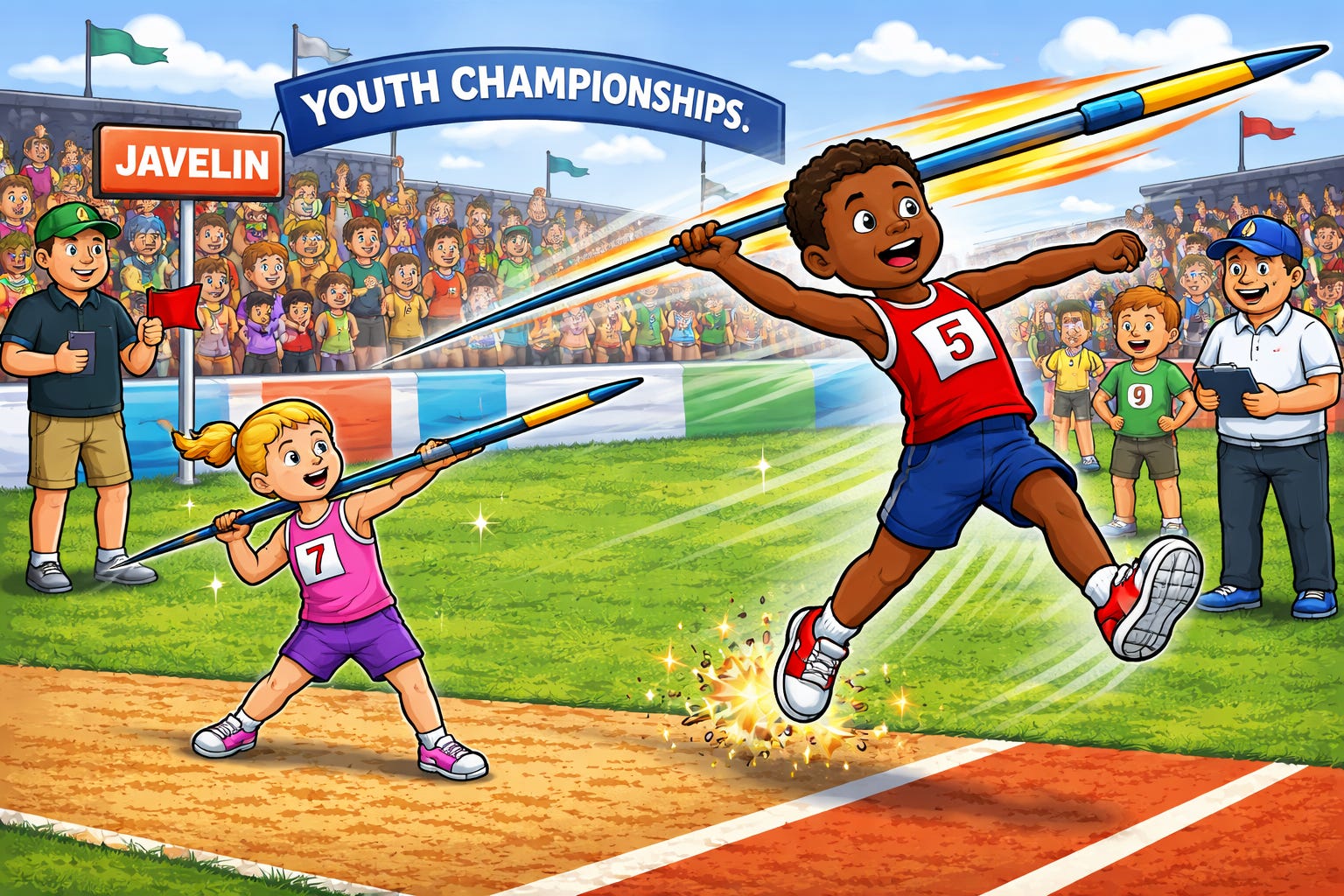
Abstract: There is an ongoing debate regarding the necessity for sex‐segregated sports particularly in youth. However, there has been minimal evaluation of prepubertal sex‐based differences in the events of shot put, javelin throw, and long jump. Therefore, the top eight performances from the USA Track and Field National Youth Outdoor Championships and National Junior Olympic Championships during the years 2016–2023 for shot put, javelin throw, and long jump in the 8‐and‐under and 9–10‐year‐old age groups were analyzed for sex‐based differences. The 8‐and‐under males threw the shot put farther (P < 0.0001 and Hedges’ g = 0.922) than females by 19.3% and the 9–10‐year‐old males threw the shot put farther (P = 0.016 and Hedges’ g = 0.332) than females by 6.5%. The 8‐and‐under males threw the javelin farther (P < 0.0001 and Hedges’ g = 1.269) than females by 32.6% and 9–10‐year‐old males threw the javelin farther (P < 0.0001 and Hedges’ g = 1.169) than females by 23.5%. The 8‐and‐under males long jumped farther (P = 0.010 and Hedges’ g = 0.359) than females by 4.7% and 9–10‐year‐old age males long jumped farther (P = 0.007 and Hedges’ g = 0.552) than females by 3.9%. The average between sex differences were larger than the within sex differences between the first through fourth place finishers in all but 9–10‐year‐old shot put. In all events, the greatest individual distance for a male exceeded that for a female. Therefore, the present data indicate that, in elite competition, males in the 8‐and‐under and 9–10‐year‐old age groups typically performed long jump and throw the shot put and javelin farther than females of the same age.
THE NUZZO LETTER IN THE NEWS
Higher Ed’s New Human-Subjects Problem
Martin Center for Academic Renewal
Woke academics are violating ethical standards. University IRBs should stop them.
United Nations Is Being Corrupted by the ‘Great Feminization’
Domestic Abuse and Violence International Alliance (DAVIA)
Women Are Sacrificing Their Own Sports in the Name of ‘Compassion’
Independent Women
ARTICLES AND ESSAYS
Sex/Gender
America’s Demoralized Men, Part 1
Institute of Family Studies
Washington Is Underinvesting In Its Boys And Men
Washington Initiative for Boys & Men
There are 13,000 grants supporting women and girls and 4,000 grants supporting men and boys. Does this difference register in the state’s equity efforts?
Momentum builds for a federal office of men’s health focused on disease prevention
STAT News
Survey Results: From Conversation to Action
Celebrating Masculinity
Three SMART and practical goals for men and boys in Australia.
Where are the men? A systematic review of sex bias in human provocation models of migraine
Cephalagia
Abstract: Objective: Human provocation models are widely used to investigate migraine mechanisms and validate therapeutic targets. Despite well-known sex differences in migraine, concerns persist regarding sex representation and reporting in experimental research. This systematic review evaluated sex distribution, sex-specific analyses, and the consideration of female-specific biological factors in randomized, placebo-controlled migraine provocation studies. Methods: PubMed and Embase were systematically searched for randomized, placebo-controlled provocation studies in adults with migraine, following PRISMA 2020 guidelines. Data were extracted on participant sex distribution, sex-stratified outcome reporting, and consideration of female-specific variables, including menstrual cycle, hormonal contraception, and pregnancy status. Results: Fifty-eight studies published between 1972 and 2025 were included. Women represented 82% of participants, while men accounted for 18%. No study performed sex-stratified analyses of provoked headache or migraine outcomes. Sex was rarely discussed as a biological variable or limitation. Female-specific factors were largely overlooked, with menstrual cycle phase unreported in over 90% of studies and inconsistent reporting of hormonal contraception and pregnancy status. Conclusions: Migraine provocation studies show marked sex imbalance and a systematic lack of sex-disaggregated analyses. Although these models have demonstrated substantial translational relevance, particularly in supporting the development of anti-CGRP therapies, the absence of sex-disaggregated analyses and limited consideration of biological sex constrain the assessment of translational applicability across sexes.
(*My brief comment on this article is available on X here.)
A Reversed Orgasm Gap? Gender Differences in Orgasm Frequency During Heterosexual Partner Sex
Sexes
Abstract: Large-scale surveys consistently show there is an orgasm gap in heterosexual partner sex of 20% to 36%—with more women not experiencing orgasm during heterosexual partner sex than men. In two Dutch/Flemish general population convenience samples (N = 1028; 756 women (73.5%), 271 men (26.4%), 1 non-binary (0.1%); Mage = 34.8 years; SDage = 12.7 years) of exclusively and almost exclusively heterosexual respondents, 140 women (20.4%) and 3 men (1.2%) who had sex in the last six months did not regularly experience orgasm during partner sex—representing an orgasm gap of 19.2% (p < 0.001). Women who did regularly experience orgasm during partner sex did more often than men experience orgasm more than once (24.2% of women versus 11.2% of men, a 13% difference; p < 0.001). MANOVA followed by post hoc ANOVAs were used to investigate group differences. Women who did not experience orgasm showed higher levels of sexual distress and sexual inhibition, and lower levels of sexual satisfaction and self-esteem than women who did experience orgasm. Also, higher levels of depressive symptoms and social anxiety were reported by the women not experiencing orgasm during partner sex. The strongest predictor of the number of orgasms during one sex session was the number of orgasms the partner presumably experienced. The current study confirmed the existence of a heterosexual gap, whilst results of this large-scale study also suggest a “reversed” orgasm gap: more women than men experience orgasm more than once during a heterosexual partner sex session.
Education
World University Rankings Are a Scam
Martin Center for Academic Renewal
Minding the Campus
A professoriate captured by laziness, self-interest, and left-wing ideology is failing students.
Education Department sits on nearly 400 college discrimination complaints from one activist
The College Fix
Education Dept. tells physical therapy accreditor to end DEI requirements
The College Fix
Theory and Society
Abstract: To maximally flourish, the social sciences must be inoculated against parasitic ideas (e.g., postmodernism) and suicidal empathy (e.g., an epistemology of care), both of which arise when the pursuit of truth is confounded with social justice activism. Furthermore, the social sciences currently exist in disorganized if not incoherent silos of knowledge void of an organizing meta-theory. The evolutionary lens provides such a unifying framework whilst engendering the requisite consilience.
EPIDEMIOLOGY
Australian Bureau of Labor Statistics
Data about alleged offenders proceeded against by police, including demographic, most serious offence, and family and domestic violence information.
Professional Psychology: Research and Practice
Abstract: The issue of whether social media use does or does not influence youth internalizing mental health disorders (e.g., anxiety, depression) remains a pressing concern for policymakers, parents, and psychologists. Widespread claims suggest potentially harmful effects of social media use on youth. This was investigated in a meta-analysis of 46 studies of youth social media use and mental health. Results indicated that the current pool of research is unable to support claims of harmful effects for social media use on youth internalizing disorders. Some types of methodological weaknesses, such as evident demand characteristics and lack of preregistration, remain common in this area. It is recommended that caution is issued when attributing mental health harm to social media use as the current evidence cannot support this.
British Journal of Pharmacology
Aims: This study aimed to analyse clinical trial initial submissions received by the MHRA between February 2019 and October 2023. Methods: Data on submissions were extracted from the clinical trials unit data bank. The primary end-point was the type of clinical trial initial submissions. Secondary end-points were sponsor types, participant demographics, healthy volunteers, health categories and studies involving first in human and advanced therapy medicinal products. The analysis used descriptive statistics for all categorical variables. Results: MHRA received 4616 submissions. The highest percentage was in 2020 (22.8%) and the lowest in 2023 (17.2%). Phase 3 submissions were the highest (32.6%) and and phase 4 the lowest (5.2%). Commercial sponsors represented 85.1% of the total submissions. Both sexes were included in most trials (90%), while the number of submissions involving females only (3.7%) was lower than male only trials (6.1%). The elderly population was represented in 67.7% of trials with pregnant and breastfeeding women represented in 1.1% and 0.6% of trials, respectively. Breastfeeding women were not included in phase 1. Paediatric trials mostly involved adolescents. Healthy volunteers were included in 16.5% of the total submissions. The most common health category was cancer (29.4%), with the lowest being pain. First in human submissions represented 12.7% and advanced therapy medicinal products 3.4% of submissions. Conclusions: These results highlight the clinical trial landscape in the United Kingdom and represent an important baseline for policymakers, healthcare providers, sponsors and patients and will enable an assessment of how policy changes can improve the variety and number of clinical trials.
Abnormal Cholesterol in Children and Adolescents: United States, August 2021–August 2023
NCHS Data Brief
Abstract: During August 2021–August 2023, 16.5% of children and adolescents had at least one abnormal cholesterol measure (high total cholesterol, low high-density lipoprotein cholesterol [HDL-C], or high non-HDL-C). The prevalence of at least one abnormal cholesterol measure was lower in girls (13.6%) than in boys (19.2%). The prevalence of at least one abnormal cholesterol measure was lower in children and adolescents with underweight or normal weight (10.3%) or overweight (11.5%) than in those with obesity (35.8%). The prevalence of at least one abnormal cholesterol measure in children and adolescents decreased between 2013–2014 and August 2021–August 2023.
Politics
In 25-Country Survey, Americans Especially Likely To View Fellow Citizens as Morally Bad
Pew Research Center
Unfounded claims of racism hurt Australia
Australians for Science & Freedom
Complaint about Australian taxpayer funding of the United Nations
Celebrating Masculinity
After two months, not even an acknowledgement from the government...
‘Secession by Western Australia’ book launch
Description: Book launch event for “Secession by Western Australia.” Featuring: Dr Joe Kosterich, Professor Gigi Foster, former barrister Julian Gillespie, and journalist Rebekah Barnett.
HISTORICAL ARCHIVES
Mankind Quarterly (2020)
Abstract: It has been claimed that left-wingers or liberals (US sense) tend to more often suffer from mental illness than right-wingers or conservatives. This potential link was investigated using the General Social Survey cumulative cross-sectional dataset (1972-2018). A search of the available variables resulted in 5 items measuring one’s own mental illness (e.g., ”Do you have any emotional or mental disability?”). All of these items were weakly associated with left-wing political ideology as measured by self-report, with especially high rates seen for the “extremely liberal” group. These results mostly held up in regressions that adjusted for age, sex, and race. For the variable with the most data (n = 11,338), the difference in the mental illness measure between “extremely liberal” and “extremely conservative” was 0.39 d. Temporal analysis showed that the relationship between mental illness, happiness, and political ideology has existed in the GSS data since the 1970s and still existed in the 2010s. Within-study meta-analysis of all the results found that extreme liberals had a 150% increased rate of mental illness compared to moderates. The finding of increased mental illness among left-wingers is congruent with numerous findings based on related constructs, such as positive relationships between conservatism, religiousness and health in general.
(*My brief comment on this article is available on X here.)
RUBBISH BIN

FIFA mandates female coaches for women’s tournaments
Women’s Agenda
(*My brief comment on this article is available on X here.)
The Conversation
(*My brief comment on this article is available on X here.)
‘Groundbreaking’ UN agreement on justice for women to include those in prison for first time
The Guardian
As numbers of incarcerated women approach one million globally, campaigners are hoping the recognition leads to action.
(*My brief comment on this article is available on X here.)
Is Barbie a feminist film? A decolonial feminist perspective
Feminist Media Studies
Abstract: Barbie took theatres by storm in 2023 igniting a global conversation about feminism. In many ways, seeing a film that explicitly critiques patriarchy, performing exceptionally at the box office suggests a societal uptake of feminism. For this reason, it is useful to examine the kind of feminism on display in Barbie. This article outlines and applies a decolonial feminist lens combined with feminist film theory to analyse Barbie. From our position within the “post”-colonial context of South Africa, we explore the ways in which the film successfully presents a critique of patriarchy, while showing how the film represents an example of white, elite feminism that fails to be intersectional. In applying the decolonial feminist lens, we explore examples throughout the film of where it falls short from this perspective, where it may offer insights or representations, and where it may support us to explore other ways of bringing a more inclusive feminism into film and media. It is argued that the film ultimately fails to be decolonial, however it provides insight into ways in which humour could be used as a decolonial feminist tool in media going forward.
Dreaming Blak Fat Queer community
Fat Studies
Abstract: Exploring the themes of joy, care, resistance, and liberation from a Blak fat queer trans lens, this article explores manifestos and literature from Indigenous, Fat, and Queer collectives, communities, and people. Centered within community perspectives, I investigate roles of care and joy (and play?) in fat resistance and liberation, questioning (and queering!) what fat Indigenous studies look like. This article aims to highlight and value knowledge production from within communities and outside of an academic framework, concluding on an imagining (and dreaming) of futures for Blak Fat Queer Joy and Liberation in so-called Australia.
(*My brief comment on this article is available on X here.)
A feminist new materialist ontology of masculinity
NORMA: International Journal for Masculinity Studies
Abstract: This paper considers how masculinity might be reconceptualised within a feminist new materialist ontology. The aim of this theoretical framing is to generate new ways of understanding the nature of masculinity and agency, and to open space for strategies that disrupt inequitable gender relations. To undertake this work, the concept of ‘assemblage’ from Jane Bennett, ‘intra-action’ from Karen Barad and ‘more-than-human gender performativity’ from Anne-Sofie Dichman are drawn together. Combining these theoretical ideas shifts current conceptualisations of masculinity beyond the human body and gender performances of men. Instead, masculinity is reconfigured as a complex multi-dimensional assemblage of forces that include human-non-human matter and their intra-relations. New materialism’s decentring of human exceptionalism and attendance to the agency of matter is acknowledged in this conceptualisation, while simultaneously identifying performative instances in which human-non-human intra-actions sediment a masculine gender identity. The ontological indeterminacy of matter and gender performativity contained within this account, offer potential for new ways of differentiating female/male bodies and identities beyond current gender binaries and human/non-human distinctions. Such ontological disruption to masculinity presents possibilities for changing existing gender politics and cross-species engagements that hold hope for more ethical relations.
How Decolonial Feminism Can Disrupt End-Times Fascism
Gender & Society
Abstract: Since January 2025, monumental anti-democratic actions led by the U.S. government have occurred at a disorienting pace for the world. We are experiencing an apocalyptic version of a far-right ideology that has been referred to as “end-times fascism,” in which global power becomes consolidated for the very few but destruction is the result for the majority of the world, effectively extinguishing hope for a better future. Drawing inspiration from the work of decolonial feminist theorist Silvia Rivera Cusicanqui of Bolivia, this essay calls for us to recognize that we—both the ancestral and the present we—can confront this kind of strongmen. Resistance at different levels that engages with a decolonial feminist practice will embolden us to move with courage, with renewed hope, with each other, and to be en route to reimagining the path of a collective feminist future.
The Myth of the Academic Social Contract
Gender & Society
Abstract: Conservative attacks on higher education have often expressed unique ire for feminist and gender studies as emblematic of a left-wing bias and overemphasis on identity in U.S. universities. Such critics of higher education long for a recentering of education that emphasizes the triumphs of Western civilization to restore universities’ social contract with the U.S. taxpayer. This brief essay offers a critique of the idea of an academic social contract, and notes that the targeting of gender may signal not just a right-wing ideological takeover, but an authoritarian one.
Care ethics, disaster, and climate justice: A relational rights-based approach for the Anthropocene
British Journal of Social Work
Abstract: Accelerating climate change and widening inequalities demand new conceptual tools for understanding how social work can contribute to reparative climate justice. Written from the Australian context where social work remains systematically undervalued, particularly within the disaster sector, this article brings feminist care ethics into dialogue with critical economic and climate justice scholarship to articulate a renewed conceptual framework for the profession. Drawing on Tronto’s ethics of care, Holten’s critique of the devaluation of caring labour, and Raworth’s Doughnut Economics, this article examines the institutional logics that externalize the costs of care and obscure interdependence, thereby reproducing structural inequities. By integrating these bodies of work, I propose a relational rights-based model that positions care as both diagnostic and transformative: a lens to understand the systemic drivers of injustice, and as a guide for shaping reparative climate responses. This model foregrounds responsibility, relationality, reparations, and planetary limits as core to social work’s ethical and political project. I argue that social work in Australia is uniquely placed to influence disaster governance, climate justice policy, and supported community outcomes, and that this influence can be increased if its knowledge, labour, and ethical commitments are recognized as central, rather than peripheral, to just climate futures.
SUPPORT THE NUZZO LETTER
If you appreciated this content, please consider supporting The Nuzzo Letter with a one-time or recurring donation. Your support is greatly appreciated. It helps me to continue to work on independent research projects and fight for my evidence-based discourse. To donate, click the DonorBox logo. In two simple steps, you can donate using ApplePay, PayPal, or another service. Thank you!

If you prefer to donate to a specific project, please see the Go Fund Me page for my current research on sex differences in muscle strength in children.

James gains mention in the National Review.
https://www.nationalreview.com/corner/academic-research-thats-unethical-and-dishonest/