
Weekly Roundup
Dec 1– 7, 2025
LEADING ARTICLE
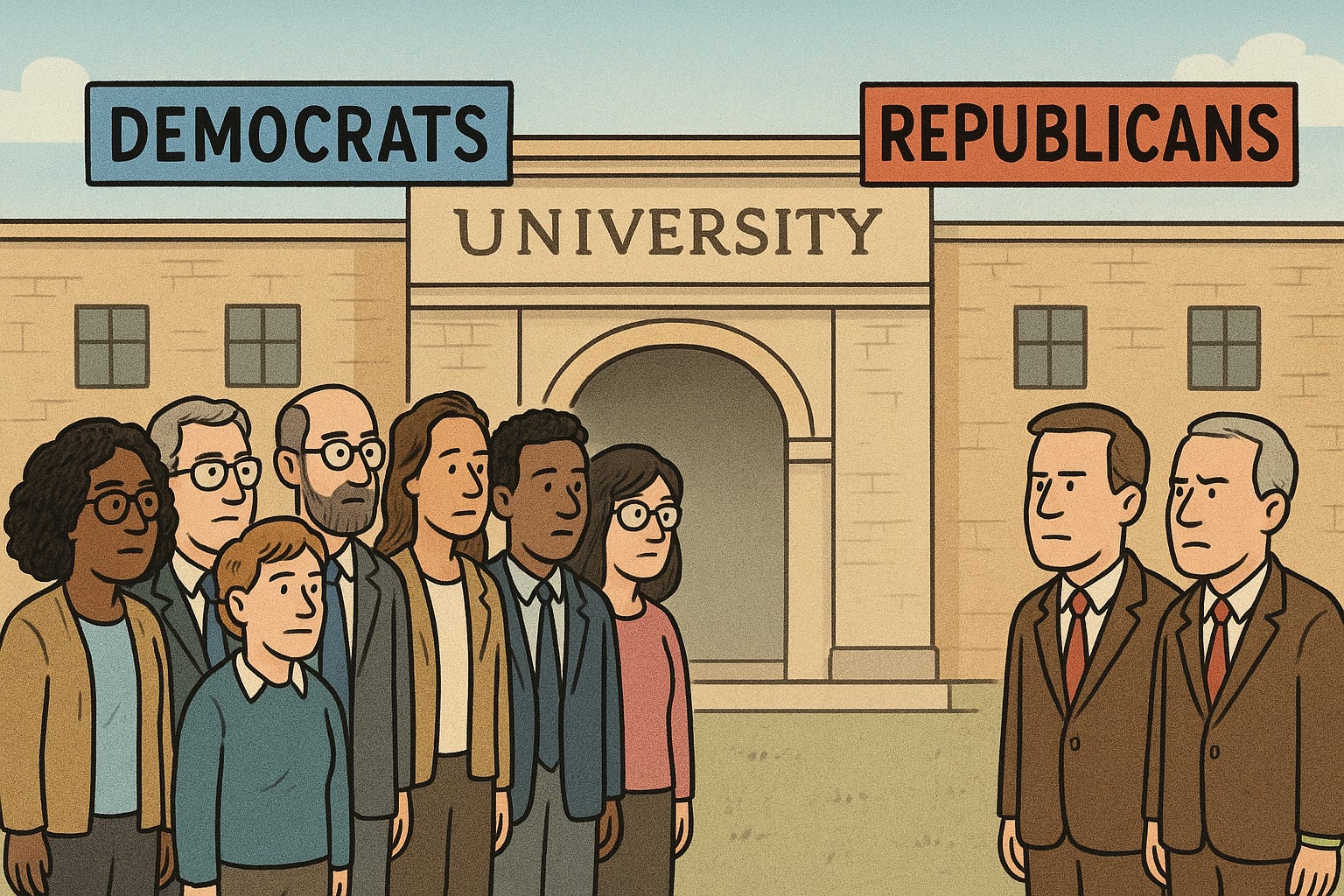
The Politics Of University Faculty
PsyArix (pre-print server)
Abstract: University faculty have been decidedly liberal for the at least the past 50 years, but since 2016 no large-scale surveys reporting the ideology of U.S. faculty have been conducted and published. The present brief provides an updated snapshot of the ideological composition U.S. college and university faculty, and reports representation quotients comparing the demographic composition of faculty to the demographic composition of U.S. adults. Implications are briefly discussed.
THE NUZZO LETTER IN THE NEWS
3 Academics ‘Cancelled’ for Dissenting Views, Warn Intellectual Freedom Still at Risk
Epoch Times
Despite strong legal protections for academic freedom, universities are finding ways to sack staff whose views don’t accord with their own, they say.
UN Launches ‘Online Violence’ Campaign to Smear Men and Frighten Women
Coalition to End Domestic Violence
American Medical Association Passes Resolution to Establish Offices of Men’s Health
Stop Abusive and Violent Environments (SAVE)
ARTICLES AND ESSAYS
Sex/Gender
Activists Are Redefining ‘Gender’ to Save a Collapsing Narrative
Reality’s Last Stand
Why activists are shifting from denying the sex binary to reclassifying everything beyond gametes as “gender.”
Evidence Backs the Transgender Social-Contagion Hypothesis
Reality’s Last Stand
Data shows that the spike in transgender identities is not rooted in biology.
Three breakthroughs for Australian men and boys
Celebrating Masculinity
The radicalisation of young women
Celebrating Masculinity
Women’s leftward movement is 2–3 times larger than men’s rightward movement
12th grade girls are less likely than boys to say they want to get married someday
Pew Research Center
Evie Magazine
Education
I Attended an Academic Freedom Symposium. It’s Worse Than You Think.
Reality’s Last Stand
How a gathering meant to defend academic freedom failed to address the forces that most endanger it.
Public Trust in Scientists and Views on Their Role in Policymaking
Pew Research Center
(My brief comment on this poll is available on X here. See also the Lancet editorial that I have tossed in the Rubbish Bin).
U.S. Confidence in Higher Education Now Closely Divided
Gallup
Nearly as many U.S. adults have little or no confidence as have high confidence.
(My brief comment on this article is available on X here.)
Just 14% of voters think bachelor’s degree is worth the cost, survey finds
The College Fix
Nearly two-thirds of Americans say college degree isn’t worth the cost: poll
The College Fix
Intellectual and Viewpoint Diversity: Importance, Scope and Bounds
Education Sciences
Abstract: In recent decades, the ideological diversity of faculties in the United States has declined considerably, and this has arguably had implications for a number of other aspects of academic life. Efforts to promote intellectual and viewpoint diversity are, however, often met with skepticism, and also with reasonable concerns over threats to the autonomy and integrity of academic disciplines and institutions. Clarifying the role, scope, and bounds of intellectual and viewpoint diversity within academic life in ways that respect the scholarly standards of disciplines is thus of critical importance. The role of, and concerns surrounding, intellectual diversity and viewpoint diversity are, moreover, not identical. In this paper, I put forward definitions for intellectual diversity and viewpoint diversity, along with related notions of ideological and political diversity. Data are presented on the decline of ideological and political diversity among faculties, along with evidence concerning the possible causes for this decline. I then present arguments for the importance of intellectual and viewpoint diversity in the pursuit of knowledge, in the transmission of that knowledge to students, and in its dissemination and application to broader society. I put forward proposals for educational leaders, faculty, and students for engaging with or, when appropriate, cultivating intellectual and viewpoint diversity in a manner that respects the scholarly standards of disciplines. I discuss what is at stake with these matters in the present context concerning the nature of the university itself, and its purposes in the generation, preservation, and transmission of knowledge.
MEDICINE
Medicine in the Age of Social Justice
Heterodox STEM
Do No Harm
POLITICS
Google warns Albanese government’s under-16 social media ban could ‘make kids less safe’
Sky News
Google and its video platform YouTube have warned the Albanese government’s controversial new social media age ban will “make kids less safe”.
HISTORICAL ARCHIVES
More Men are Killed in Households Each Year Than Women
Byline Times (2022)
Partisan Registration and Contributions of Faculty in Flagship Colleges
National Association of Scholars (2020)
RUBBISH BIN

Offline: Is there really a trust crisis in science?
Lancet
(My brief comment on this article is available on X here.)
The Guardian
(My brief comment on this article is available on X here.)
A ‘feminised workplace’ doesn’t mean what you think it means
The Guardian
(My brief comment on this article is available on X here.)
The Real Way Schools are Failing Boys
Time
(My brief comment on this article is available on X here.)
‘I had sex with two men on same night and got pregnant – my twins’ DNA test shocked me’
Mirror
(My brief comment on this article is available on X here.)
Where women lead, equality follows
BMJ
Countries can learn from the UK’s success with mandatory gender pay gap reporting and accountability, write Helen Clark and colleagues
Humanities and Social Science Communications
Abstract: hat is a feminist queer crip approach to the gut? How might we use feminist queer crip theory to make sense of non-normative guts? And how might crip guts help us make sense of the world? This paper is an autoethnographic reflection on my crip guts, specifically being diagnosed with ulcerative colitis (UC), a form of inflammatory bowel disease (IBD), and having a colectomy (surgery to remove my colon) to create an ileostomy (a type of stoma). I consider the epistemic complexities of being both patient and researcher and the importance of acknowledging multiple forms of expertise, putting my autoethnographic reflections into conversation with a variety of texts. I argue that my crip guts provide an embodied, if stigmatised, form of knowledge that complicates academic/lived experience and body/mind divisions, alongside necessitating more holistic responses to crip guts beyond individualising biomedical models. I examine the violence of discourses of normality around bodily difference and the complex temporalities of the gut through a focus three key moments in my crip gut experience – late diagnosis and (not) being believed; stoma representation and stigmatised imagined futures; and, the gut remembering colonial pasts – before arguing for queer stoma pride as a destigmatised collective refusal of normative gut discourse and valuation of crip gut knowing.
SUPPORT THE NUZZO LETTER
If you appreciated this content, please consider supporting The Nuzzo Letter with a one-time or recurring donation. Your support is greatly appreciated. It helps me to continue to work on independent research projects and fight for my evidence-based discourse. To donate, click the DonorBox logo. In two simple steps, you can donate using ApplePay, PayPal, or another service. Thank you!

If you prefer to donate to a specific project, please see the Go Fund Me page for my current research on sex differences in muscle strength in children.

Brilliant curation highlighting how ideological monoculture in academai shapes not just what gets researched but what gets funded and discussed. The tension between intellectual diversity and viewpoint diversity you present through that Education Sciences piece is especially sharp, it shows how institutions can claim openess while structurally limiting inquiry that challenges dominant narratives. What seems missing from most ofthese discussions is how self-selection and institutional pressure interact over time to create these patterns.
Thank you, James. It is encouraging to see left-leaning publications like Time talk about schools failing young men.