
Weekly Roundup
Mar 30 - Apr 5, 2026
LEADING ARTICLE
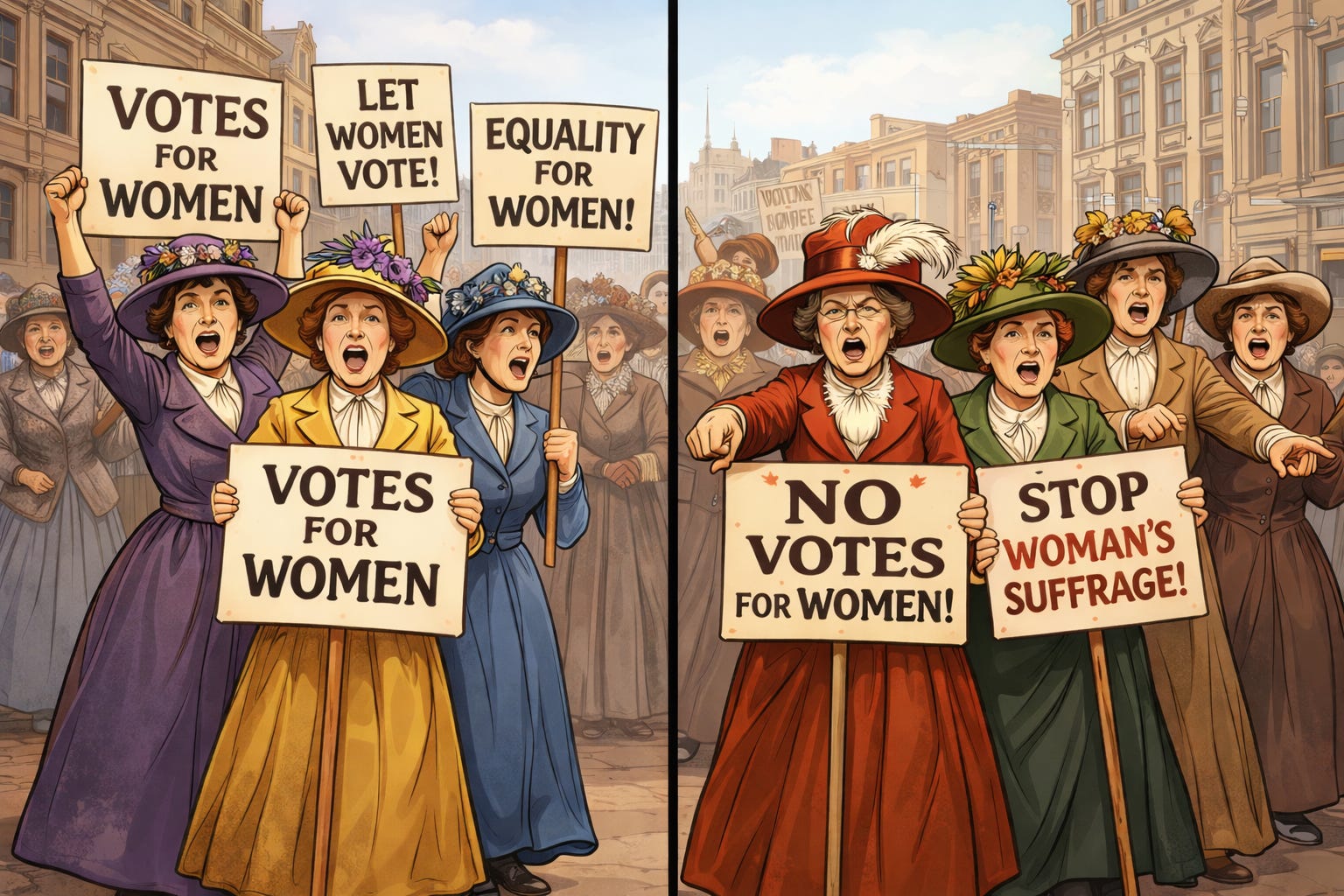
Women Who Opposed the Vote for Women
The Fiamengo File
Anti-suffragists did not win the day, but many of their concerns remain relevant.
ARTICLES AND ESSAYS
Sex/Gender
What we know—and don’t know—about pornography and boys and men
American Institute for Boys and Men
Sexual Assaults of Underage Boys by Female Teachers
SAVE
Education
Newly obtained emails reveal private push to silence Bari Weiss at UCLA
The College Fix
(*My brief comment on this article is available on X here.)
Claudine Gay will teach class on ‘governance’ of universities
The College Fix
DEI Mandates No More: The LCME Quietly Removes ‘Bias’ and ‘Equity’ Requirements
Do No Harm
States Should Lead on Higher-Ed Reform
Martin Center for Academic Renewal
Politics
Healthcare Reclaims Top Spot Among U.S. Domestic Worries
Gallup
Institute of Public Affairs
Exercise Science
Acute and Chronic Effects of Drop-Set Training: A Meta-Analysis and Systematic Review
Sports Medicine Open
Abstract: Background: Drop-set training (DROP) is a time-efficient resistance training method for hypertrophy and strength. Its long-term adaptations remain debated, particularly in relation to its acute physiological responses such as metabolic stress and fatigue. This meta-analysis examines both acute and chronic effects of DROP to provide a comprehensive evaluation of its efficacy. Methods: A systematic search was conducted across PubMed, Web of Science, SCOPUS, and SPORTDiscus up to January 20, 2026, following PRISMA guidelines. Studies comparing DROP and traditional resistance training (TRAD) on hypertrophy, strength, metabolic stress, fatigue, and perceived exertion were included. Data extraction and risk of bias assessment were performed using the PEDro scale. Meta-analyses were conducted using a random-effects model. Results: The meta-analysis, based on 12 studies (n = 274 participants), revealed significant increases in ratings of perceived exertion (SMD = 1.62, 95% CI [0.33 to 2.91]) and lactate levels (SMD = 0.67, 95% CI [0.20 to 1.14]) for DROP. A trend in favor of DROP was observed for heart rate, although this did not reach statistical significance (SMD = 0.45, 95% CI [- 0.12 to 1.02]). No significant differences were observed between DROP and TRAD for chronic hypertrophy (SMD = 0.04, 95% CI [- 0.29 to 0.36]), strength (SMD = - 0.04, 95% CI [- 0.34 to 0.26]), or muscle endurance adaptations (SMD = 0.53, 95% CI [- 0.20 to 1.26]). Conclusion: DROP offers a time-efficient alternative to TRAD, yielding comparable long-term gains in muscle hypertrophy and strength. Based on current evidence, DROP acutely induces significantly higher perceived exertion and lactate responses, whereas heart rate shows no consistent differences between methods. Practitioners should consider these elevated perceptual demands and potential recovery needs when integrating DROP into long-term training periodization.
HISTORICAL ARCHIVES
RAF diversity targets discriminated against white men
BBC News (2023)
RUBBISH BIN

Feminist Review
Abstract: In this article, we argue that a Slow Feminism, which evolves through the slow but consistent support of other women that is embedded in care, compassion and constructive challenge against patriarchal expectations, is essential for the future of feminist praxis within higher education. This work emerged from our coming together to reflect-on-action on our experiences as disabled, women, postgraduate researchers in different disciplines during the COVID-19 pandemic. Feeling ‘othered’ by and invisible to hierarchal structures, we sought to understand our individual challenges through a collective lens. Relational ethics and a praxis of care in line with feminist epistemology underpinned our systematic ‘feminist collaborative autoethnography’, whereby we critically engaged with individual reflections and together in online meetings to interpret shared social, emotional and structural challenges. In this article, we draw on our experiences sharing this data through poetry, during the stage of our collaborative project in which we utilised ‘poems’ to identify the challenges of being a disabled woman navigating higher education, and the resistance we employed individually, and collectively, in support of one another. Through this process, we challenged the neoliberal, patriarchal and oppressive systems that we are forced to engage with daily and our own complicity in them. Using our individual, collective and overlapping voices, whereby we recognise the tensions and supportive narratives created by and within our research conversations, we identify that feminist activism and feminist futures are not solely a response to extreme events.
Feminist Review
Abstract: The theories underpinning gender/feminist studies, alongside critical race studies and queer studies, are rooted in historic, intersecting, radical social movements, driven by communities who were and remain oppressed by states, societies and institutions. Individuals who work in these fields therefore hold an ambiguous relationship with the university, often experiencing it as a site of both material potential and co-optation. In this article, I explore whether, and how, those in this contradictory position can carve out space and time from within institutional thresholds to engage in decolonial feminist praxes. Abolitionist theorists have sketched the figure of the ‘subversive intellectual’, whose labour is paradoxically indispensable to and disowned by the university. Seeking the material existence of this figure, I held conversations with subversive intellectuals. My analysis of these interviews follows queer and posthuman feminist thinkers who invest in the political potential of the body – and the multiplicity of its possible relations with space, time and other bodies – for counter-institutional action. In this article, my aim is not to determine what role, if any, the subversive intellectual has in the university’s abolition, but I do share and make connections between the stories of individuals who are re-orientating relationships, spaces and time towards an imagined future, and who are collectively embracing a queer uprising from within the university.
(*My brief comment on this article is available on X here.)
Decolonising against a backdrop of colonial amnesia: barriers, challenges, and finding a way forward
Frontiers in Sociology
Abstract: This paper, originally delivered as a keynote at De Montfort University, interrogates the persistence of colonial amnesia within educational, institutional, and cultural contexts in the UK. Through an autoethnographic lens, it explores both structural and embodied barriers to meaningful decolonisation, drawing attention to the epistemic violence of historical erasure alongside the deeply personal labour of self-decolonisation. Combining conceptual critique with situated narrative, the paper presents three autoethnographic vignettes that examine naming, diasporic dissonance, and joy as a mode of refusal. It argues for a dual praxis that foregrounds structural transformation while simultaneously centring introspective reclamation. The analysis ultimately underscores the need for healing, justice, and historical redress within ongoing struggles for equity and recognition.
A plan for black American reparations
BMJ Global Health
Abstract: The frequent criticism of a programme of reparations for Black Americans is that, however justified, no feasible blueprint exists for its implementation. We provide a detailed outline of a viable plan for reparations for Black American descendants of persons enslaved in the USA. Central to the plan are monetary payments calculated to eliminate the racial wealth gap, the foremost economic indicator of the cumulative, intergenerational effects of White supremacy. Closing the racial wealth gap can, in turn, contribute significantly to reducing racial disparities in health, including overall life expectancy. By providing a comprehensive and actionable plan, it becomes clear that the primary obstacle to adoption of reparations by the US Congress is political resistance. The article concludes with a discussion of the current political climate regarding reparations in the USA and an assessment of whether there are grounds for optimism for progress in the reparations movement.
(*My brief comment on this article is available on X here.)
Dying while fat: Post-mortem inequality
Fat Studies
Abstract: Like all people, fat people will die. Yet, fat people are particularly likely not only to die of anti-fatness, but also to be perceived as blameworthy for their own deaths. I argue that fat people are subject to postmortem inequality and discrimination via exclusionary death and dying technologies. I show that fat people’s dignity and right to choice in death are constrained. I highlight how technologies relating to both cremation and burial – the two most common options for postmortem disposition – both convey additional burdens for fat people and their loved ones, and highlight how contemporary mediation of death via technology can perpetuate anti-fat discrimination. I review the financial and emotional burdens of dying while fat, with an eye toward enhancing social justice and equity in death.
Becoming Fat ‘Differently’: Theorising ‘Embodied Re-visioning’
Body & Society
Abstract: This article draws upon body becoming and new materialist paradigms, and specifically the conceptual repertoires of Deleuze and Guattari (becoming, assemblage, reterritorialisation) and Karen Barad (apparatus, and agential cut), to theorise the dynamism of fat embodiment within India. It proposes the concept of ‘embodied re-visioning’, and related processes of ‘seeing the other-within’ and ‘carrying the body’, to expound the conditions, mechanisms, agencies, and effects of evolving fat embodiments. This concept provides means to understand and critically interrogate the emergence and nature of the diverse strands of fat activism – ‘body positivity’, ‘body neutrality’, and so forth – revealing the nature of ‘cuts’ or boundary-marking practices that differently and relationally organise the possibilities for embodiment. The article moves beyond a comparative analysis of discourses or restricting its analytical scope to questions of (re)signification to reveal the entwined material-discursive dynamics of fat embodiment. Embodied re-visioning is conceptually advanced to understand and provide commentary on the ‘agential becoming’ of the fat body in the context of the global south.
American Psychologist
Abstract: This article contributes to the decolonization efforts in psychological science by initiating a transnational dialogue among Black women scholars and decolonial psychologists to highlight and dissect the historical manifestations and impacts of colorism across the United States and South Africa. We define colorism as a skin tone stratification system favoring lighter skin-conceptualizing it as both a colonial tool and a psychological consequence of White supremacy. We discuss how colorism travels across borders as an undertheorized, underrecognized, and ignored colonial inheritance. To understand this complex, deeply gendered psychological dynamic, we blend empirical psychological literature with collective and personal narratives, cultural artifacts, and historical recollections. Through historical analyses of race and skin color, we present empirical evidence of how colorism moves through our bodies. We draw on research projects in South Africa and the United States to offer models for continued inquiry into the economic, social, and psychological impacts of this interpersonal, transnational, transgenerational, political, economic, and deeply internalized construct. In our analysis, we lean on the works, scholarships, and activism of Frantz Fanon, Steve Biko, Jioni Lewis, and Sinethemba Bizela to investigate colorism in its subjective, political, and intersectional dimensions. Most importantly, through this article, we invite the American Psychologist readership to consider colorism in its underexplored dynamics: its gendered nature, economic exploitation, and colonial legacies-to address the embodied understandings of colonization and the decolonizing project.
Rethinking Male Privilege and Gendered Authority in Nursing Leadership: A Sociological Analysis
Journal of Advanced Nursing
Aim(s): To critically examine how male privilege operates within nursing leadership by applying sociological theories that highlight the paradox of men’s advancement in a female-majority profession. Design: This position paper adopts a critical sociological lens to explore how gendered power structures continue to shape leadership in nursing. Methods: Three interrelated sociological frameworks (tokenism, the glass escalator, and hegemonic masculinity) are applied to analyse how men, despite being numerically underrepresented, often reach leadership roles and hold institutional authority disproportionately. Literature from gender studies, nursing sociology, and workforce research is synthesised to trace patterns of privilege and exclusion. Results: The analysis demonstrates that male nurses often benefit from symbolic visibility, access to informal mentorship, and alignment with leadership norms that prioritise traits such as assertiveness and autonomy. Although some men encounter initial marginalisation, their minority status can enhance perceived legitimacy and accelerate advancement. However, these dynamics are not uniformly experienced. Intersections of race, sexuality, and citizenship significantly shape how male privilege is accessed and constrained. Conclusion: Male privilege in nursing leadership is sustained by deeply rooted power structures. Addressing these disparities requires more than increasing male representation; it demands a redefinition of leadership values, and a critical review of the assumptions embedded in professional advancement.
SUPPORT THE NUZZO LETTER
If you appreciated this content, please consider supporting The Nuzzo Letter with a one-time or recurring donation. Your support is greatly appreciated. It helps me to continue to work on independent research projects and fight for my evidence-based discourse. To donate, click the DonorBox logo. In two simple steps, you can donate using ApplePay, PayPal, or another service. Thank you!

If you prefer to donate to a specific project, please see the Go Fund Me page for my current research on sex differences in muscle strength in children.
