
Weekly Roundup
Jan 12 - 18, 2026
LEADING ARTICLE
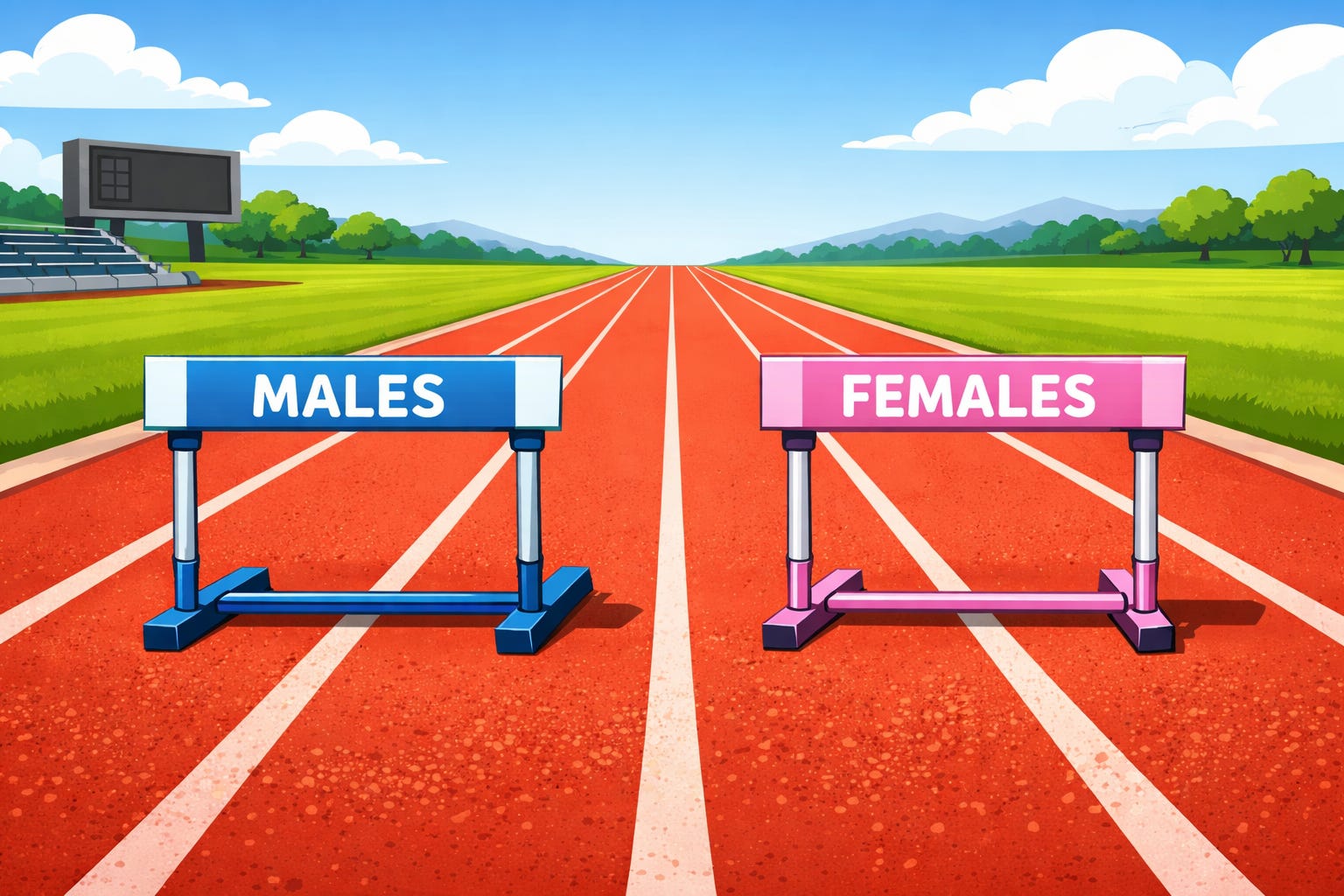
The Transgender Sports Deception
Wall Street Journal
Nobody is banned from playing, only from playing for opposite-sex teams.
THE NUZZO LETTER IN THE NEWS
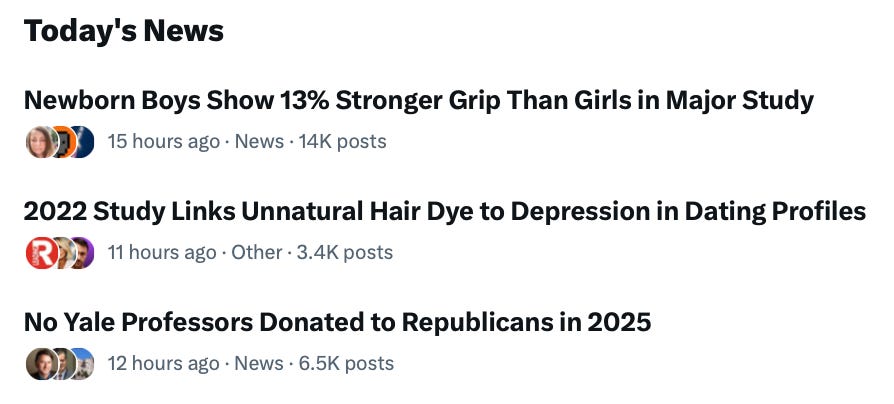
This week, my research on childhood sex differences in grip strength was a number one trending story on X (screenshot below). The main graph from my paper was tweeted by biologist Colin Wright, and Wright’s tweet was retweeted by Elon Musk.
A few other notes about this research:
The full-text of the paper is available here.
I discussed the findings on Men Are Good here.
The GoFundMe to support this continued line of research is available here. I discussed why I chose GoFundMe to support this research in this other interview with Men Are Good.

ARTICLES AND ESSAYS
Sex/Gender
Virginia introduces bill to create nation’s 1st boys and men commission
Virginia Coalition for Boys and Men
K12, higher ed, workforce development and mental and physical health addressed.
Circumcision classed as possible child abuse in draft CPS document
The Guardian
‘Feminist Collective’ took over political science journal, prioritized DEI: report
The College Fix
Emory med school professor dodges question from senator on whether men can get pregnant
The College Fix
The Four Horsewomen of Modern Feminism
Celebrating Masculinity
An excerpt from The Relentless War on Masculinity by David Maywald.
DOD launches review of ‘effectiveness’ of women in ground combat roles
Military Times
Jerusalem severs ties with 7 UN agencies, citing anti-Israel bias
The Times of Israel
Sa’ar decries UN Women for ignoring sexual violence cases on Oct. 7, slams another agency for wastefulness, will examine ties with further UN organizations.
Education
Colleges Didn’t Only Lose Their Value—They Lost Their Way
American Enterprise Institute
U. Minnesota professors studying ‘antiracist parenting’ for white moms
The College Fix
Schools Still Have Illegal DEI? Tell Us!
National Association of Scholars
Key facts about public school teachers in the U.S.
Pew Research Center
Politics
Death & Taxes
New anti-speech laws are rushed, unnecessary, and dangerous.
HISTORICAL ARCHIVES
Heterosexual Males: A Group Forgotten by the Profession of Social Work
Journal of Sociology & Social Welfare (2002)
Abstract: Social work literature has mainly focused upon females and gay males. A search was undertaken of general references to heterosexual males in published social-work authored articles and appearing in book reviews and publishers’ ads in two prominent social work journals during the last decade. The conclusion reached was that heterosexual males are seldom discussed and when they are discussed they are portrayed in a very biased manner. It is believed that social workers do not receive necessary preparation for understanding and working with heterosexual males, especially from minority and immigrant groups, who are facing emotional, physical, interpersonal, and family problems. A stereotypic view of heterosexual males is both unfair and untrue, and precludes necessary attention in the classroom and in practice to their normative needs and special problems.
RUBBISH BIN

Sociology of Sport Journal
Abstract: Female eligibility policies punish people for gender nonconformity and normalize patriarchal rule. These policies were used first to exclude women deemed “too masculine” from competing against women who more closely conform to gender stereotypes. In recent years, this form of discipline has dovetailed with efforts to determine the circumstances, if any, under which transgender women may compete against cisgender women. Modern sport, as a set of institutions, does not stand apart from capitalism, colonialism, white supremacy, and heteropatriarchy. In this article, I use a prison abolitionist lens to connect anti-trans campaigns and female eligibility policies that police sporting identity to the carceral logics of racial capitalism to make the argument that sex surveillance is related to race, social control, and capital accumulation.
(*My brief comment on this article is available on X here.)
The rise of antifeminist perspectives among future educators: a growing concern?
Frontiers in Psychology
Abstract: Introduction: Antifeminist discourses have historically emerged in response to feminist advancements. In Spain, the past decade has seen significant feminist progress, yet antifeminist rhetoric has simultaneously gained traction, particularly among younger populations. This study examines the antifeminist narratives present among university students in education programs, a critical demographic as future educators play a key role in shaping social attitudes. Methods: A free association exercise was conducted with 252 students enrolled in education programs. The collected textual data were analyzed using Iramuteq software, applying lexical analysis techniques to identify dominant antifeminist discourses. Results: The findings indicate that the most prominent antifeminist narratives among participants center on feminist principles, salary aspirations, perceived disparities in rights, household chores, and the alleged provocative behavior of women. Notably, frequently cited statements include “Feminism does not seek equality” and “They expect to be paid the same”, reflecting common misconceptions about feminism. Despite expressing support for gender equality, participants were less likely to self-identify as feminists. Discussion: These findings highlight the contradictions within young adults’ perceptions of feminism and gender equality. The persistence of antifeminist narratives within future educators underscores the need to address these discourses in academic settings. Integrating feminist pedagogies into teacher training programs is essential to fostering a more equitable and informed educational environment. Conclusion: This study underscores the necessity of actively confronting antifeminist rhetoric within educational institutions to ensure that future educators contribute to gender equality rather than perpetuate misconceptions.
(*My brief comment on this article is available on X here.)
Queering the Poster: Disruptive Knowledge at the AACN Diversity Symposium
Journal of Nursing Education
Abstract: Background: This article advances theory to practice by describing the application of queer norm-critical pedagogy to a poster given as part of a virtual session at the 2021 American Association of Colleges of Nursing Diversity Symposium. Method: The authors created and facilitated the experience of a queered, conceptual poster, inviting a critical appraisal of both the limits and the possibilities of knowledge sharing and co-creation among nurse educators and nursing scholars. Results: The poster was and remains a multimodal, democratic, space/time-transgressing performance whose reach extended well beyond the Symposium in both time and (virtual) space. Conclusion: Inviting learners into this co-created, ongoing educational activity up-ends the hierarchies of conference participation, breaking the fourth wall. This kind of work also has potential for the classroom. With planning and creativity, nursing educators can use the methods described here to queer their teaching.
Battleground education: Activism, protest and campaigning in diverse educational contexts
Education, Citizenship and Social Justice
Abstract: This Special Issue throws a spotlight on educational activism. It brings together an international collection of papers offering insights into struggles over education in a variety of contexts. Collectively, the papers capture the breadth and diversity of educational activism. They document battles fought by a range of different actors and illustrate how educational settings can become important sites for collective mobilisation and active citizenship. Beyond introducing the contributions to the collection, this opening paper serves two further purposes. First, we survey recent research in the field to build a picture of prominent areas of conflict in public education systems. And second, we present a novel conceptualisation of educational activism designed to aid further understanding and development of this important area of educational enquiry. Our ambition is for the collection to inspire further research in the field and encourage closer collaboration with campaigners engaged in struggles for educational and social justice.
(*My brief comment on this article is available on X here.)
Topping the genre: pro-porn feminist implications of trans-topping in gay pornography
Critical Studies in Media Communication
Abstract: This article examines the socio-political potential of trans-topping in gay pornography through a case study of Trans Guys in Sweatpants. Using Audre Lorde’s conception of the erotic, this essay positions trans-feminist pornography as a critical theoretical foundation for analyzing the intersections of transness, sexuality, and power. Through a critical reading of Trans Guys in Sweatpants and its corresponding media, this essay mobilizes the erotic as a means of conducting critical textual analysis, interrogating how trans bodies are positioned within dominant socio-cultural and political frameworks. By engaging with pornographic production as a site of resistance, this work argues that performances of trans-topping disrupt hegemonic understandings of sex, gender, and masculinity. Ultimately, this analysis demonstrates how trans sexual performance in gay porn can expand representations of trans desire, reimagine erotic expression, and serve as a tool for challenging normative ideological constructions of transness and sexuality.
(*My brief comment on this article is available on X here.)
SUPPORT THE NUZZO LETTER
If you appreciated this content, please consider supporting The Nuzzo Letter with a one-time or recurring donation. Your support is greatly appreciated. It helps me to continue to work on independent research projects and fight for my evidence-based discourse. To donate, click the DonorBox logo. In two simple steps, you can donate using ApplePay, PayPal, or another service. Thank you!

If you prefer to donate to a specific project, please see the Go Fund Me page for my current research on sex differences in muscle strength in children.

Congrats, but it’s kinda sad that your most popular article ended up being the one about grip strength differences, and not any of the ones about discrimination against boys and men. I can guess why.
It’s a good argument for why boys and men shouldn’t compete in girls’ and women’s sports – and I totally agree that men/boys shouldn’t be competing in female sports. Really.
Still, it’s frustrating that issues affecting men and boys never seem to get the same level of attention. I don’t see women showing solidarity with us and organising protests against, say, discrimination against boys in education – the way men and women do when it comes to protecting women’s and girls’ sports.
Re the final article- have the Mormons all left Salt Lake City, or have they just become "liberal"?