
“Woke” is a colloquial term that refers to a raised awareness of purported injustices that are said to be caused by unjust power dynamics in society. The current data brief updates a previous analysis at The Nuzzo Letter on the use of Woke medicine terminology in the titles and abstracts of academic articles indexed in PubMed.
PubMed, which is maintained by the National Institutes of Health (NIH) and the U.S. National Library of Medicine, is a digital database of millions of academic articles in the biomedical and life sciences. PubMed indexes most biomedical and public health journals. Thus, a search of Woke terminology in the titles and abstracts of articles indexed in PubMed can reveal the extent to which the philosophical underpinnings of Woke - critical theory, intersectionality, etc. - have been adopted in medical and health science.
The current data brief extends my previous analysis in a couple of ways. First, and most importantly, the search has been extended from the year 2024 to the year 2025. Thus, the current data brief allows for an examination of whether peak Woke medicine has been reached. Second, the current data brief presents results from Woke terms that were not included in my previous analysis (e.g., climate anxiety, critical race theory, neoliberalism). Third, for a couple of terms, I altered my previous search strategy to more accurately capture the term being studied. For example, in my previous analysis, I graphed the results for the term “underrepresentation” without considering that a search for that term will not identify titles and abstracts that include the spelling “under-representation.”
Notes on the Search Strategy
Many Woke words have an inverse. For example, the inverse of “equity” is “inequity.” The inverse of “justice” is “injustice.” The inverse represents the same general concept as its counterpart. In such instances, both words were searched to represent the concept.
Many Woke words have plural versions. The plural versions were also searched using the asterisk (*) wild card operator. For example, the keyword search of birthing person* finds the phrases “birthing person” (singular) and “birthing persons” (plural).
Woke words that represent the same concept sometimes share the same root or prefix but have different suffixes. Thus, the asterisk (*) wild card operator was used at the end of word roots or prefixes to identity all relevant referrals to the concept. For example, the keyword search of misogyn* identifies articles that included the following words in their titles or abstracts: misogyny, misogynist, misogynistic.
Some Woke words have different spellings in American and British English (e.g., “decolonize” and “decolonise”). In such cases, both spellings were searched to represent to identify that concept in the titles and abstracts of articles.
The exact PubMed search that I performed for each term is shown at the bottom of each graph.
Limitations of the Search Strategy
The current data brief does not examine all Woke terms. Many other Woke words and phrases exist. Thus, these graphs do not represent the totality of Woke words and phrases in articles indexed in PubMed. Please see the encyclopedia of Woke terminology at the New Discourses website for an extensive list of Woke terms and their definitions.
Only the titles and abstracts of articles were searched. Some articles will have discussed Woke concepts in the main body of the text but not included that terminology in the article’s title or abstract. Thus, these graphs do not represent the totality of Woke words and phrase in articles indexed in PubMed.
Only PubMed was searched. Several other databases of academic articles exist. PubMed indexes journals in the biomedical and life sciences. Journals in other academic areas, including many areas in the humanities, where Woke is most common, were not searched. Thus, the current graphs do not represent the totality of Woke in academia. Instead, the current graphs primarily represent Woke medicine and healthcare.
See the Bonus Commentary at the end of this data brief post for a discussion on the implications of the results. If you would like to support more research like this, one-off or recurring monthly donations can be made to The Nuzzo Letter’s Donorbox in two simple steps. Thank you!

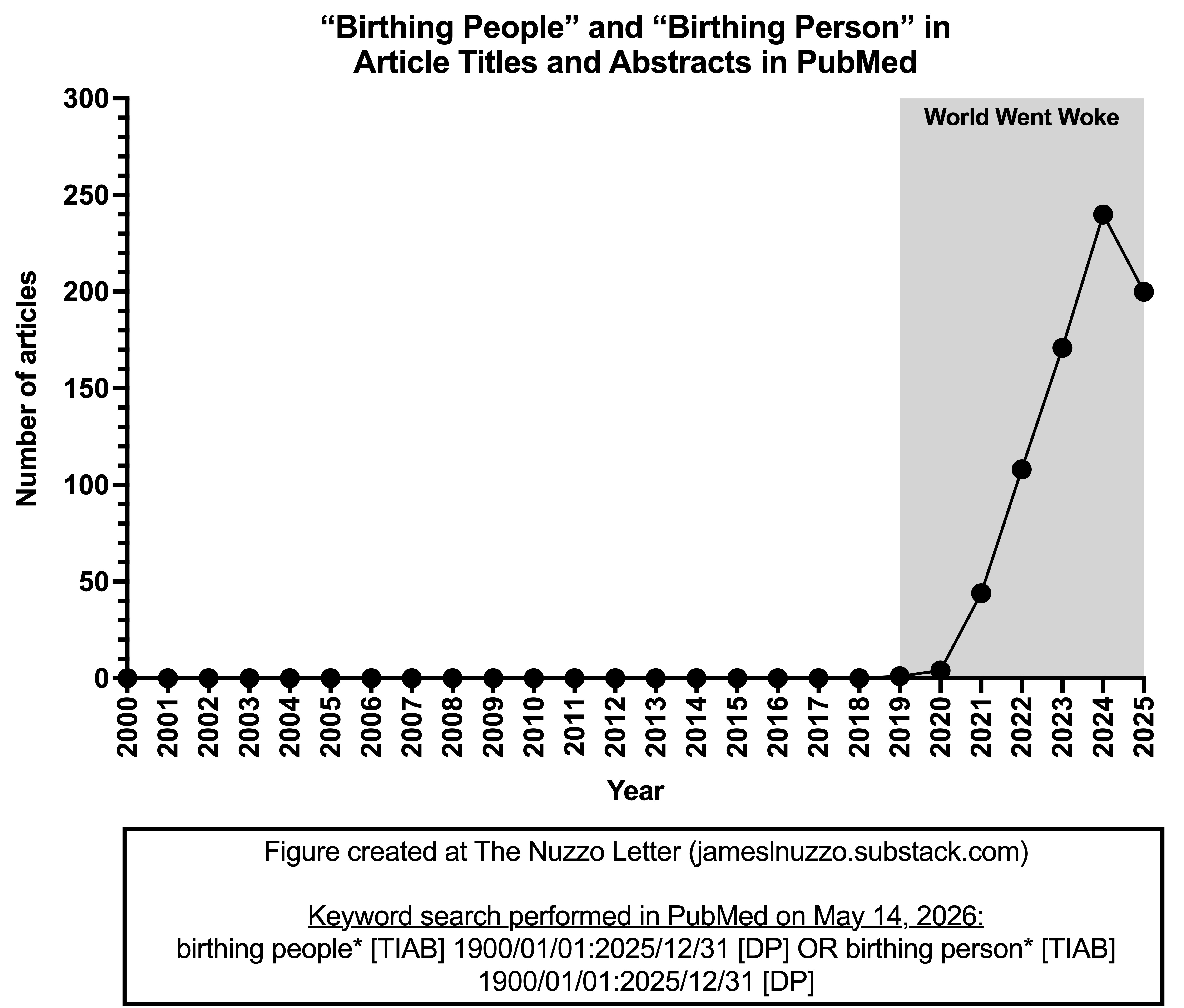
“Birthing People” and “Birthing Person”
The first year that the phrase “birthing people” or “birthing person” was used in the title or abstract of an article indexed in PubMed was 2019.
Use of these two phrases increased noticeably in 2021.
In 2025, 200 articles indexed in PubMed had the phrases “birthing people” or “birthing person” in their titles or abstracts, which is down from 240 articles in 2024.
Between 2019 and 2025, the words “birthing people” and “birthing person” appeared in the titles or abstracts of 768 articles indexed in PubMed.
Climate
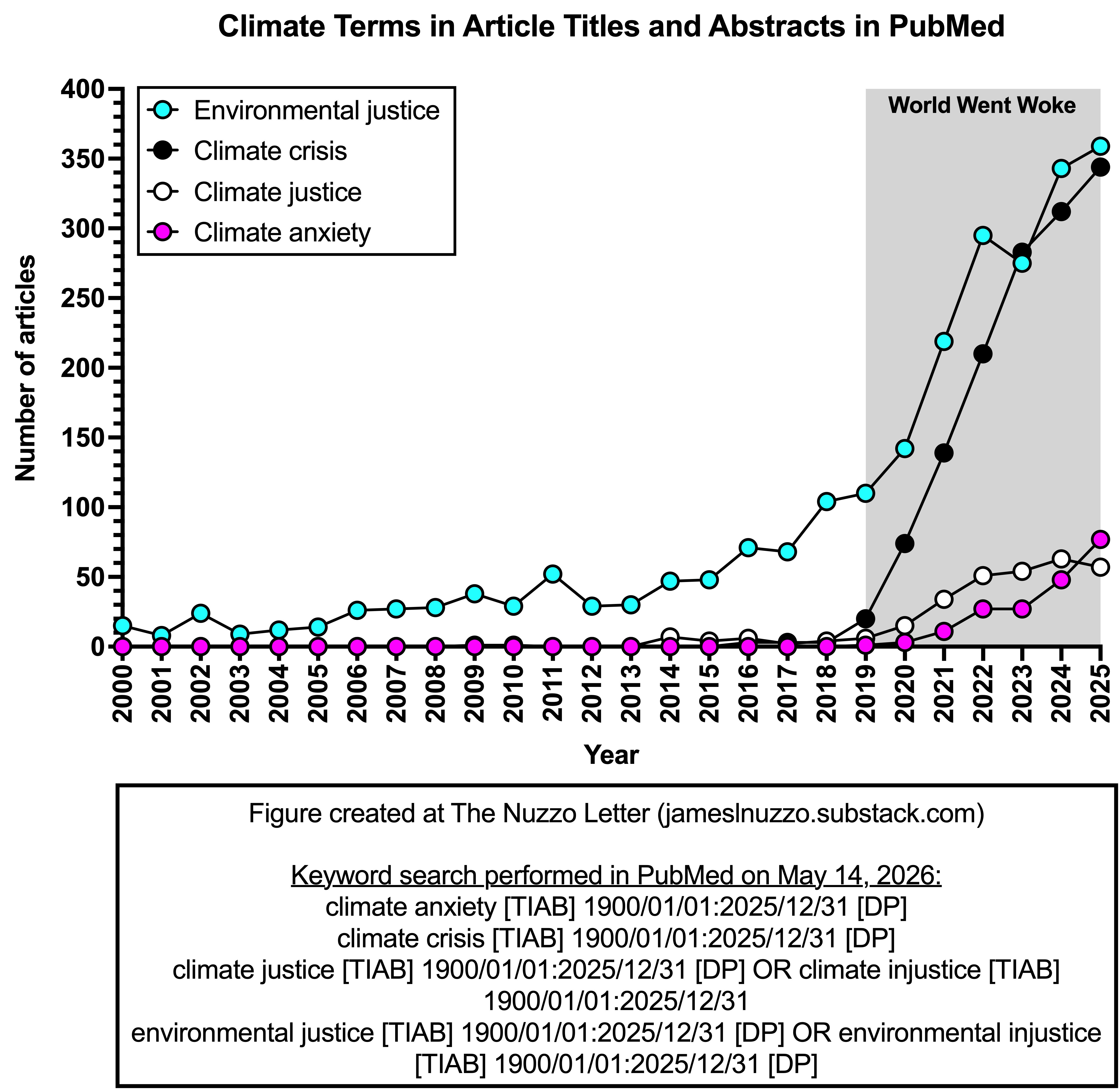
Climate can be studied in an objective and politically neutral way. However, in recent years, climate research has become highly political. This is evident from the graph below.
Use of the phrases “climate crisis,” “climate justice,” and “environmental justice” has increased noticeably since 2019.
Between 2019 and 2025, the phrase “climate crisis” appeared in the titles or abstracts of 1,382 articles indexed in PubMed.
Between 2019 and 2025, the phrase “environmental justice” (or “environmental injustice”) appeared in the titles or abstracts of 1,743 articles indexed in PubMed.
Colonialism
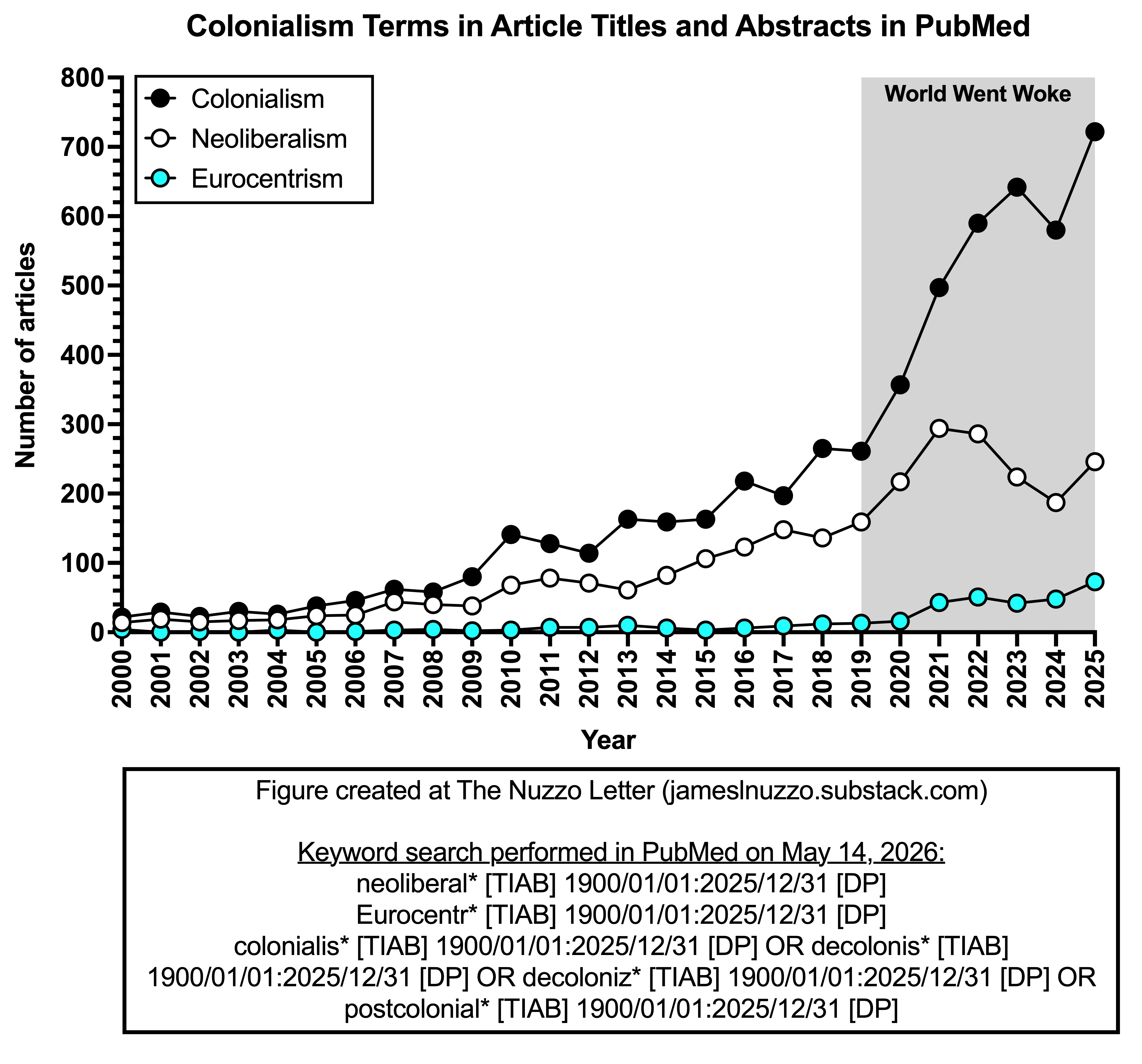
Critical theorists have advocated for “decolonizing” academic curricula, public policy, and clinical practice. They have also railed against “neoliberalism” and “Eurocentrism.”
The graph below confirms the increased use of these words, particularly “colonialism” (or “decolonize”), in the titles and abstracts of articles indexed in PubMed.
Critical Theory
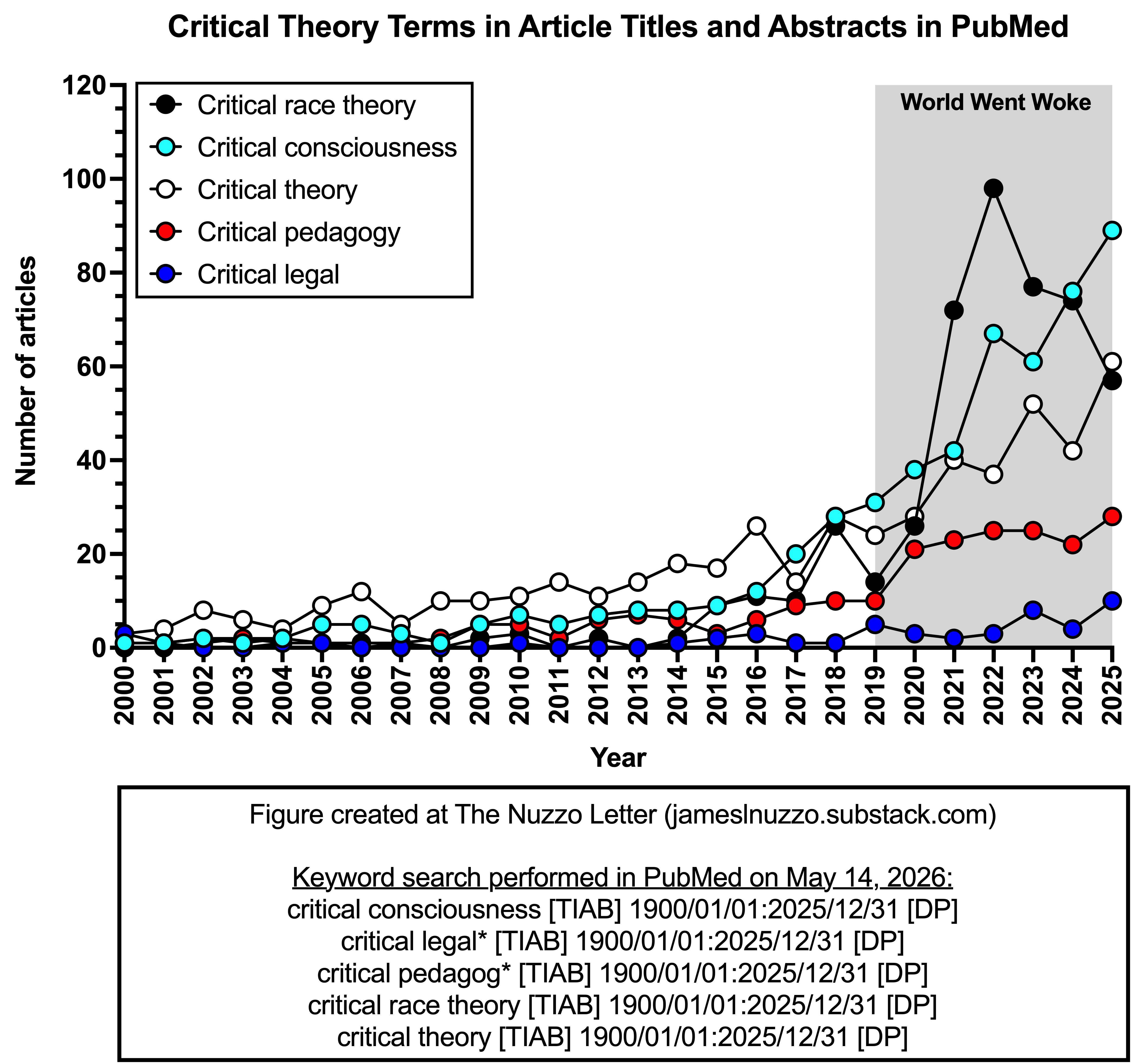
Reference to specific critical theories in the titles and abstracts of articles in PubMed has increased in recent years.
Between 2019 and 2025, the phrase “critical race theory” was used in the titles or abstracts of 418 articles indexed in PubMed.
Articles on the use of “critical pedagogy” in health and medical education have also become more common.
Diversity, Equity, and Inclusion
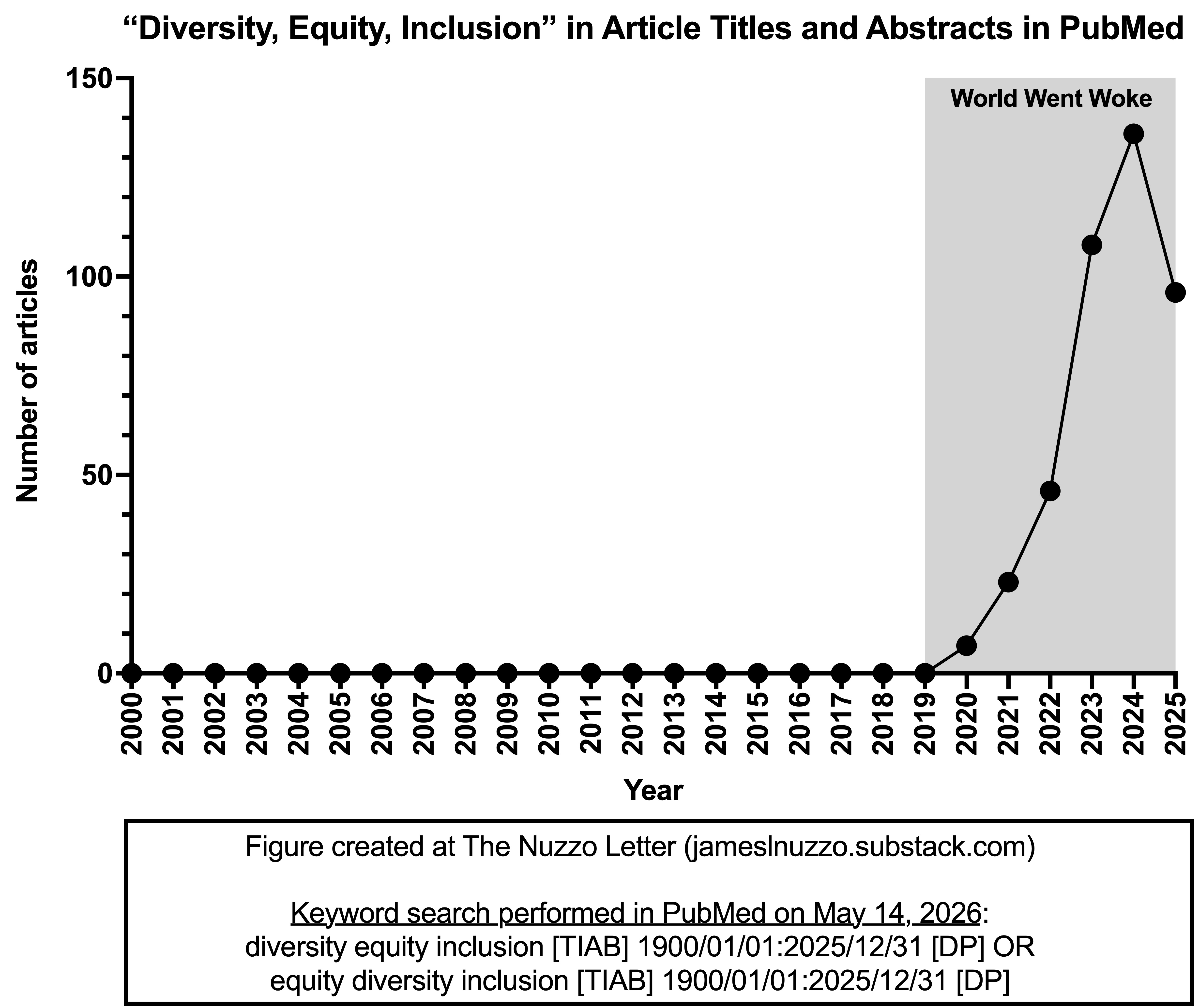
The first year that the phrase “diversity, equity, and inclusion” (or “equity, diversity, and inclusion”) was used in the title or abstract of an article indexed in PubMed was 2020.
Between 2020 and 2025, the phrases “diversity, equity, and inclusion” and “equity, diversity, and inclusion” were used in the titles or abstracts of 416 articles indexed in PubMed.
Use of these phrases peaked in 2024 (136 articles) and decreased in 2025 (96 articles).
Disability
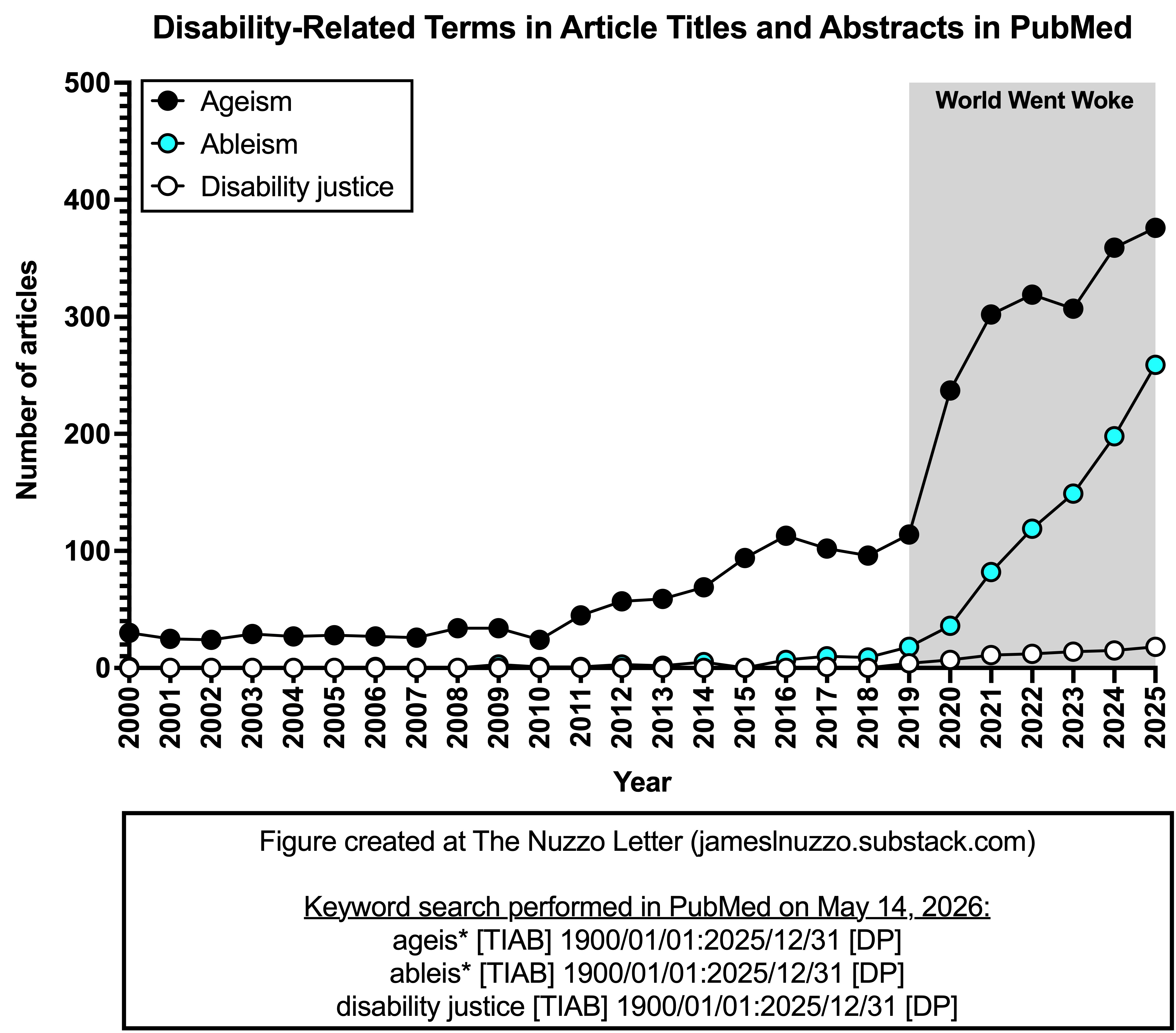
Critical disability studies is part of the critical theory and social justice milieu.
Notable increases in the use of the words “ableism” and “ageism” in articles indexed in PubMed occurred in 2020 and 2021 and continued to increase most years thereafter.
Between 2019 and 2025, the word “ableism” appeared in the titles or abstracts of 861 articles indexed in PubMed.
Between 2019 and 2025, the word “ageism” appeared in the titles or abstracts of 2,014 articles indexed in PubMed.
Epistemology
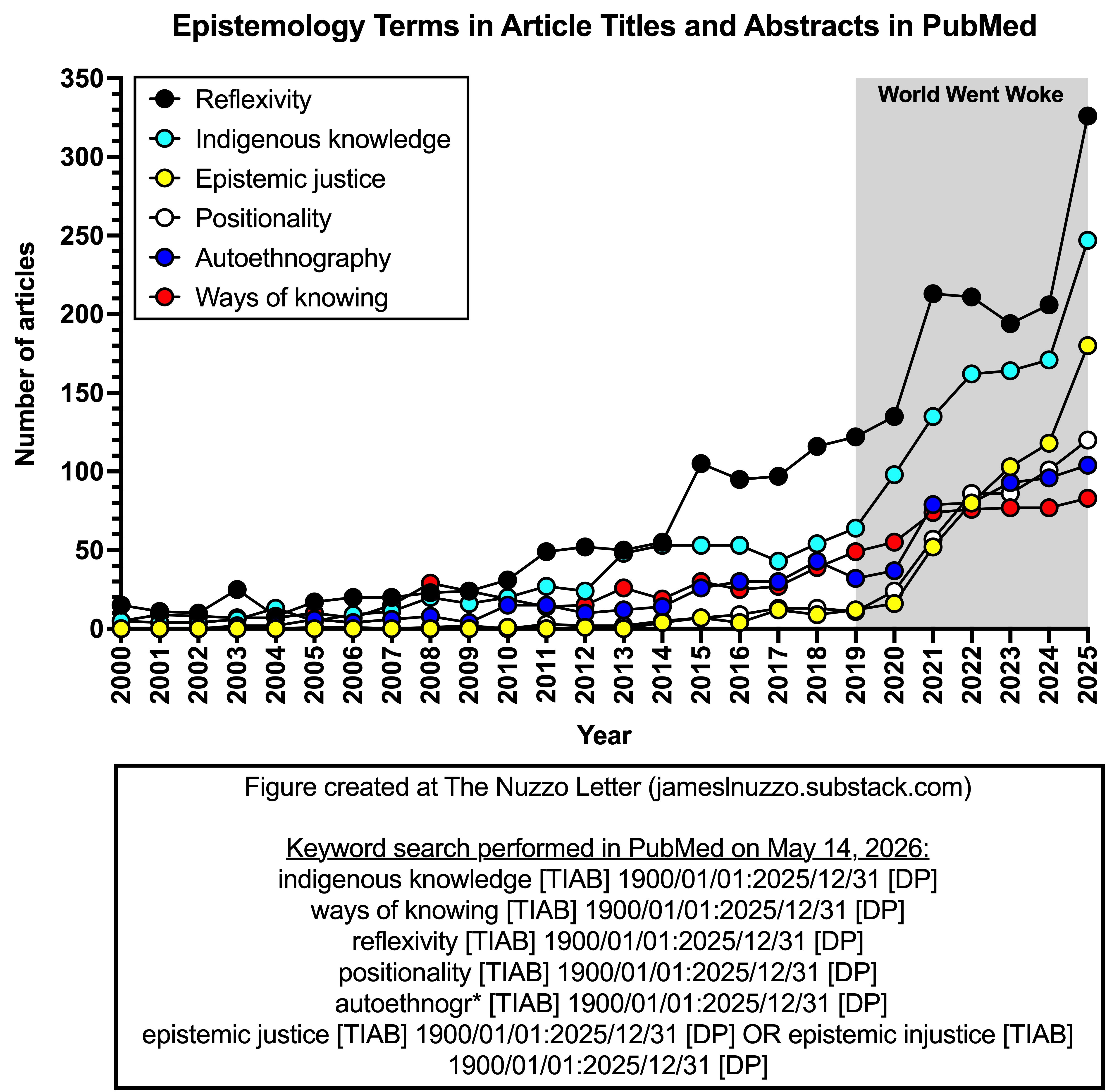
Epistemology refers to what knowledge is and how we obtain it. Critical theorists often reject the idea that the world can be understood objectively through the scientific method. Instead, critical theorists view knowledge as dependent on one’s position in either an oppressor group or oppressed group. In this view, “ways of knowing” the world are believed to differ between people who are oppressors or the oppressed. Between 2019 and 2025, 491 articles indexed in PubMed included the phrase “ways of knowing” in their titles or abstracts.
“Epistemic justice” (or injustice) is the idea that oppressed people’s “ways of knowing” are not adequately valued by society. Between 2019 and 2025, 561 articles indexed in PubMed included the phrase “epistemic justice” in their titles or abstracts.
Indigenous people, who are said to have their own way of knowing called “indigenous knowledge,” are often referred to as an oppressed groups. Between 2019 and 2025, 1,041 articles indexed in PubMed included the phrase “indigenous knowledge” in their titles or abstracts.
Because one’s position in the oppression hierarchy is thought to impact one’s way of knowing things, academics now regularly write “positionality” statements in their papers. “Positionality” or “reflexivity” statements are declarationsmade by academics about their own social identities or “lived experiences” that shape their perspectives on the research topic. However, as explained by Colin Wright of Reality’s Last Stand, positionality statements undermine scientific integrity. Between 2019 and 2025, 485 articles indexed in PubMed included the word “positionality” in their titles or abstracts, and 1,407 articles included the word “reflexivity” in their titles or abstracts.
Autoethnographies are qualitative papers that involve academics using their own life experiences to explain broader social trends. Autoethnographies are prone to researcher bias, and the reliance of many academics on this technique is problematic. Between 2019 and 2025, 521 articles indexed in PubMed included the word “autoethnography” in their titles or abstracts.
Gender Identity and Sexual Orientation
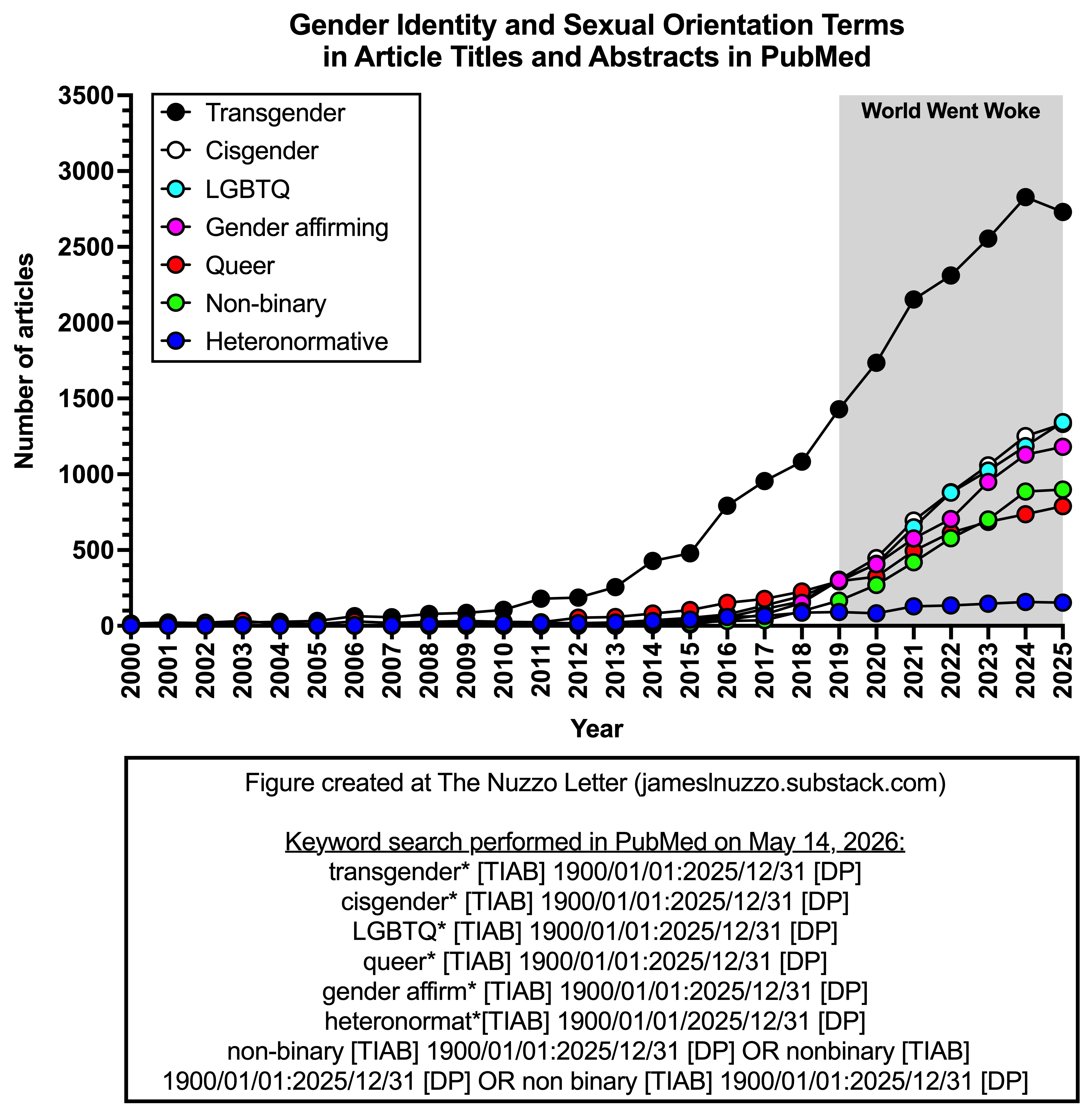
Words that refer gender identity or sexual orientation (e.g., “cisgender,” “queer”) have been used more frequently by academics over the past few years.
In the current analysis, the most frequently used of these word was “transgender.” Between 2019 and 2025, the word “transgender” appeared in the titles or abstracts of 15,741 articles indexed in PubMed. Use of the word “transgender” peaked in 2024 (2,828 articles) and declined slightly in 2025 (2,730 articles).
Gender/Sex Differences
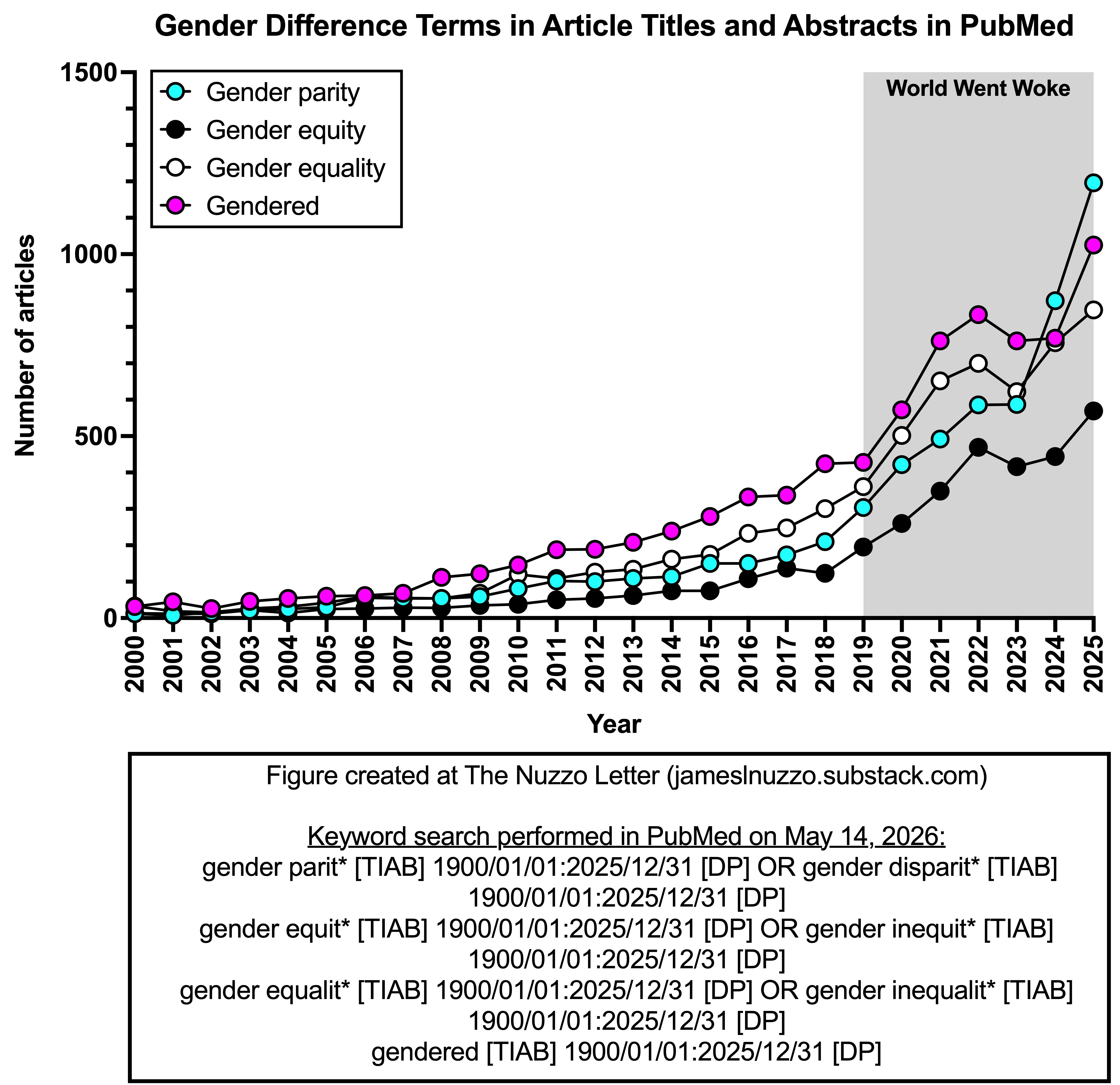
The rise of Woke medicine has been associated with a heightened focus on sex/gender differences. Relevant words or phrases have included “gender parity,” “gender equity,” “gender equality,” and “gendered.”
Use of all four of terms has increased noticeably in recent years and their trajectories in use follow a similar pattern.
Between 2019 and 2025, the phrase “gender equity” appeared in the titles or abstracts of 2,702 articles indexed in PubMed.
Between 2019 and 2025, the phrase “gender equality” appeared in the titles or abstracts of 4,441 articles indexed in PubMed.
Gender Mistreatment
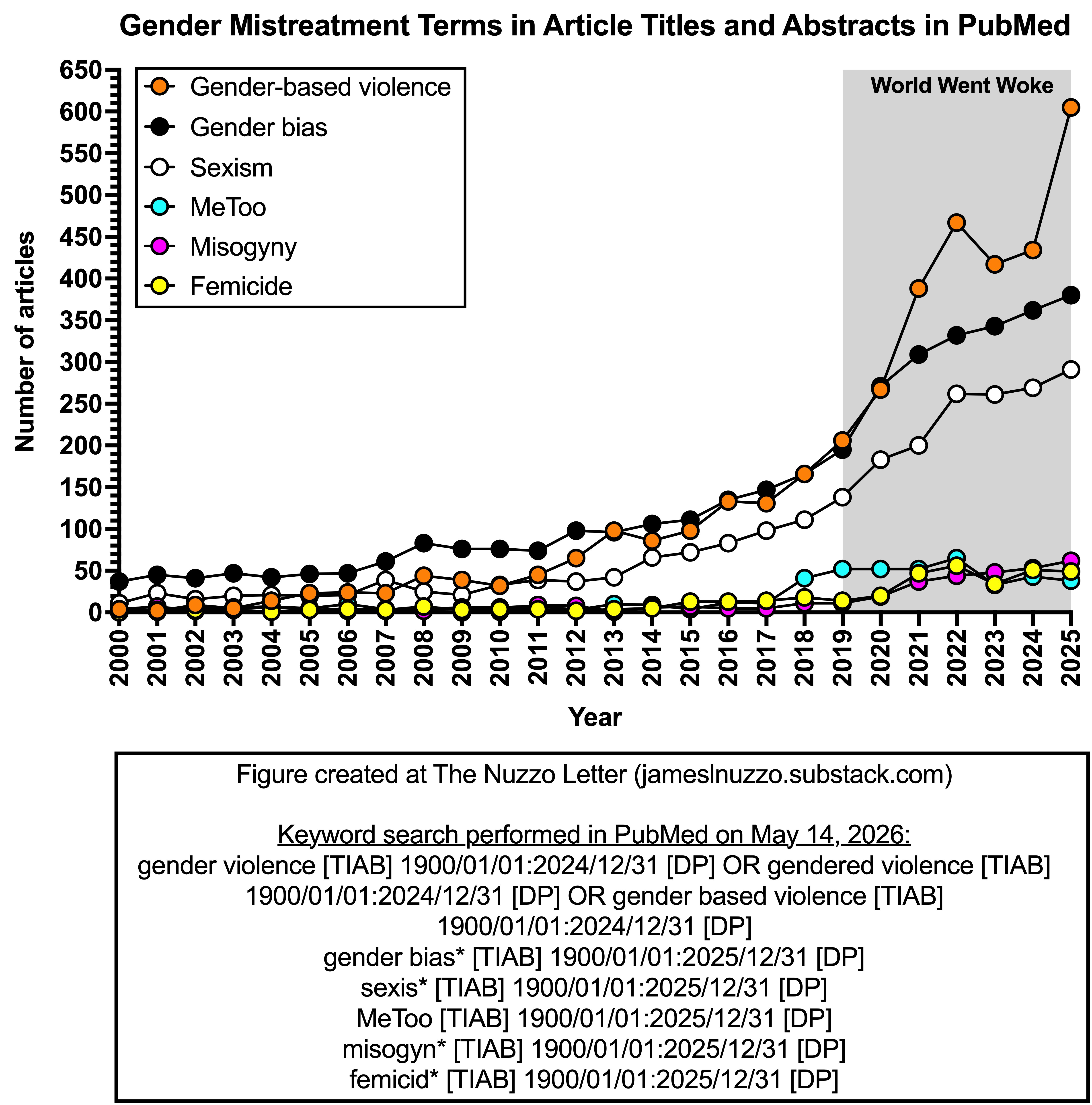
Women, particularly minority women, are considered an oppressed or “marginalized” group, and focus on female victimization is a key component of Woke.
Between 2019 and 2025, the phrase “gender-based violence” appeared in the titles or abstracts of 2,784 articles indexed in PubMed.
Between 2019 and 2025, the phrase “gender bias” appeared in the titles or abstracts of 2,192 articles indexed in PubMed.
Between 2019 and 2025, the phrase “MeToo” appeared in the titles or abstracts of 335 articles indexed in PubMed.
Between 2019 and 2025, the word “misogyny” appeared in the titles or abstracts of 274 articles indexed in PubMed.
Group Differences
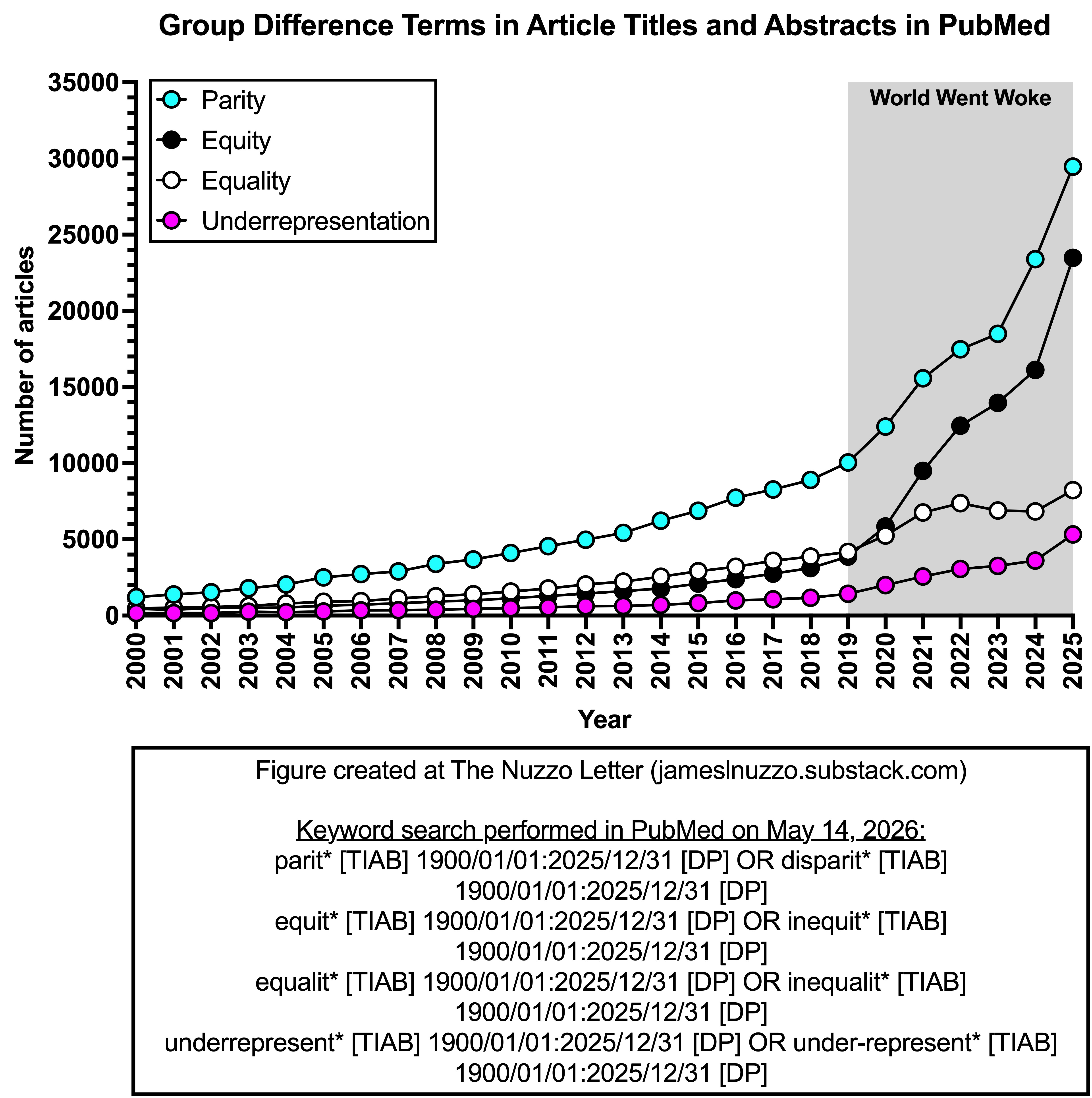
Group differences in health outcomes exist, and these group differences are a key focus of Woke medicine. Woke medicine focuses on demographic groups rather than individual patients, and the objective of Woke medicine is to create “parity,” “equality,” and “equity” in group health outcomes, usually by acting on the “social determinants of health.” Because critical theory says that these group differences are due to unjust systemic or structural factors associated with the oppressor-oppressed paradigm, the ethically neutral word “difference” is replaced with words like “parity,” “equality,” and “equity,” which imply some level of injustice or wrongdoing. Between 2019-2021, use of these words in the titles and abstracts of articles indexed in PubMed accelerated.
Interestingly, use of the word “equality” plateaued starting around 2021, while use of the word “equity” continued to increase. Between 2019 and 2025, the word “equality” appeared in the titles or abstracts of 45,535 articles indexed in PubMed. Between 2019 and 2025, the word “equity” appeared in the titles or abstracts of 85,239 articles indexed in PubMed.
The word “underrepresentation” falls within the Woke lexicon. It is often used in discussing group differences in positions of power or influence, and academics often advocate for new policies that they believe will create “parity,” “equality,” or “equity” in those positions. Between 2019 and 2025, the word “underrepresentation” appeared in the titles or abstracts of 21,271 articles indexed in PubMed.
Hate
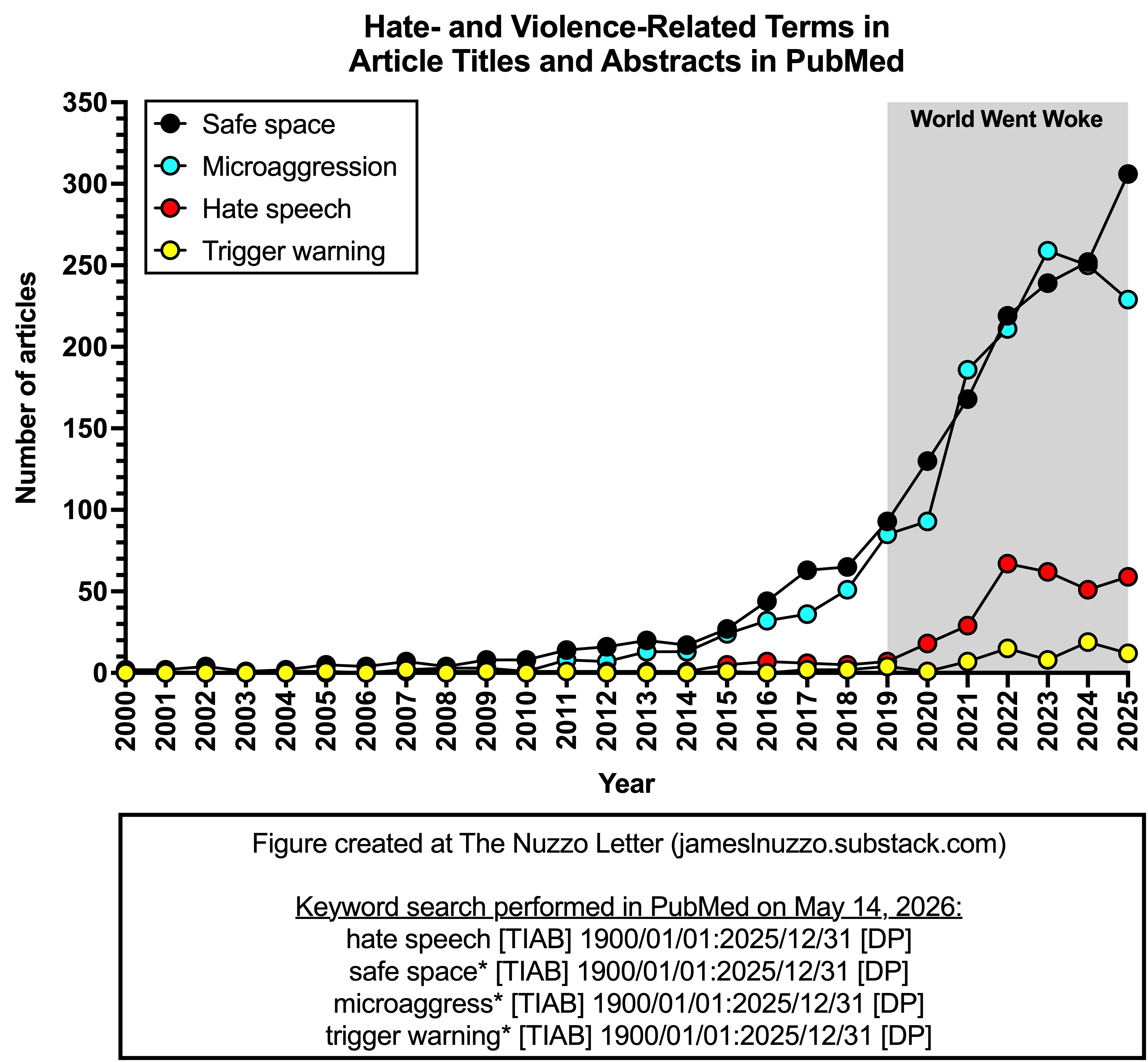
As universities have become increasingly feminized, articles on the safety of women and other intersectional groups have become more common. “Hate speech,” “microaggressions,” “safe spaces,” and “trigger warnings” are terms that reflect this heightened safetyism.
Between 2019 and 2025, the word “microaggression” appeared in the titles or abstracts of 1,313 articles indexed in PubMed.
Between 2019 and 2025, the phrase “safe space” appeared in the titles or abstracts of 1,407 articles indexed in PubMed.
Health Differences
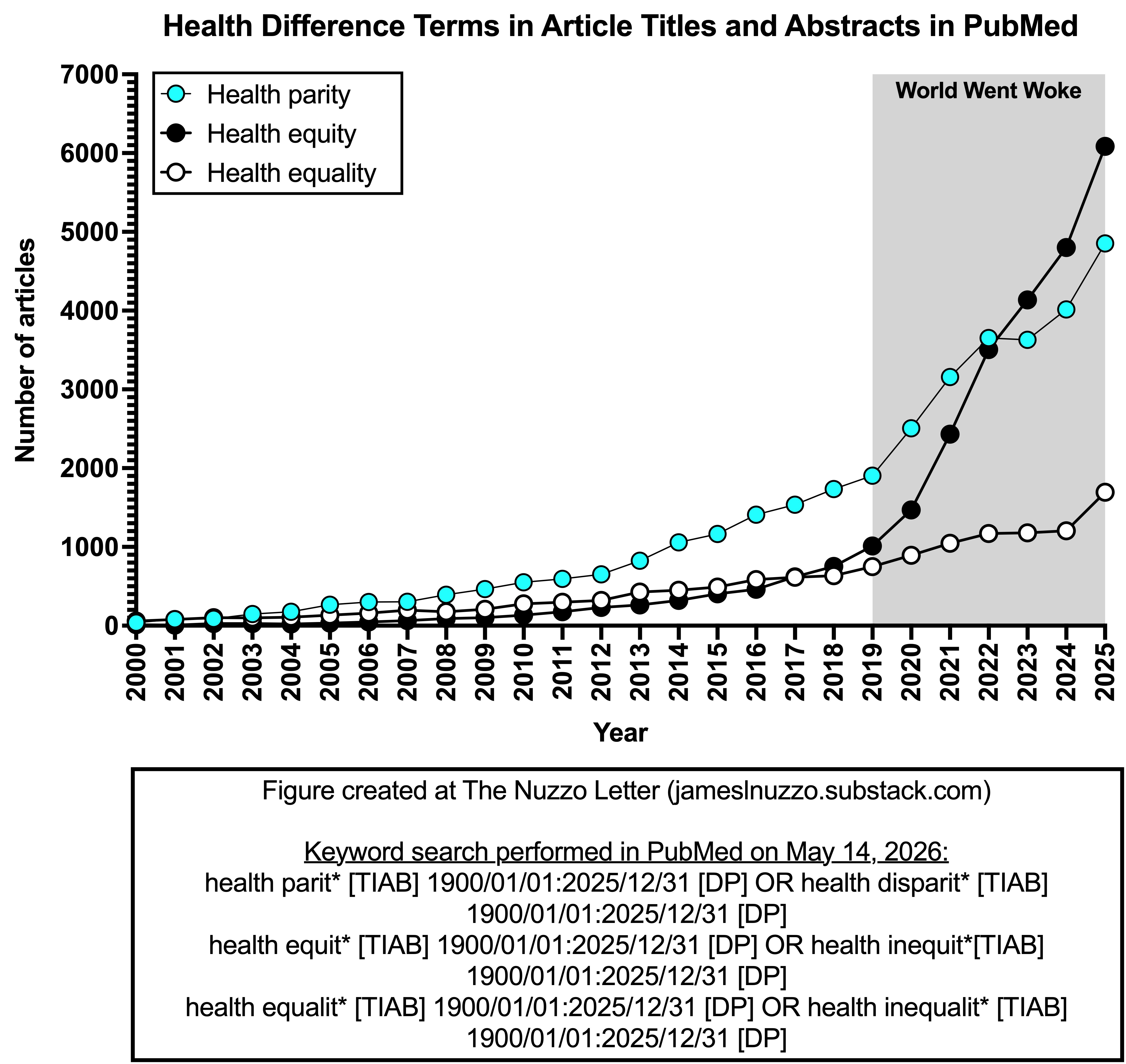
Above, I presented a graph showing use of the words “parity,” “equity,” and “equality.” Those words could have been used in various contexts, such as “gender equity” or “racial equity.” In the graph below, I show use of the phrases “health equity,” “health equality,” and “health parity.”
Accelerated use of the phrase “health equity” and “health parity” occurred starting in 2020. Interestingly, use of phrase “health equality” plateaued, while use of the phrases “health equity” and “health parity” continued to increase.
Between 2019 and 2025, the phrase “health parity” appeared in the titles or abstracts of 23,722 articles indexed in PubMed.
Between 2019 and 2025, the phrase “health equity” appeared in the titles or abstracts of 23,441 articles indexed in PubMed.
Between 2019 and 2025, the phrase “health equality” appeared in the titles or abstracts of 7,939 articles indexed in PubMed.
Intersectionality
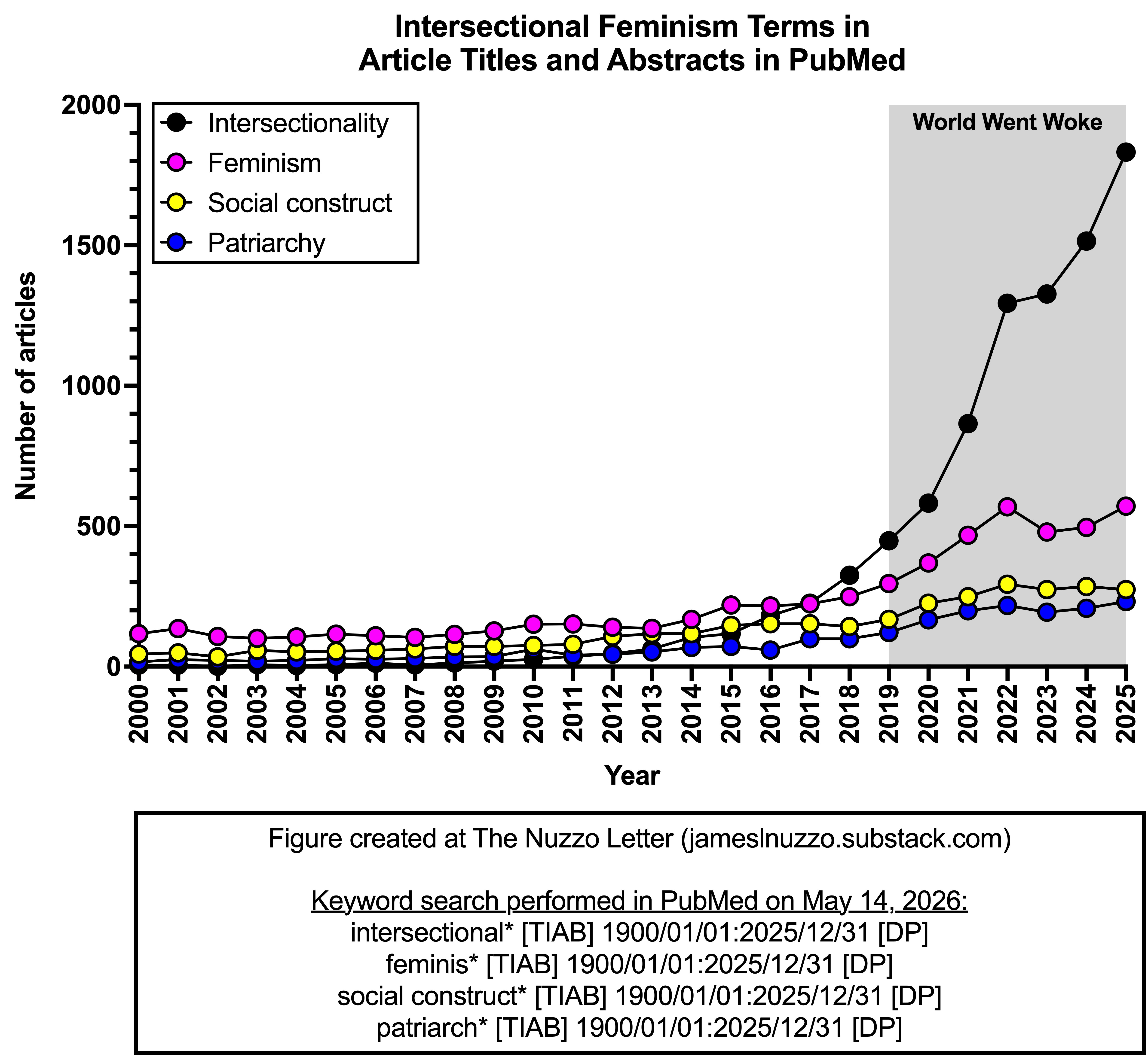
“Intersectionality” refers to one’s multiple group identities – e.g., sex, race, sexual orientation. Intersectionality and concepts like patriarchy and social construction are key to feminist theory.
Between 2019 and 2025, the word “intersectionality” appeared in the titles or abstracts of 7,863 articles indexed in PubMed.
Between 2019 and 2025, the word “feminism” appeared in the titles or abstracts of 3,248 articles indexed in PubMed.
Justice and Activism
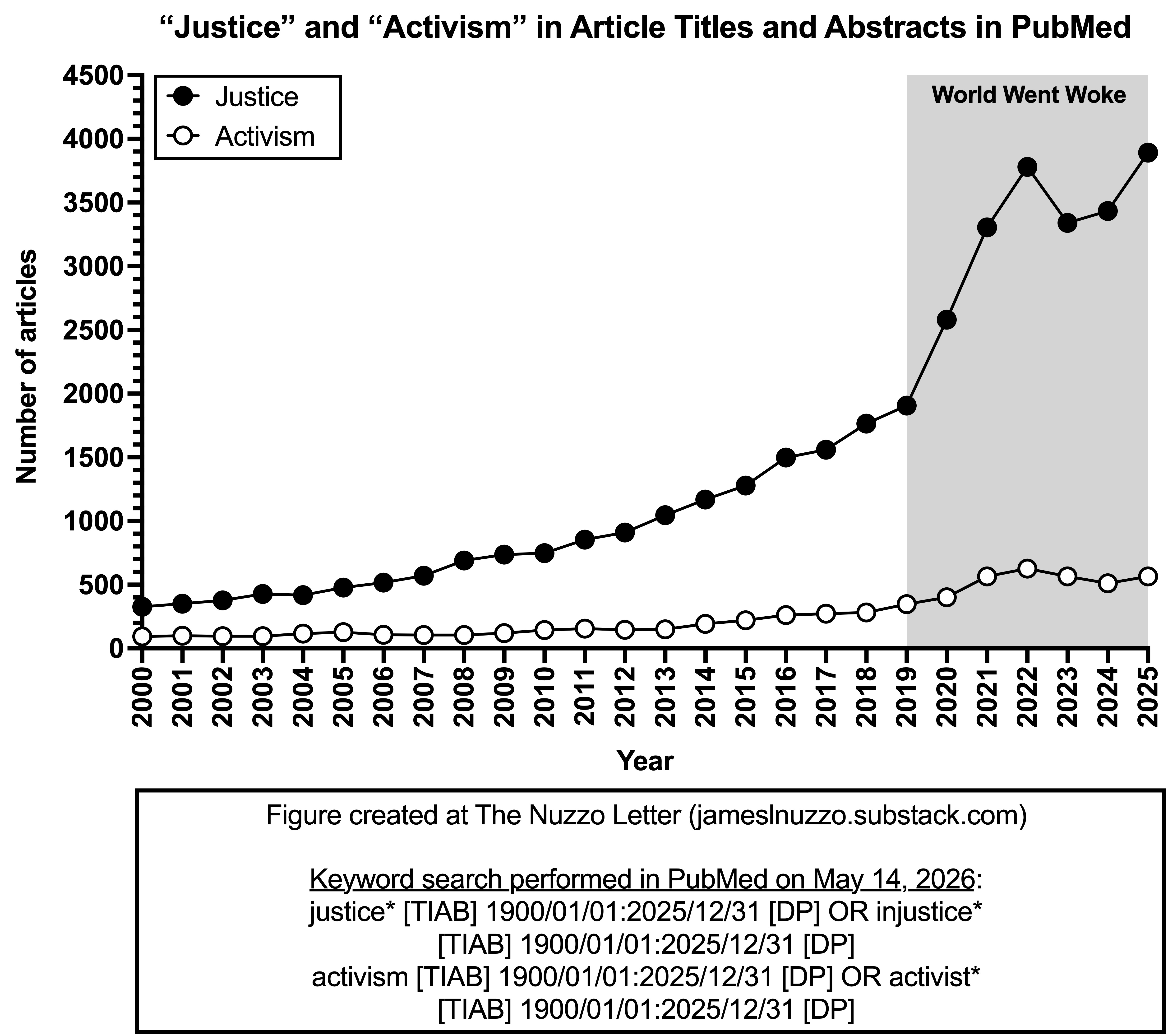
The activist nature of contemporary academia has become obvious in recent years. Changing policies, laws, and clinical practices are the aims of Woke academics. Thus, the words “justice” and “activism” appear regularly in articles indexed in PubMed.
Between 2019 and 2025, 22,237 articles indexed in PubMed contained the word “justice” in their titles or abstracts.
Between 2019 and 2025, 3,583 articles indexed in PubMed contained the word “activism” in their titles or abstracts.
Lived Experience
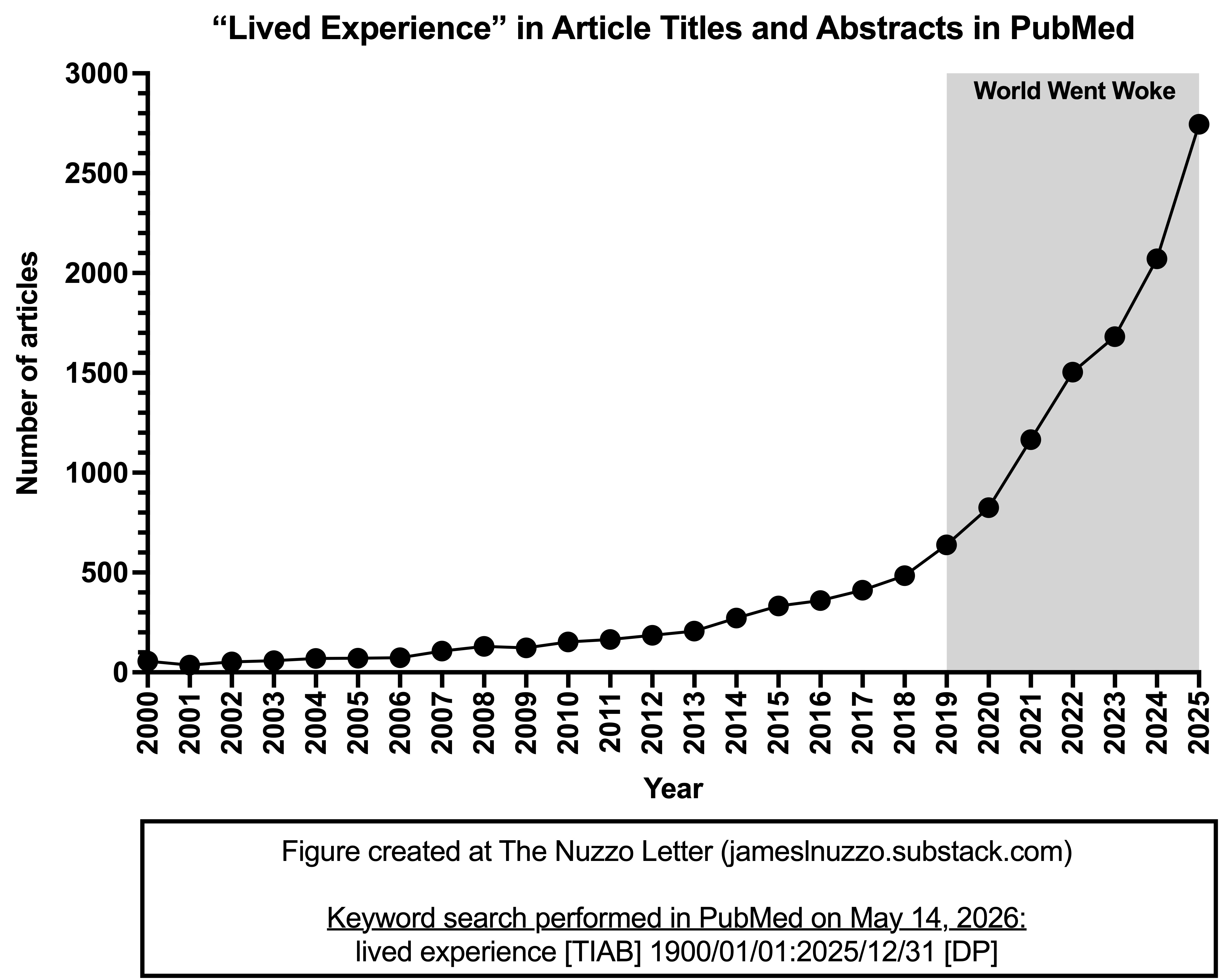
In critical theory, “lived experience” refers to “one’s life experiences in allegedly systemic power dynamics of dominance and oppression that shape society structurally…”. A claim of “lived experience” by a person of an alleged oppressed group is then often used by that person to make unsubstantiated claims against an alleged oppressor group.
Accelerated use of the phrase “lived experience” in the titles and abstracts of articles indexed in PubMed occurred starting around 2019. Between 2019-2025, the phrase “lived experience” appeared in the titles or abstracts of 10,631 articles indexed in PubMed.
Masculinity and Femininity
Masculinity Studies is part of the critical theory project, and research and commentary on sex/gender has grown enormously in the past few years.
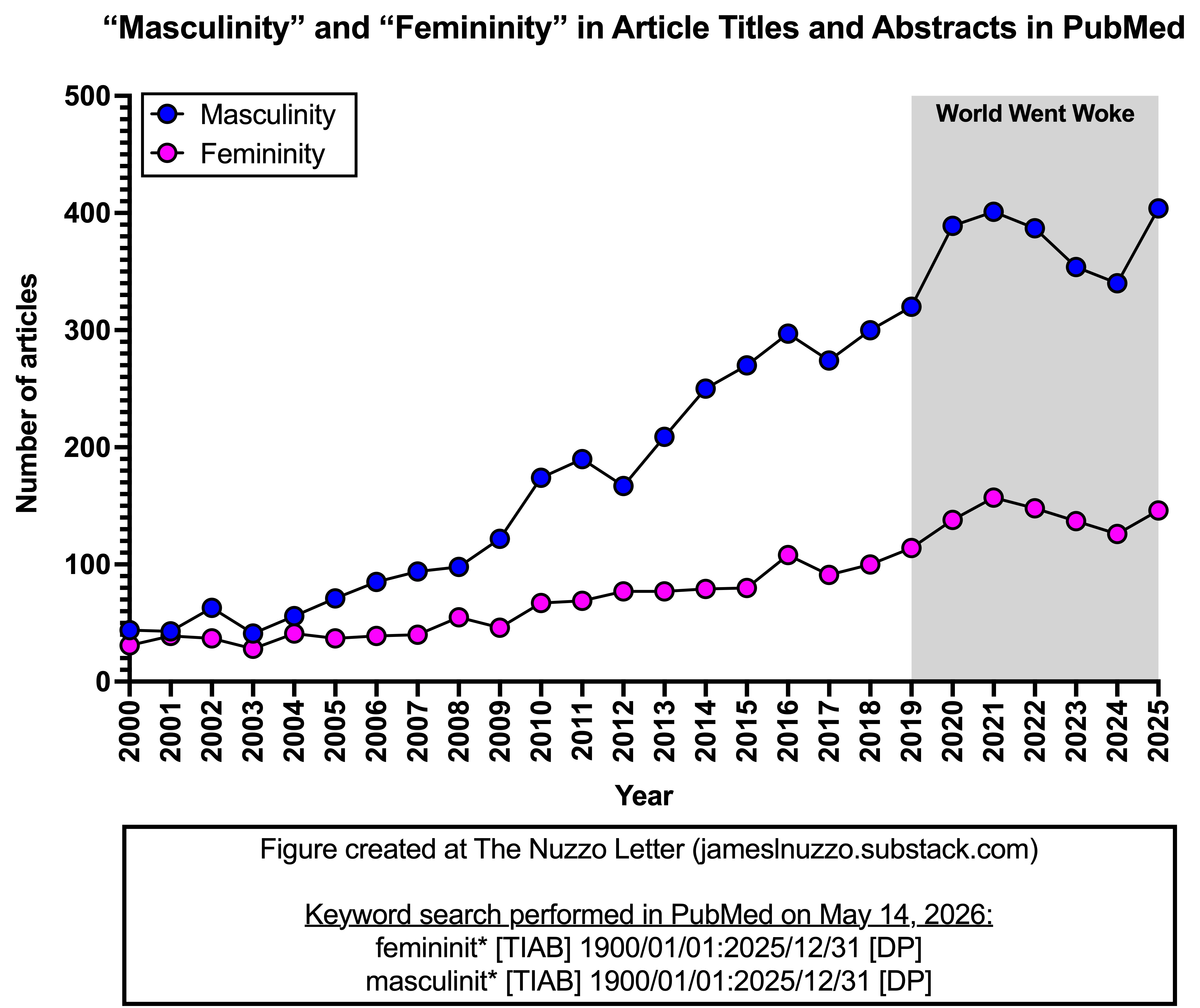
The below graph compares how often the words “masculinity” and “femininity” have appeared in the titles and abstracts of articles indexed in PubMed.
The word “masculinity” has been used significantly more than the word “femininity.”
Between 2019 and 2025, the word “femininity” appeared in the titles or abstracts of 966 articles indexed in PubMed.
Between 2019 and 2025, the word “masculinity” appeared in the titles or abstracts of 2,595 articles indexed in PubMed. Thus, word “masculinity” appeared over 2.5 more times than the word “femininity.”
Masculinities
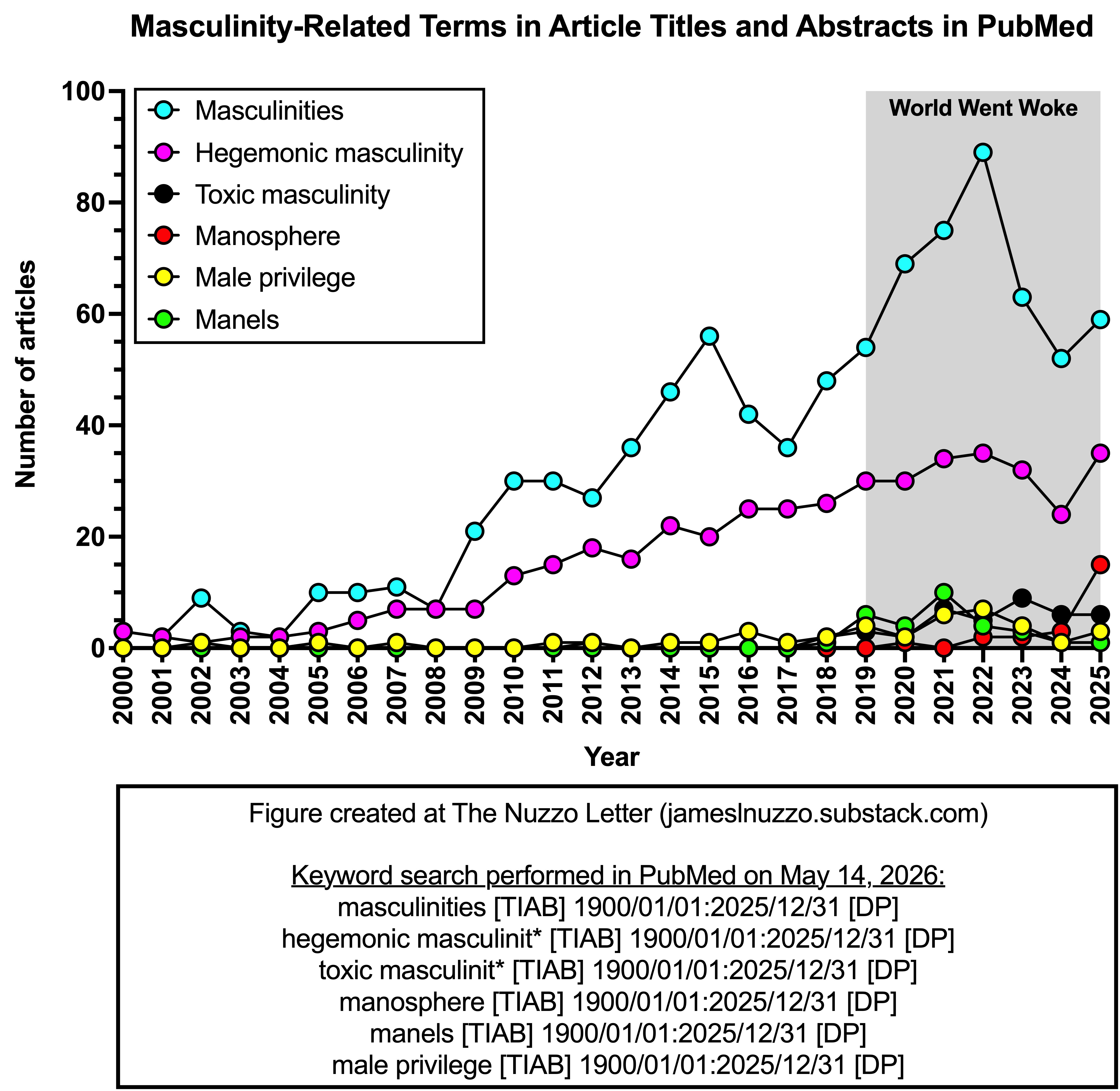
As shown in the graph above, the topic of “masculinity” has received significant attention from academia in recent years. The graph below shows how often subtopics in Masculinity Studies have been referred to in articles indexed in PubMed.
Between 2019 and 2025, the phrase “hegemonic masculinity” (i.e., the dominance of men and the subordination of women) appeared in the titles or abstracts of 220 articles indexed in PubMed; the phrase “toxic masculinity” appeared in the titles or abstracts of 38 articles; the word “manosphere” appeared in the titles or abstracts of 23 articles (15 in 2025); the word “manels” appeared in the titles or abstracts of 29 articles (10 in 2021); and the phrase “male privilege” appeared in the titles or abstracts of 27 articles.
Menstrual and Reproductive Justice
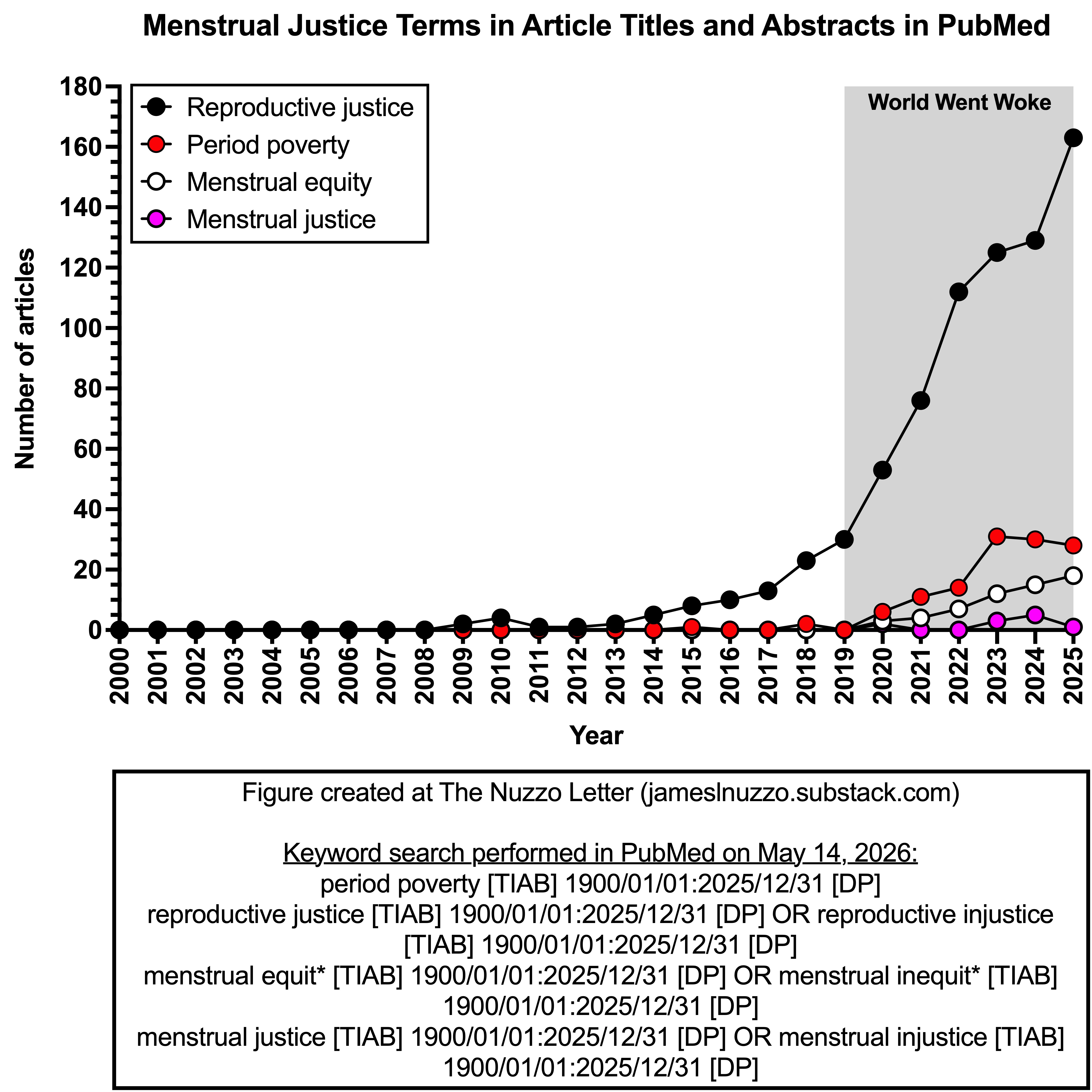
“Reproductive justice,” and more recently “menstrual justice,” are key issues for feminists.
Use of the phrase “reproductive justice” in articles indexed in PubMed began to accelerate in 2020 and has risen markedly in most years since 2020. Between 2019 and 2025, the phrase “reproductive justice” appeared in the titles or abstracts of 688 articles indexed in PubMed.
Use of the phrases “period poverty,” “menstrual justice,” and “menstrual equity” increased most noticeably between 2002 and 2025.
Multiculturalism
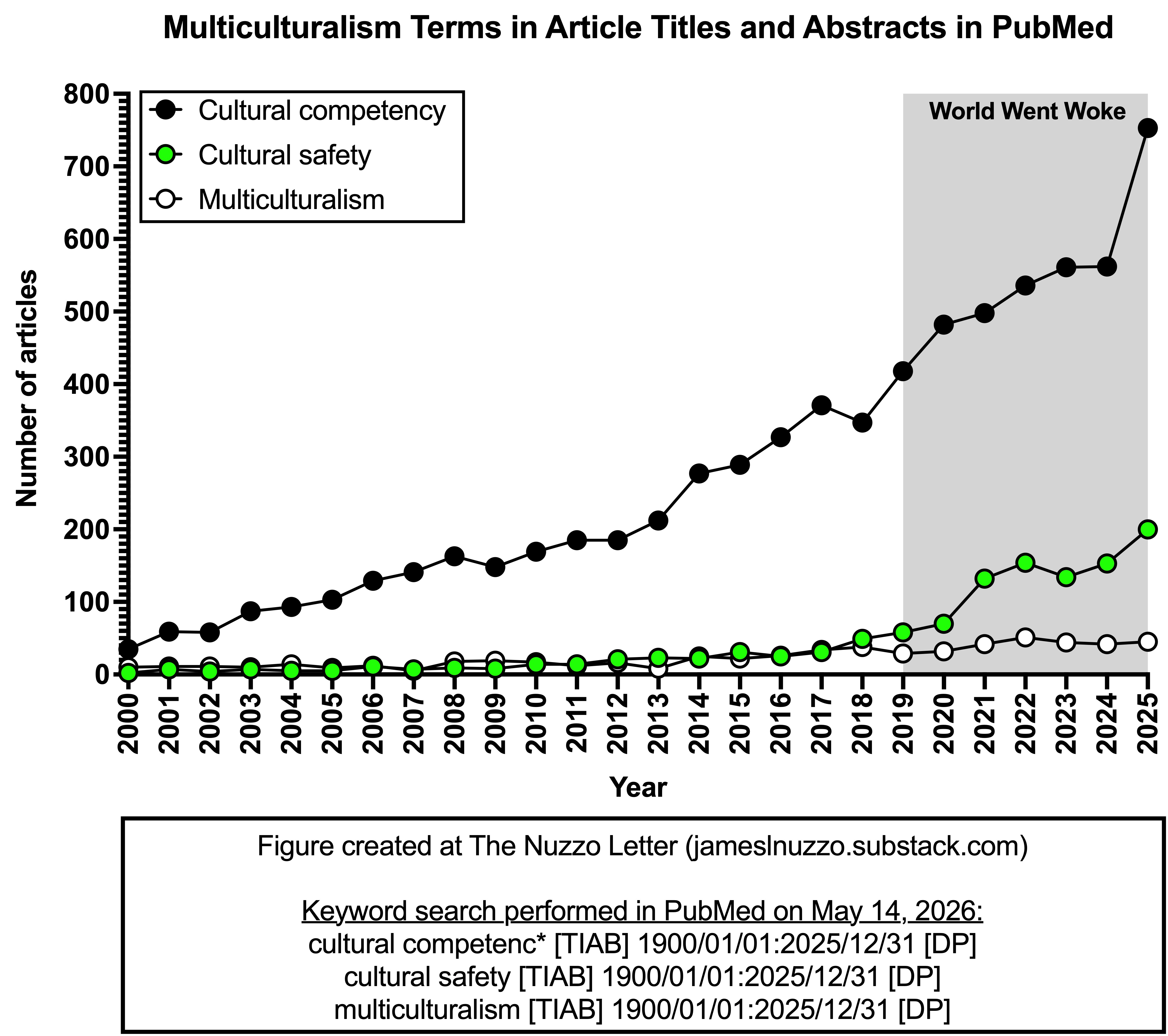
Part of Woke involves a belief that cultures associated with oppressed/”marginalized” groups are as valid, ethical, and important (if not more so) than the culture of the oppressor group. Thus, part of Woke medicine involves teaching students about multiculturalism via “cultural competency” training and assessments.
“Cultural safety” refers to the idea that people from “marginalized” groups are likely to feel unsafe around individuals of an oppressor group and that students and employees must undergo “cultural competency” training to make individuals from “marginalized” groups feel safer.
Notable increases in use of the phrases “cultural competency” and “cultural safety” were observed between 2019 and 2025, with a substantial increase in reference to “cultural competency” in 2025.
Oppression
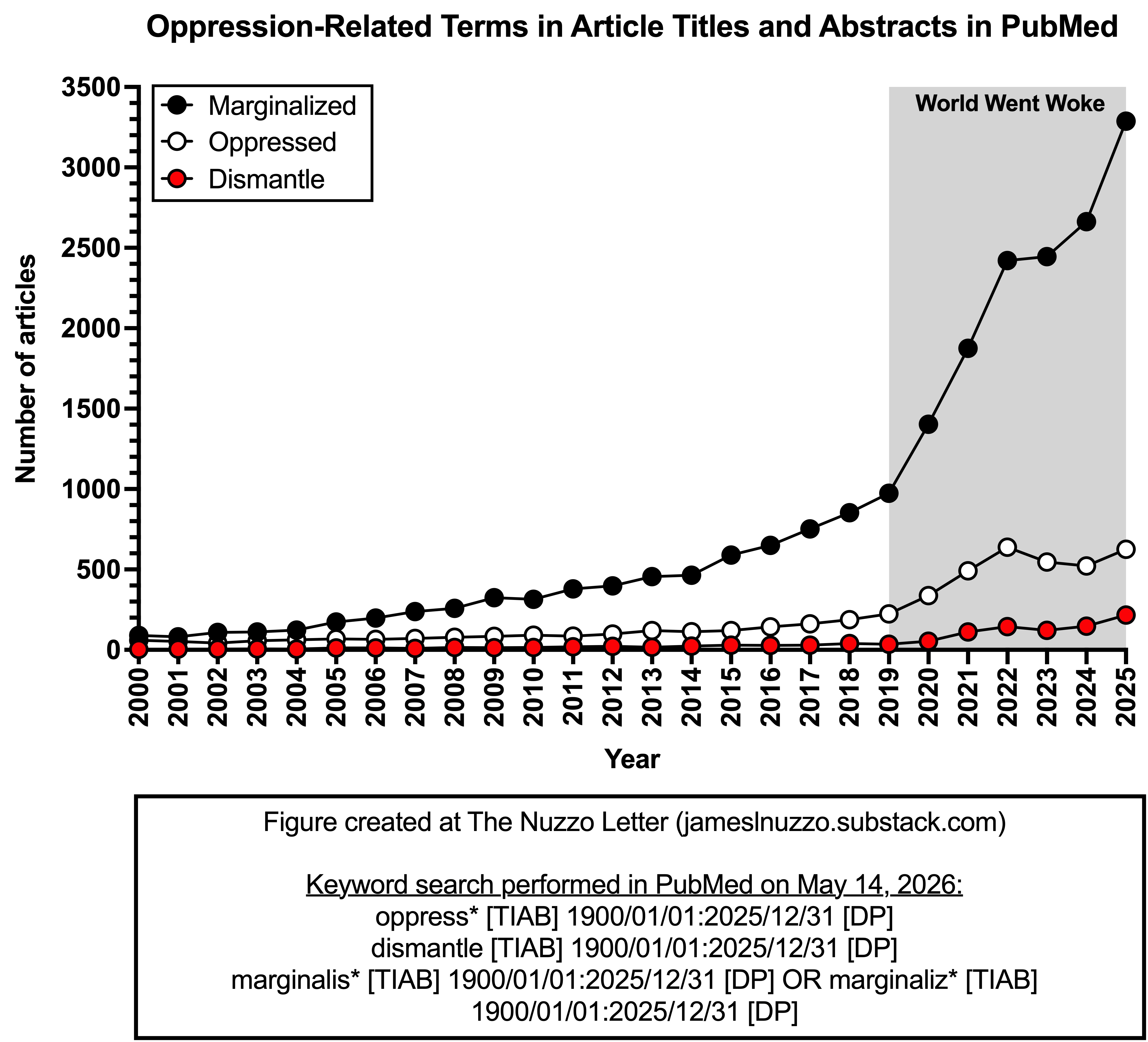
Within intersectionality, the greater the number of “marginalized” identities that a person has, the more they are considered a victim of “oppression.” The purpose of critical theory and social justice work is to “dismantle” the structures that oppress marginalized groups.
A notable increase in use of the word “marginalized” occurred in 2020 and its use has continued to increase since 2020. Between 2019 and 2025, the word “marginalized” appeared in the titles or abstracts of 3,387 articles indexed in PubMed.
People (Woke Theorists / Critical Philosophers)
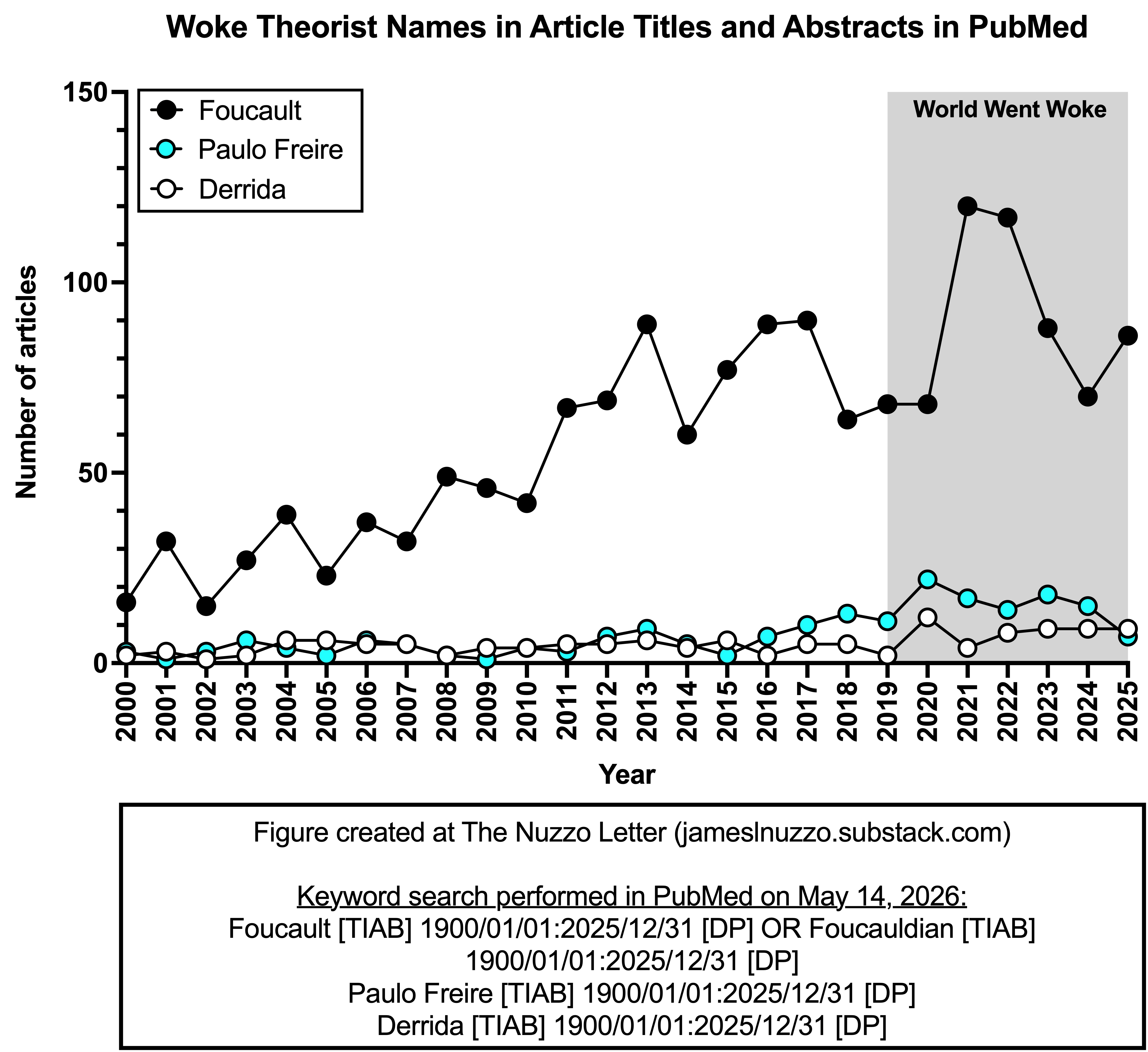
A couple of individuals whose thinking underlies critical theory are Michael Foucault, Paulo Freire, and Jacques Derrida. These three men are referred to regularly in academic papers published in humanities journals, but they also are now referred to in articles indexed in PubMed.
Of the three, Foucault has been mentioned the most. Between 2019 and 2025, Foucault (or “Foucauldian”) appeared in the titles or abstracts of 617 articles indexed in PubMed.
Phobias of Intersectional Groups
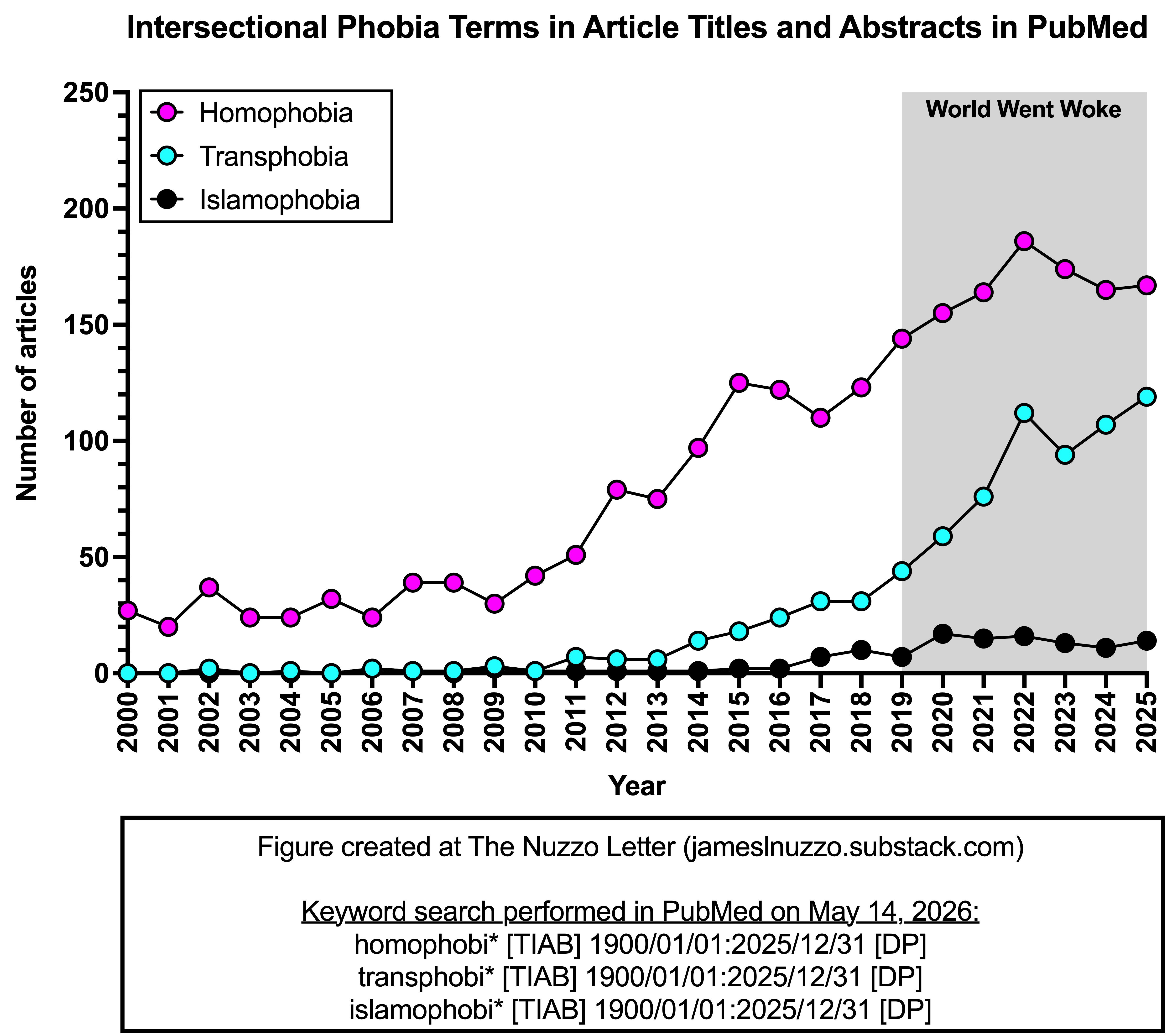
Fear, hatred, or prejudice against “marginalized” groups by oppressor groups is thought to lead to discrimination against marginalized groups, leading to their continued oppression. “Homophobia,” “transphobia,” and “Islamophobia” are examples.
As can be seen in the graph below, interest in “homophobia” pre-dates the contemporary era of Woke medicine. However, “transphobia” parallels the heightened interest in transgender persons that has occurred in the era of Woke medicine. Between 2019 and 2025, the word “transphobia” appeared in the titles or abstracts of 611 articles indexed in PubMed.
“Islamophobia” has been referred to less often than “homophobia” and “transphobia” in articles indexed in PubMed.
Race Differences
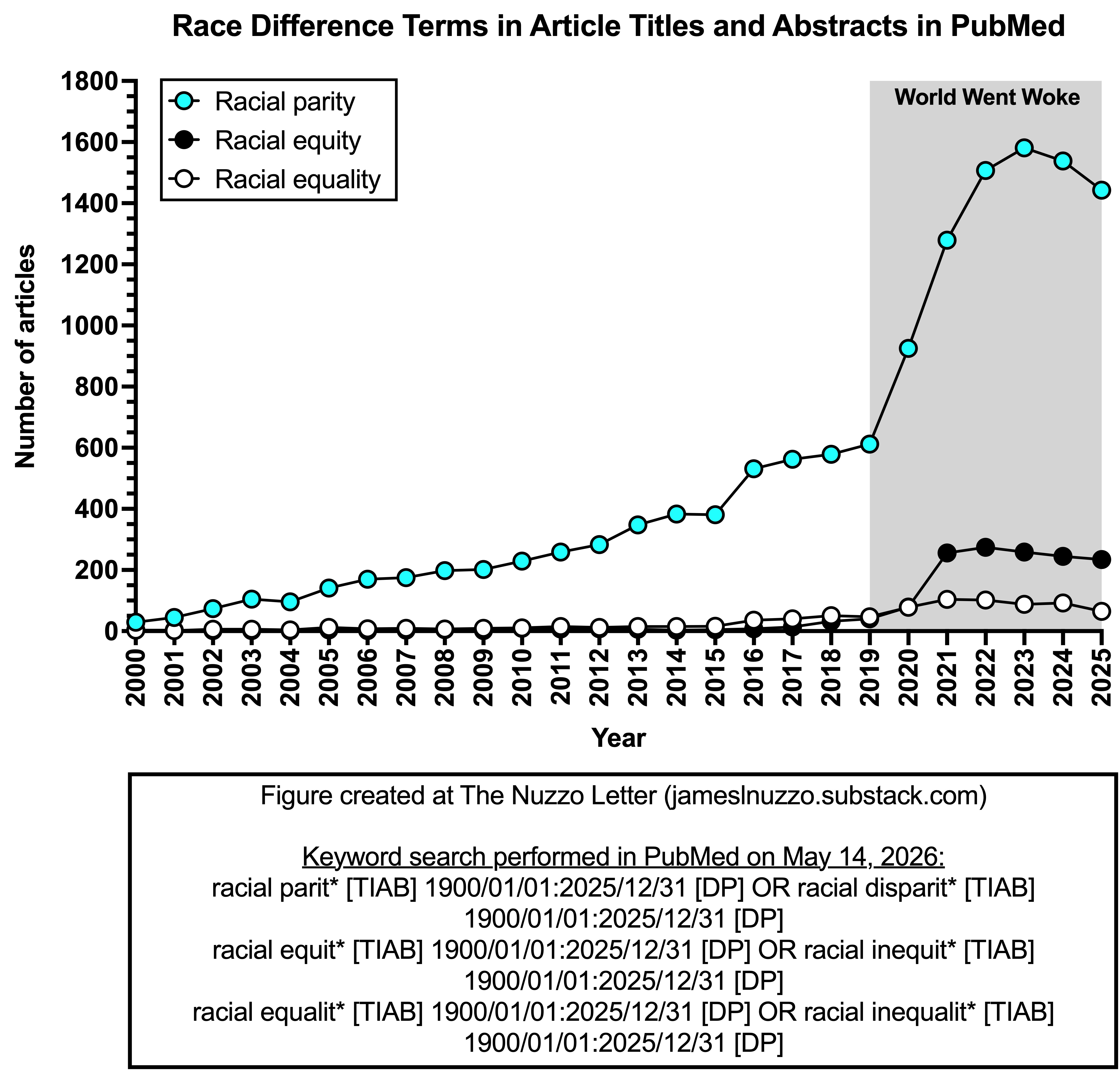
The concepts “parity,” “equity,” and “equality” are often applied to differences in health outcomes between groups of different races or ethnicities. These racial differences in health outcomes are fundamental to Woke medicine.
As seen in the graph below, a significant increase in use of the phrase “racial disparity” occurred in 2020. Its use peaked in 2023 and then trended downward in 2024 and 2025, albeit at still much higher levels than before 2020.
Use of the phrase “racial equity” increased markedly in 2021 and then plateaued.
Use of the phrase “racial equality” has been less common than use of the phrase “racial equity” since 2021.
Racism
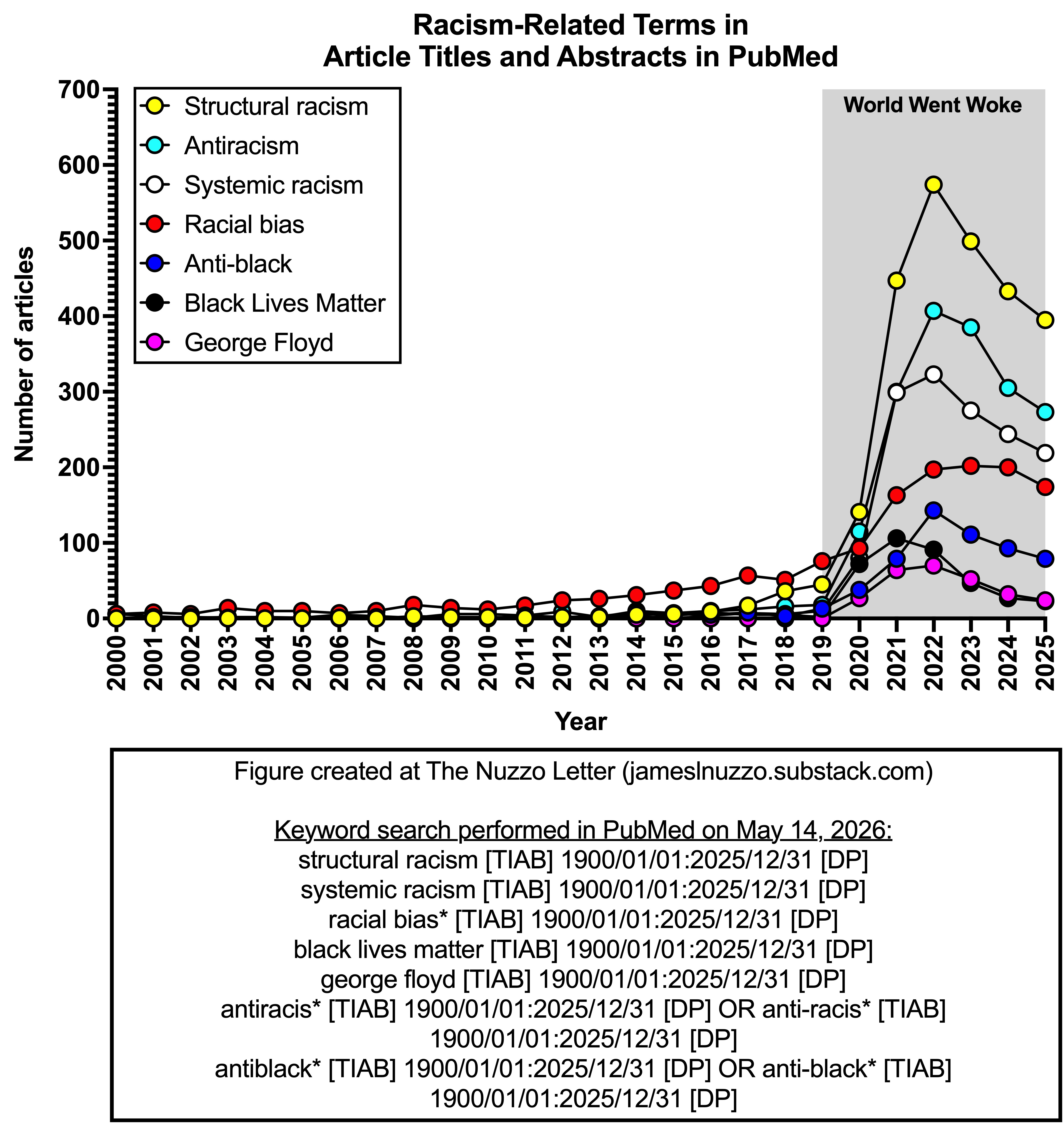
The death of George Floyd in May of 2020 was a key cause of heightened Woke culture in academia. Floyd’s death markedly increased discussions on race in academia, including in health and medical journals. In fact, George Floyd’s name appeared in the titles or abstracts of 269 articles indexed in PubMed between 2020 and 2025. Similarly, the phrase “Black Lives Matter” appeared in the titles or abstracts of 343 articles indexed in PubMed between 2020 and 2025, with a peak in its use in 2021.
The terms “antiracism” and “systemic racism” also saw increased use after Floyd’s death, with peaks in their use occurring in 2022.
Social Determinants of Health
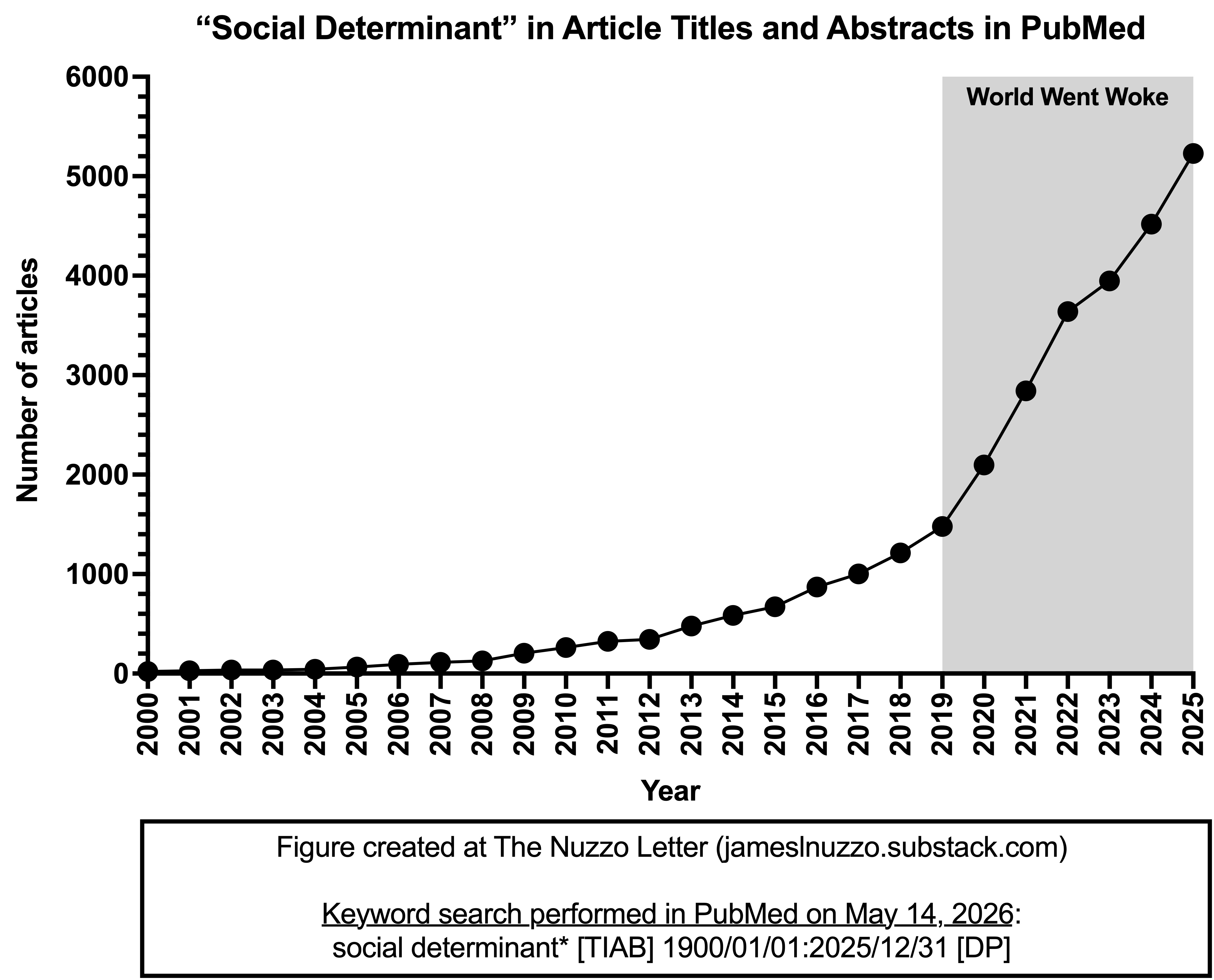
In a previous post, I discussed the politicized public health movement known as the “social determinants of health.” The World Health Organization’s crusade on the “social determinants of health” predates the modern Woke medicine movement, which is why regular use of the phrase “social determinant” appears prior to 2019. However, from 2019 to 2020, one can see accelerated use of this phrase in the titles and abstracts of articles indexed in PubMed. This happened because the “social determinants of health” movement has, for most of its history, been associated with the concept of “health equity” and other aspects of Woke medicine.
Between 2019-2025, the phrase “social determinant” appeared in the titles or abstracts of 23,756 articles indexed in PubMed.
Social Justice
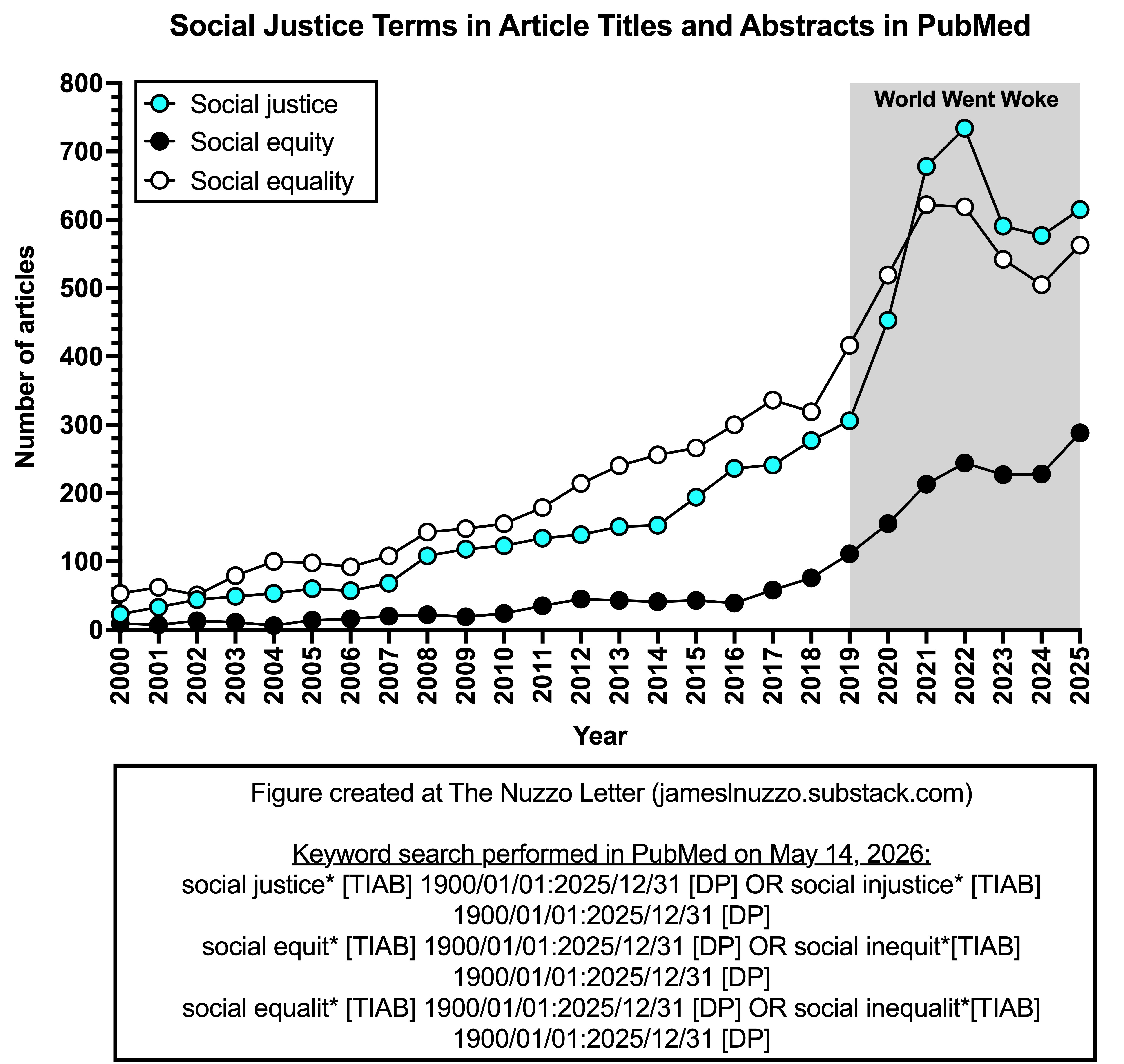
A goal of critical theory is to achieve “social justice,” including in health and medicine.
The phrase “social justice” was used in medical and health research papers prior to 2019, but its use accelerated in 2020. Its use peaked in 2022, and after a decline, its used has plateaued over the past couple of years at about 600 articles per year. Between 2019 and 2025, the phrase “social justice” appeared in the titles or abstracts of 3,954 articles indexed in PubMed.
The phrases “social equity” and “social equality” have also appeared in the titles and abstracts of hundreds of articles indexed in PubMed.
Weight Bias
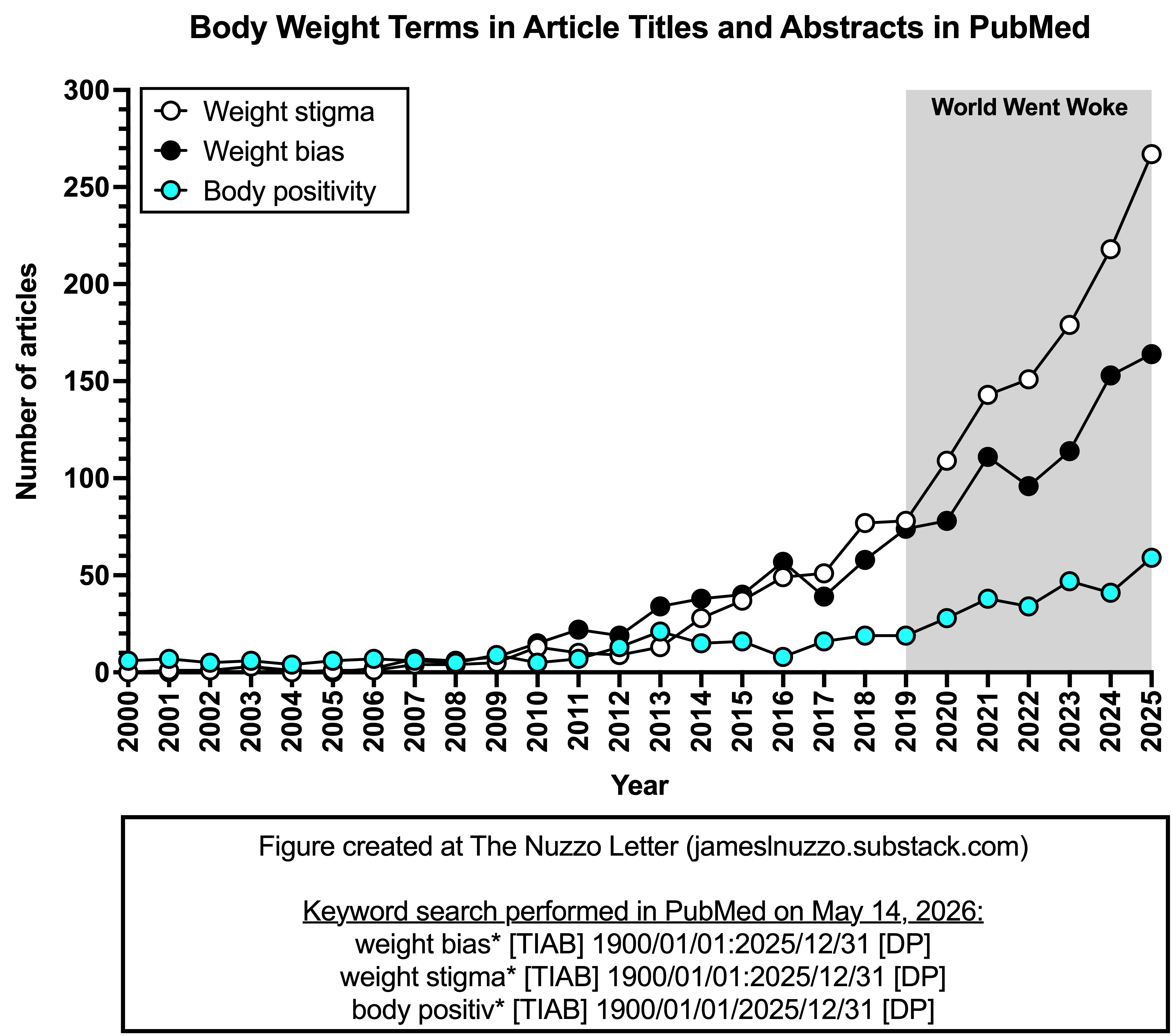
“Body positivity,” “weight stigma,” and “weight bias” are all part of the Woke medicine lexicon, though weight stigma and weight bias have potential to be used in politically neutral ways. “Fat acceptance,” “fat inclusivity,” and “fatphobia” are other related concepts.
Use of “weight stigma” and “weight bias” in articles in indexed PubMed has been increasing for many years, with noticeable increases occurring around 2020 and 2021.
Whiteness
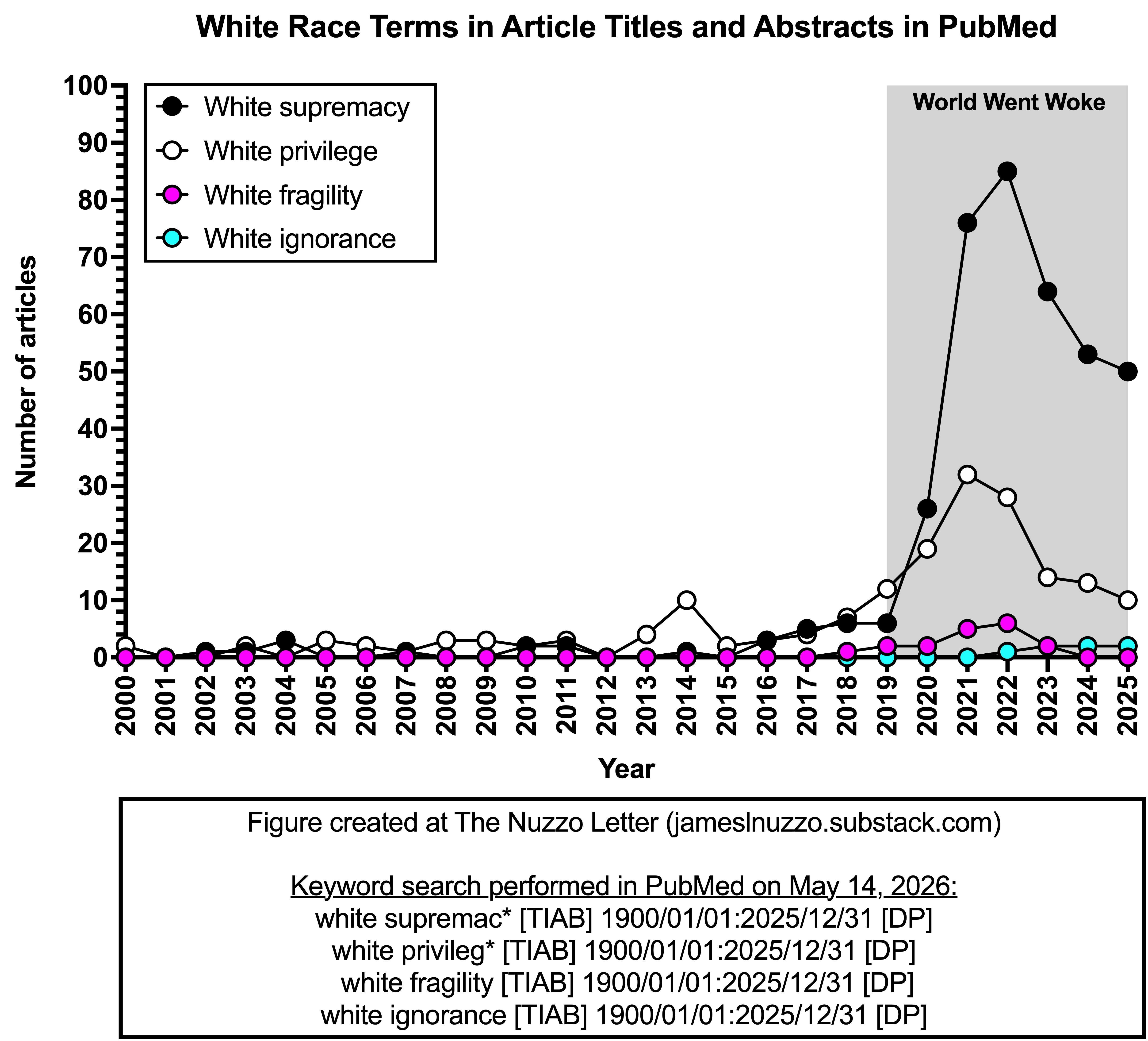
White Studies and Whiteness are part of critical theory. The graph below shows the use of related terms in articles indexed in PubMed.
A marked increase in the use of the phrase “white supremacy” occurred in 2020, and its use peaked in 2022. Between 2019 and 2025, the phrase “white supremacy” appeared in the titles or abstracts of 360 articles indexed in PubMed.
Use of the phrase “white privilege” followed a trend similar to that of “white supremacy,” albeit to a lesser magnitude. Between 2019 and 2025, the phrase “white privilege” appeared in the titles or abstracts of 128 articles indexed in PubMed.
Use of the phrase “white fragility” peaked in 2022, appearing in the titles or abstracts of six articles indexed in PubMed that year.
Bonus Commentary
This scientometric analysis confirms the timeline of the rise of Woke medicine. The exponential increase in Woke medicine started around 2019-2020 and was associated with the COVID-19 pandemic (January 2020), the death of George Floyd (May 2020), and the 2020 U.S. presidential election (November 2020). Once the Biden White House was in place, further increases in the growth of Woke medicine occurred. Substantial government funding for research on the “social determinants of health” and related topics likely facilitated the growth of Woke medicine. However, under the new directorship of Jay Bhattacharya, the NIH began cutting its funding of Woke medicine in 2025. Thus, in the coming years, as funds for this type of research began to dry up, we can expect to see a decrease in the number of articles indexed in PubMed that contain Woke nomenclature in their titles or abstracts.
The results from the current analysis are broadly consistent with results from two other similar reports. A report published by the Institute of Public Affairs (IPA) in April of 2025 presented results from keyword searches in Google of 20 Woke words and phrases. Like the current analysis, the IPA found an exponential increase in the use of these terms around 2020-2021, with peak Woke occurring in 2023. A report published by the Manhattan Institute in April of 2025 presented results from keyword searches of 12 Woke words in the archives of The New York Times. The results tended to show a peak in the use of the words in 2020 (see Figure 29 in the report). Thus, the results published by the Manhattan Institute and IPA suggest that peak Woke has been reached. However, the current scientometric analysis, which examined academia’s use a wide range of Woke concepts in health and medical research papers, revealed that certain Woke topics have peaked, while others are still rising. Topics that are clearly still rising include “health equity,” “social determinants of health,” “intersectionality,” “lived experience,” “reproductive justice,” “Indigenous knowledge,” “cultural competency,” and “climate crisis.” Moreover, though some topics appear to have peaked, reference to them remains well above pre-2019 levels. Thus, some aspects of Woke medicine might have peaked, but Woke medicine is still widespread.
Finally, the ideas underlying Woke medicine have likely caused substantial misallocation of funds and thus harmed patients. Consequently, a shift away from identity politics in medicine is necessary. A focus on the individual patient, in all their physiological and psychological nuance, is a healthier, more ethical, and less polarizing way to move forward. For additional critiques of Woke medicine, see works by Do No Harm, Critical Therapy Antidote, Steve Stewart-Williams, and Sally Satel.
Related Content at The Nuzzo Letter



SUPPORT THE NUZZO LETTER
If you appreciated this content, please consider supporting The Nuzzo Letter with a one-time or recurring donation. Your support is greatly appreciated. It helps me to continue to work on independent research projects and fight for my evidence-based discourse. To donate, click the DonorBox logo. In two simple steps, you can donate using ApplePay, PayPal, or another service. Thank you!
WOW suspicions ‘justified’ by the data, crazy times laid bare. Can our western society revert to an equilibrium?
The steep rise coinciding with people being forced to stay home on their couches often against their will, is striking. Excellent piece Jim