
NIH Funding of Menopause Research, 2007-2024
Graph of the Week
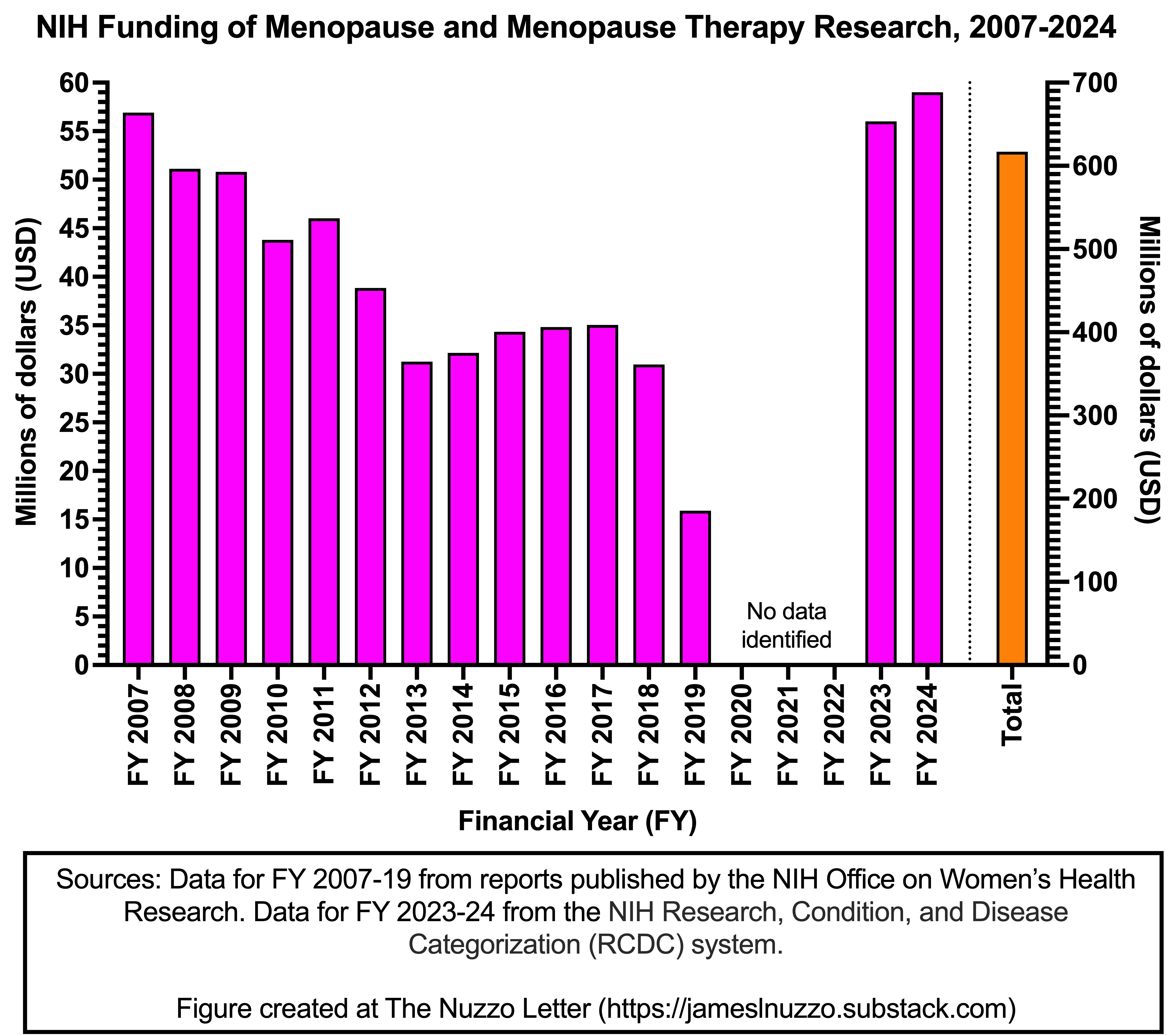
This week’s graph shows the amount of money that the United States (U.S.) National Institutes of Health (NIH) has invested into menopause and menopause therapy research between financial years (FY) 2007-2024. The annual funding amounts (pink bars) align with the scale of the left y-axis. The orange bar on the far right represents total funding between FY 2007-2024. The orange bar aligns with scale of the right y-axis. I was unable to find data for FY 2020-2022. Thus, the total funding amount (orange bar) underestimates the actual amount of NIH funding of menopause and menopause therapy research between FY 2007-2024.
Key Points
For most years between FY 2007-2024, the NIH invested $30-55 million in menopause and menopause therapy research.
The total funds invested by the NIH in menopause and menopause therapy research across the 15 years for which data were available was $617 million.
Sources
FY 2007-2019: Reports published by the NIH Office on Women’s Health Research
FY 2023-2024: NIH Research, Condition, and Disease Categorization (RCDC) system
NB. In reports from the NIH Office on Women’s Health Research, separate funding amounts are listed for (a) menopause research and (b) menopause therapy research. In the above graph, these two funding amounts were summed to represent menopause research for a given year.
Bonus Commentary
Menopause is a normal part of aging for women. It is the stage in life when a woman’s menstrual period ends. Physical and mental health symptoms experienced by women during menopause range considerably. According to the National Institutes of Aging, the most common symptoms include “hot flashes, night sweats, trouble sleeping, joint and muscle discomfort, pain during sex, moodiness and irritability, forgetfulness, difficultly concentrating, or a combination of these.”
Menopause is a women’s health issue that warrants attention. Unfortunately, some women’s health advocates wrongly portray the funding history of this health area. For example, one medical practitioner on X, who labels herself a “misinfo fighter,” recently claimed that there is “[a]lmost no research” on menopause. When I confronted this woman with some of the above funding data, and with data on the number of research articles indexed in PubMed on menopause, the woman deflected the conversation, while not taking personal accountability for her misinformation. Another X user attempted to defend the woman by referencing an anonymous editorial published in Nature. The editorial stated that “[t]he NIH established a category for menopause research in 2023...,” and the implication of the statement was that prior to 2023, the NIH was operating unaware of how much money (if any at all) it was investing into menopause research. However, this editorial statement contradicts the fact that biennial reports published by ORWH regularly included menopause and menopause therapy as NIH-funded categories. The menopause category first appears in the NIH Research, Condition, and Disease Categorization (RCDC) system in 2023, but, clearly, the NIH’s ORWH was categorizing menopause research for many years prior to 2023. By not revealing this information, the anonymous author of the editorial deceived readers, like the X user, into thinking that the NIH only became interested in menopause in 2023. (By the way, I have previously written about why anonymous editorials are a problem in academic publishing.) Thus, the claim that there is a lack of research on menopause is inaccurate, and the claim fits with the array of other inaccurate claims made about women’s health over the past 30 years.
Finally, individuals who make such inaccurate claims do not seem to understand the damming nature of their own inaccurate claims. The NIH has spent billions of dollars on women’s health research over the past 35 years, and the NIH houses the ORWH. A main function of the ORWH has been to promote and coordinate efforts across the NIH to advance research on women’s health. Thus, if after all the billions of dollars spent on women’s health under the direction of ORWH, we still do not know anything about menopause or other women’s health conditions (e.g., endometriosis), then that is an indictment of the public health bureaucracy (most of which is made up of women) and its ineffectiveness to advance knowledge of women’s health.
Related Content at The Nuzzo Letter


SUPPORT THE NUZZO LETTER
If you appreciated this content, please consider supporting The Nuzzo Letter with a one-time or recurring donation. Your support is greatly appreciated. It helps me to continue to work on independent research projects and fight for my evidence-based discourse. To donate, click the DonorBox logo. In two simple steps, you can donate using ApplePay, PayPal, or another service. Thank you!

Amazing. Evidence is seen as challenge and challenge is seen as attack. You simply cannot win.
Thanks for this Jim. Good to know the truth.
It occurs to me, that if money is handed out then it signals how important that Cause is, but, there can never be enough money given because then the victim status is lost. Therefore, more money is required to be handed out to prove that the Cause is worthy!