
Online Harassment Victimization
Graph of the Week
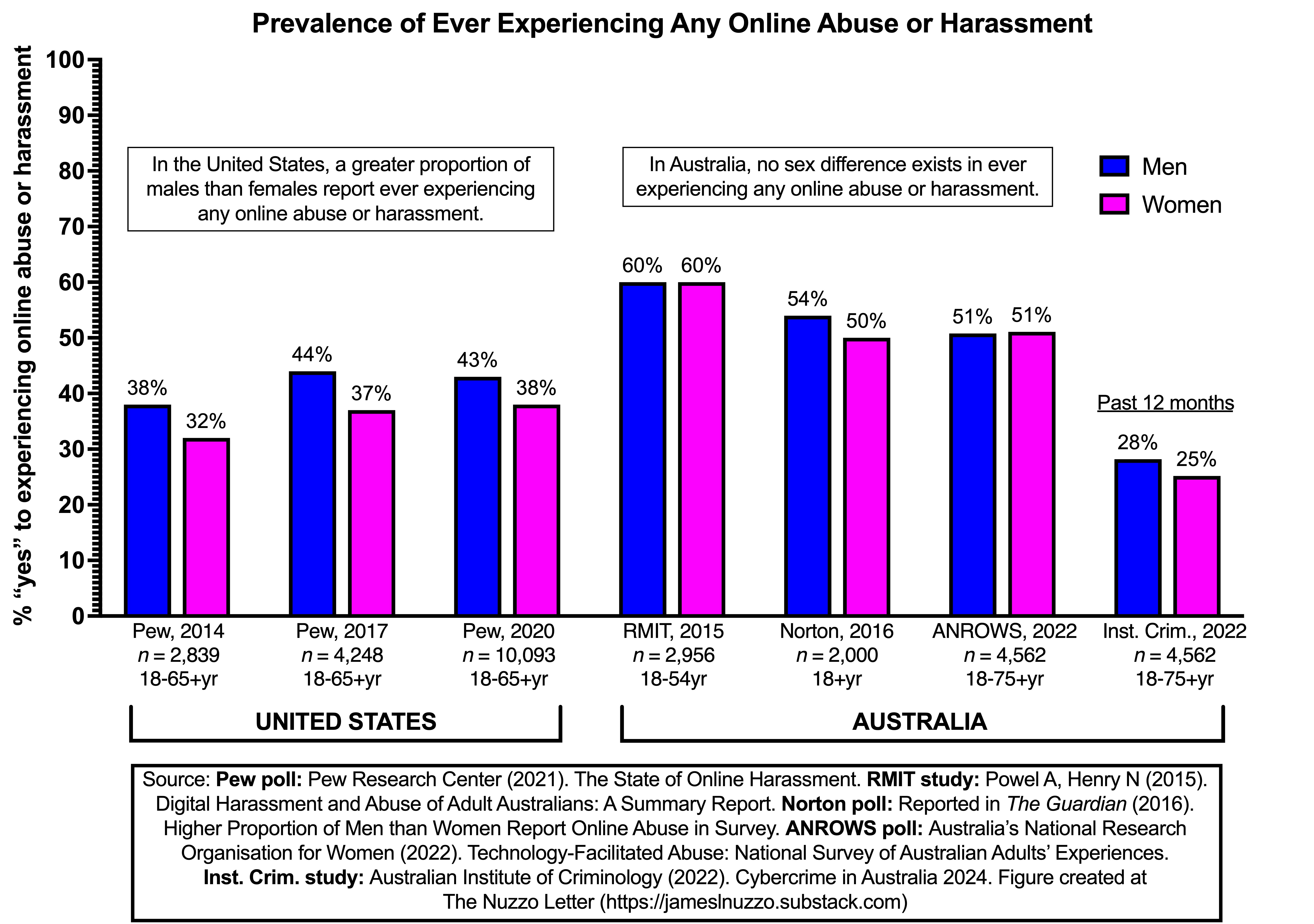
This week’s graph shows sex-specific prevalence rates of online abuse and harassment victimization, as measured in population-level surveys in Australia and the United States (U.S.).
Key Points
In the U.S., polls conducted by the Pew Research Center in 2014, 2017, and 2020 have consistently shown that men are more likely than women to report having ever experienced any form of online abuse or harassment. In 2020, 43% of men and 38% of women in the U.S. reported having experienced at least one form of online abuse or harassment in their lifetimes.
In Australia, four population-level surveys conducted between 2015 and 2022 have found either (a) no sex difference in the prevalence of ever having experienced any form of online abuse or harassment, or (b) men are slightly more likely than women to have ever experienced any form of online abuse or harassment.
Sources
Powel A, Henry N (2015). Digital Harassment and Abuse of Adult Australians: A Summary Report.
The Guardian (2016). Higher Proportion of Men than Women Report Online Abuse in Survey.
Australia’s National Research Organisation for Women (ANROWS) (2022). Technology-Facilitated Abuse: National Survey of Australian Adults’ Experiences.
Australian Institute of Criminology (2022). Cybercrime in Australia 2024.
Pew Research Center (2021). The State of Online Harassment. [*Note: the Pew Research Center conducted polls in 2014, 2017, and 2020. In the report associated with the 2020 poll, Pew published reweighted results from the 2014 and 2017 polls. The graph above displays the reweighted results from the 2014 and 2017 polls. The reweighting decreased the 2014 prevalence rates of ever experiencing any online abuse or harassment (originally 44% for men and 37% women) but did not change the 2017 prevalence rates.]
Bonus Commentary
Groups like the United Nations (UN) and Australian eSafety Commissioner’s office frame online abuse and harassment as impacting only or predominantly girls and women. As shown in the graph above, population-level surveys on online abuse and harassment in the U.S. and Australia have repeatedly shown that online abuse and harassment victimization rates are either slightly lower among women than men or there is no sex difference in prevalence rates.
These survey studies have also asked about specific forms of online abuse and harassment. Results from these questions have also revealed data that do not fit the narratives pushed by groups like the UN. For example, Pew polls have consistently shown that men are more likely than women to be called offensive names online, be physically threatened online, and be purposefully embarrassed online, whereas women are more likely than men to be sexually harassed online. No sex differences in prevalence rates have been reported for being stalked online or experiencing continued harassment online. The specific results from the Pew polls are listed below:
Called offensive names online – ever in lifetime
· Men: 27%, 30%, 35% (2014, 2017, 2020)
· Women: 19%, 23%, 26% (2014, 2017, 2020)
Physically threatened online – ever in lifetime
· Men: 9%, 12%, 16% (2014, 2017, 2020)
· Women: 5%, 8%, 11% (2014, 2017, 2020)
Purposefully embarrassed online – ever in lifetime
· Men: 21%, 24%, 28% (2014, 2017, 2020)
· Women: 17%, 21%, 25% (2014, 2017, 2020)
Sexually harassed online – ever in lifetime
· Men: 4%, 4%, 5% (2014, 2017, 2020)
· Women: 6%, 8%, 16% (2014, 2017, 2020)
Stalked online – ever in lifetime
· Men: 6%, 6%, 9% (2014, 2017, 2020)
· Women: 7%, 8%, 13% (2014, 2017, 2020)
Sustained harassment online – ever in lifetime
· Men: 7%, 8%, 11% (2014, 2017, 2020)
· Women: 6%, 7%, 11% (2014, 2017, 2020)
The survey conducted by the Australia’s National Research Organisation for Women’s Safety (ANROWS) also shows sex differences (and similarities) in prevalence rates of online abuse or harassment, depending on the specific form of abuse or harassment:
Experienced emotional abuse or threats online – ever in lifetime
· Men: 29.8%
· Women: 31.2%
Experienced harassing behaviours online – ever in lifetime
· Men: 29%
· Women: 24.7%
Experienced monitoring or controlling behaviours online – ever in lifetime
· Men: 35%
· Women: 32.6%
Experienced sexual and image-based abuse online – ever in lifetime
· Men: 19.3%
· Women: 28.9%
A selection of other findings from these surveys include the following:
Men are more likely than women to be perpetrators of online abuse and harassment, with female victims more likely to report male perpetrators and male victims equally likely to report female or male perpetrators.
In the Australian RMIT study, 50.4% of all respondents reported a male perpetrator or group of male perpetrators, 21.9% reported a female perpetrator or group of female perpetrators, 15.2% reported a perpetrator group that consisted of both males and females, and the remaining 12.5% did not know the sex of their perpetrator. Also, 68% of females reported a male perpetrator, whereas 32% of males reported a male perpetrator (males experienced roughly equal levels of perpetration from males and females).
In the ANROWS survey, 621.% of all respondents reported a male perpetrator, 31.1% reported a female perpetrator, and 4.3% said they were unsure of the sex of their perpetrator. Also, 77% of women reported a male perpetrator, 17.9% reported a female perpetrator, and 3.3% did not know the sex of their perpetrator. For male victims, 47% reported a female perpetrator, while 43.9% reported a male perpetrator.
Women are more likely than men to find their experience abuse and harassment more upsetting.
In the Australian RMIT study, 56% of women and 36% of men reported being “moderately,” “very,” or “extremely” upset from their experience of online abuse or harassment.
In the Pew polls, 63% of women and 38% men reported by “somewhat,” “very,” or “extremely” upset from their experience of online abuse or harassment.
Related Content at The Nuzzo Letter


SUPPORT THE NUZZO LETTER
If you appreciated this content, please consider supporting The Nuzzo Letter with a one-time or recurring donation. Your support is greatly appreciated. It helps me to continue to work on independent research projects and fight for my evidence-based discourse. To donate, click the DonorBox logo. In two simple steps, you can donate using ApplePay, PayPal, or another service. Thank you!

This brings much-needed clarity, and a distinctly alternative perspective when compared to the UN Women campaign regarding online harassment... The United Nations motto appears to be "never let facts get in the way of a female-focused narrative".
International Council for Men and Boys has endorsed three main goals for reforming the United Nations during 2026:
1. Formal recognition of International Men’s Day by the UN. There are 13 days on the official calendar that observe/celebrate girls and women, but none for boys or men... Half of the world's population deserves to have at least one day that's formally recognised by the United Nations.
https://x.com/RichardvReeves/status/1991903149959832021
2. UN reporting of male and female outcomes for their programs (including the Sustainable Development Goals), in order to bring transparency to the disparities faced by men and boys. The current disclosure is patchy, and is biased towards only pursuing female empowerment. Men and boys matter, as do women and girls.
https://www.menandboys.net/un-2/
3. Endorsement of the New York Declaration for Men and Boys, which commits to 27 actions across the range of disparities that males experience. The Beijing Declaration and Platform for Action on women and girls was adopted by the UN in 1995. After 31 years, it's better late than never to bring equal recognition to the other half of humanity...
https://www.menandboys.net/declaration/
Please add these goals as a call-to-action for all of your campaigning and advocacy relating to the United Nations and UN Women. Together men and women of goodwill can achieve positive change, which benefits everyone...