


On the same day that United States (U.S.) President Donald Trump announced that the U.S. would no longer fund United Nations (UN) Women and several other UN entities, Foreign Affairs published an article by Saskia Brechenmacher, titled “How to Save the Fight for Women’s Rights: The Backlash Against Democracy Calls for New Strategies.”
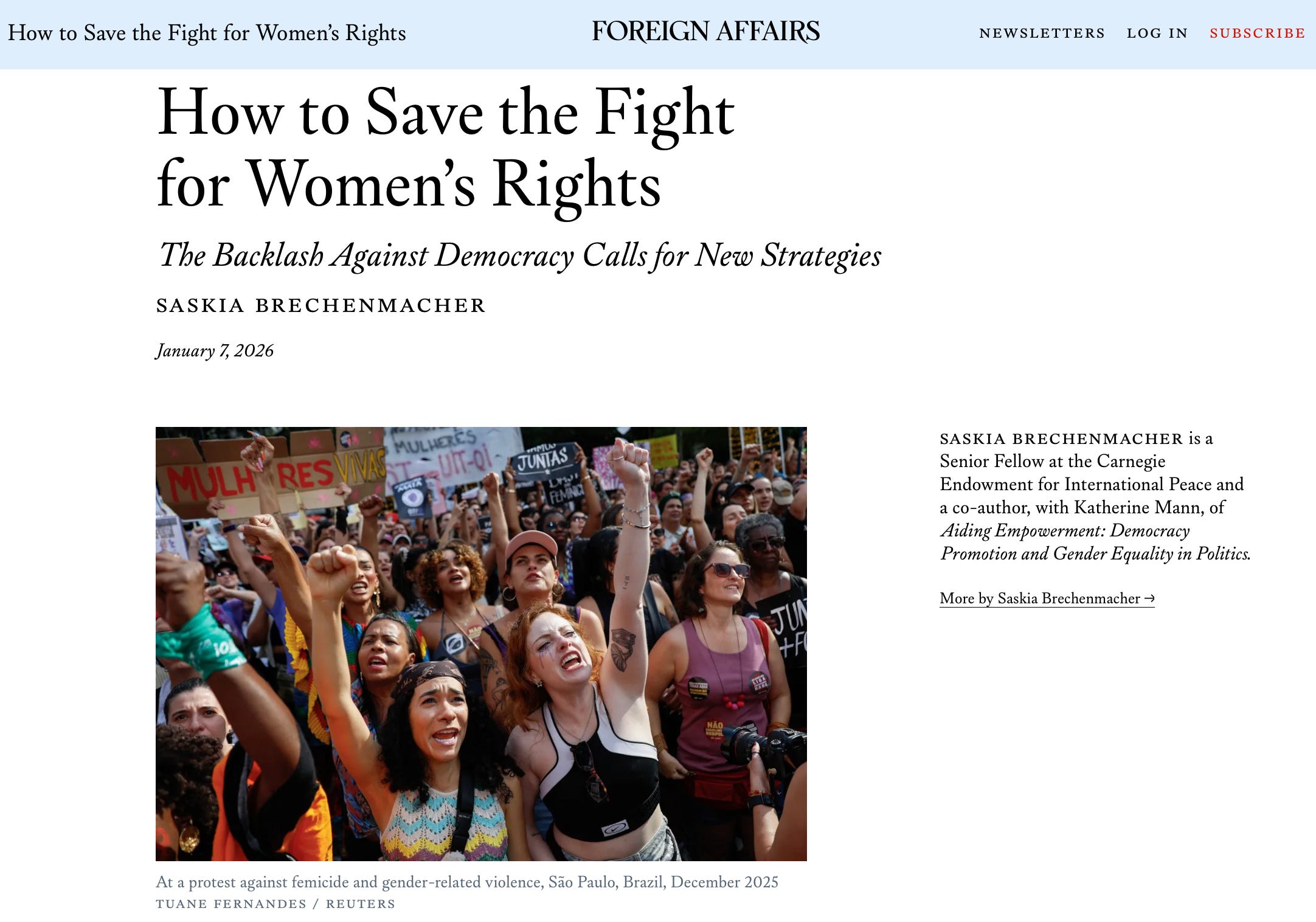
Brechenmacher, who is a senior fellow at the Carnegie Endowment for International Peace, started her article by discussing the “backlash” against feminist movements in 2025, citing a press release from the UN along the way. Brechenmacher then presented a “new template for action” to counter this backlash. Brechenmacher’s template consisted of the following recommendations for feminist groups":1
1. Use “multilateral forums.” (By this, Brechenmacher presumably means the UN and ideologically similar international organizations.)
2. Focus on local level collaborations rather than efforts that are “solely technical and elite-driven.” (That Brechenmacher mentioned the “elitist” nature of previous “gender equality” efforts is an interesting admission.)
3. Invest in initiatives that include men and boys.
4. Connect messaging about women’s empowerment to family well-being, community resilience, and economic stability.
5. Strengthen democratic institutions.
6. Engage with “coalitions of the willing,” which Brechenmacher defines as “smaller circles of governments, civil society groups, and private sector actors that collaborate to tackle specific hurdles to gender equality.” Brechenmacher then lists specific issues that she believes these smaller coalitions should focus on. The examples included: “expanding access to reproductive health care, improving childcare and eldercare systems, tackling young men’s online radicalization, and ensuring artificial intelligence tools are designed and deployed with attention to their different effects on women and men.” Here, Brechenmacher also highlighted the Global Partnership for Action on Gender-Based Online Harassment and Abuse, which started under the Biden White House in 2022 as a coalition of governments, international organizations, and private companies whose aim was to combat technology-facilitated gender-based violence.
Though not stated explicitly, a likely key player in Brechenmacher’s new template for action is UN Women. UN Women was one of the informers of the Global Partnership for Action on Gender-Based Online Harassment and Abuse, and at the end of 2025, UN Women, and the UN more broadly, went on a biased, weeks-long “digital violence” campaign, which refused to acknowledge that boys and men face just as much online abuse and harassment as girls and women.
Brechenmacher and UN Women also share broadly similar views on the “backlash against gender equality.” In 2025, UN Women regularly commented on X about this “backlash,” and toward the end of the year, the UN co-sponsored a meeting of the International Gender Champions (IGC) network. The aim of the meeting was to have a “critical conversation on advancing equality amid a rising tide of organized opposition.” The meeting centred around a report that was published by UN Women and the UN Research Institute for Social Development titled, “Understanding Backlash Against Gender Equality: Evidence, Trends and Policy Responses.” Similar, to Brechenmacher’s article, the report says what the feminist playbook is going to look like in 2026.
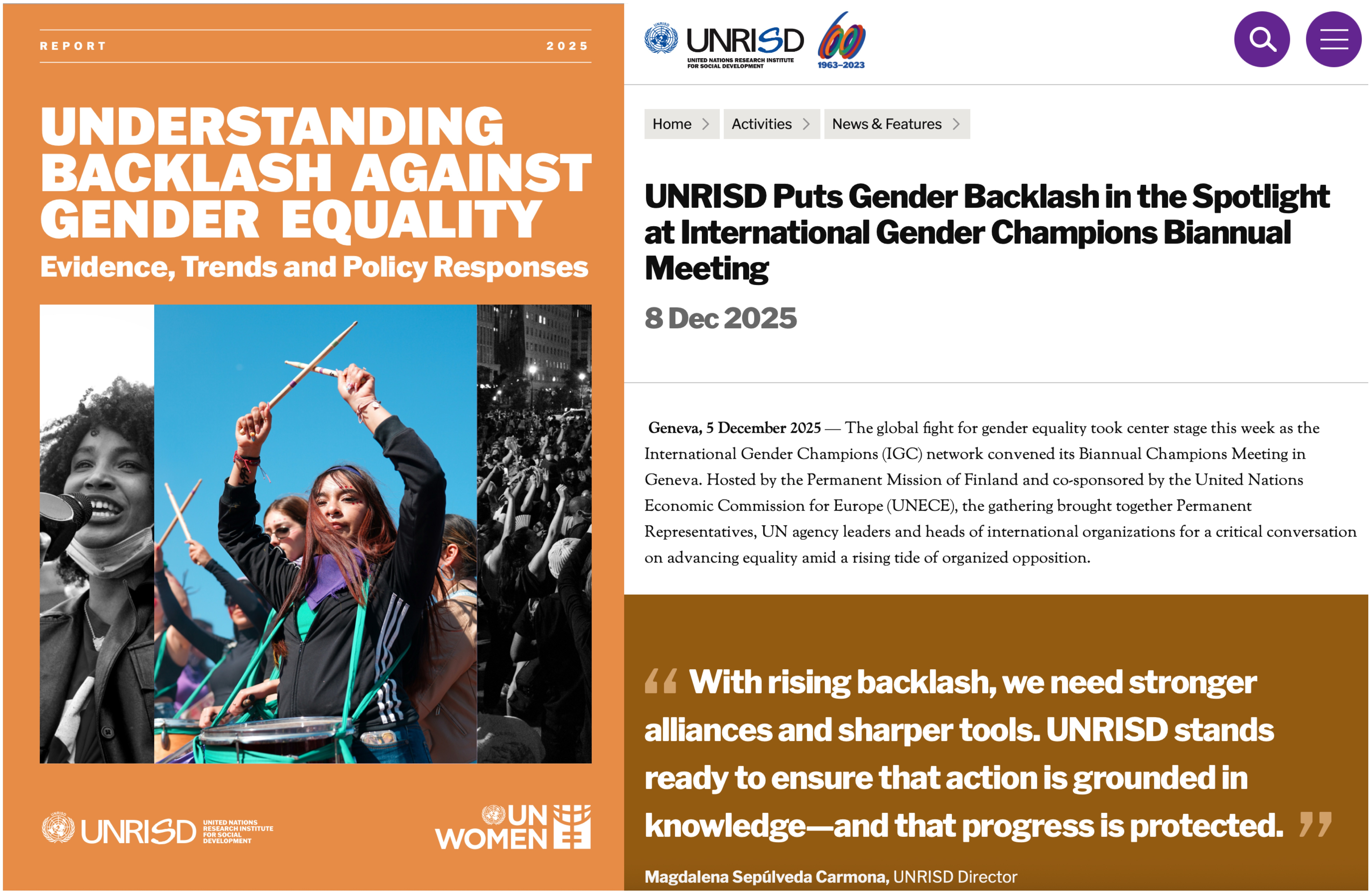
Before revealing that playbook, UN Women’s report first defined what the backlash is. According to UN Women, the backlash is “deliberate, organized attempts to roll back established commitments, rights and achievements in gender equality, women’s rights and women’s empowerment as defined in a given local, national, regional or global context.”
UN Women then identified the people behind the backlash as “networks of old and new conservative actors and men’s rights activists,” who are “rallying around the fight against “gender ideology”” and who are funded by faith-based organizations, conservative religious institutions, far-right politic parties and actors, philanthropic foundations, civil society organizations and high-net-worth individuals. Then, in an ironic act of projection, UN Women accused these groups of using “emotionally laden slogans” that “exploit” the public’s concerns and “[feed] a sense of ‘moral panic’ in societies around highly sensitive…social and economic problems..” The report continues along these lines:
“After instilling a sense of urgency and stoking a moral outcry, anti-gender campaigns position the strengthening of the “traditional family” and/or “the nation” as the solution to social and economic ills. Their vision proposes a return to a real or imagined past where gender hierarchies were accepted and “traditional family models” were based on what they consider to be “natural”, binary and complementary gender roles and identities. Candidates and authorities strategically use these slogans and campaigns to gain or perpetuate themselves in power and divert public attention from their failures in other areas.”
Finally, in the report, UN Women provided its readers with recommendations on how to counter the backlash against “gender equality.” Their recommendations were broadly similar to those proposed by Brechenmacher. A few examples included:
1. “Strengthen broad-based coalitions across countries and in intergovernmental spaces to win over leaders in the “moveable middle””;
2. “[E]nsure human rights and gender equality language is preserved and advanced”;
3. “[S]afeguard gender issues from undue polarization”;
4. “Eliminate, prevent and respond to all forms of intimidation, persecution and violence directed at women in public life, including politicians, journalists and activists, in online and offline spaces”;
5. “Promote and cultivate capacities to develop positive narratives on strategic issues that can expand the reach of feminist and human rights ideas… Positive narratives can, for instance, highlight the benefits gender equality gains bring to wider communities or cast key terms such as “family”, “life” or “care”, used by conservative actors in narrow ways, in a new light”;
6. “Reinforce and create new safe spaces to boost solidarity where feminists can share innovative practices of resistance and assess their effectiveness across settings”;
7. “Support and amplify emerging research on feminist strategies and practices to resist and push forward for gender equality, to understand what works, in which contexts and why.”
In conclusion, feminist leaders are saying out loud what their plan is for 2026. Their base will continue to be large international organizations, and they will target specific issues at a local level. They are going to modify their messaging to be more family friendly, and they are going to continue to try to “engage with boys and men,” with continued focus on “young men’s online radicalization.” They are also planning to continue their campaign on “digital violence” against girls and women. This campaign is going to try to protect female politicians and journalists from justified criticisms of poor performance and will reframe such criticisms as harassment or misogyny.
However, the problem for feminist groups in 2026 is going to be their continued unwillingness to listen, learn, and genuinely reform. Framing legitimate criticisms of their work as “backlash” against “gender equality” is not going to work, and no new “template for action” is going to resolve their unwanted messages, their untenable ideas, their tone deafness, and their misdirected moral compass.
The U.S. is leading the way in saying that “enough is enough” from these groups. In January of 2026, the U.S. announcedthat it would no longer fund UN Women. Later in the month, Israel followed suit, and perhaps some other countries will now also find it easier to cut ties with UN Women. This stranglehold on the money supply to entities like UN Women is the fundamental solution to having more rational and fair discussions about both men’s and women’s issues.
Related Content at The Nuzzo Letter


SUPPORT THE NUZZO LETTER
If you appreciated this content, please consider supporting The Nuzzo Letter with a one-time or recurring donation. Your support is greatly appreciated. It helps me to continue to work on independent research projects and fight for my evidence-based discourse. To donate, click the DonorBox logo. In two simple steps, you can donate using ApplePay, PayPal, or another service. Thank you.

The most relevant text about Brechenmacher’s recommended “new template for action”:
“Faced with a prolonged democratic recession, gridlocked international institutions, and a surge in conservative countermobilization, proponents of gender equality and their governmental supporters need a new template for action. Multilateral forums will remain an important arena for advancing progress and protecting existing achievements. But rather than being solely technical and elite-driven, reformers committed to the women’s rights agenda must expand their efforts, focusing on more collaboration at the local level, investing in initiatives that include men and boys, and connecting messaging about women’s empowerment to family well-being, community resilience, and economic stability.”
“What does this altered landscape mean for gender equality advocacy? Holding the line in multilateral negotiations remains essential to preventing the erosion of existing norms and mobilizing resources to mitigate the devastating impact of abrupt aid cuts on women and girls, particularly in conflict zones. But these efforts should be accompanied by issue-focused “coalitions of the willing”: smaller circles of governments, civil society groups, and private sector actors that collaborate to tackle specific hurdles to gender equality.”
“One recent example is the Global Partnership for Action on Gender-Based Online Harassment and Abuse, a coalition of governments, tech companies, and civil society groups collaborating to combat technology-facilitated gender-based violence, such as the nonconsensual sharing of intimate images and deepfakes. Similar efforts could focus on expanding access to reproductive health care, improving childcare and eldercare systems, tackling young men’s online radicalization, and ensuring artificial intelligence tools are designed and deployed with attention to their different effects on women and men. Regional institutions could also serve as effective loci for such efforts, as could partnerships among major cities or subnational governments to share effective ideas for reform.”
“Funders and governments committed to advancing gender equality also need to act more strategically and with greater urgency to counter movements against gender equality. Given the importance of civic freedoms and political space to meaningful progress for women, strengthening democratic institutions will be an important element of this. Yet focusing only on democracy while neglecting specific initiatives to improve gender equality would be misguided.”


