
Dating App Abuse in Australia
Data Brief
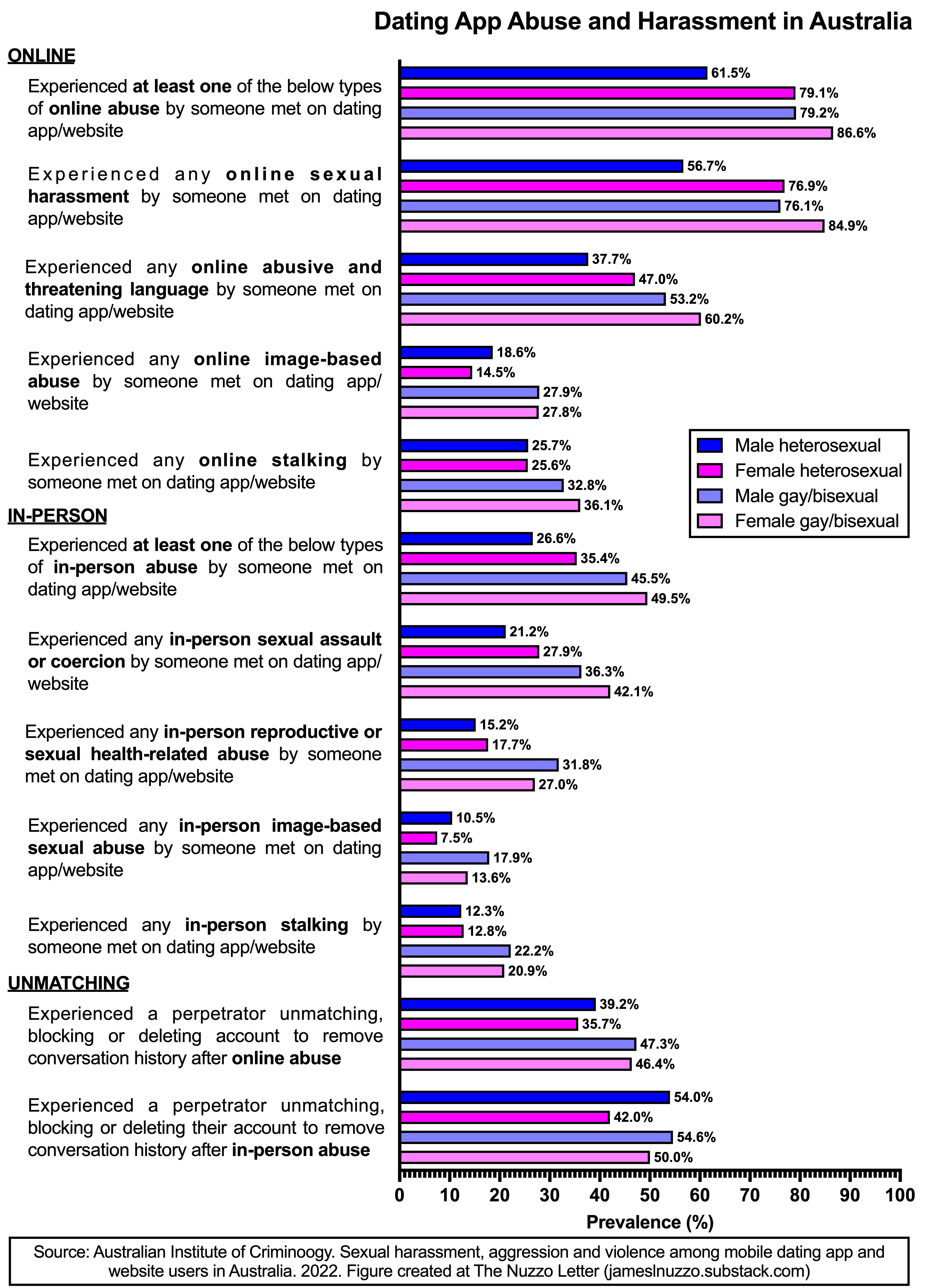
The current data brief summarises results from a survey study conducted by the Australian Institute of Criminology in 2022 on the prevalence of abuse and harassment on dating apps and dating websites. The survey asked about abuse and harassment that occurred (a) on dating apps and websites (i.e., “online”) and (b) in-person after connecting via a dating app or website. The survey also asked about experiencing “unmatching” after being abused or harassed. Here, unmatching refers to whether the perpetrator deleted their account, blocked the victim’s account, or unmatched from the victim’s account after abusing or harassing the victim.
Key Points
The prevalence of experiencing online or in-person abuse or harassment by someone met through a dating app or dating website was often higher among gay and bisexual men and women compared to heterosexual men and women.
In comparing heterosexual men and heterosexual women, some sex differences existed, depending on the specific type of online, in-person, or unmatching behaviours.
A total of 61.5% of heterosexual men and 79.1% of heterosexual women reported experiencing at least one type of online abuse perpetrated by someone they met on a dating app or dating website.
A greater proportion of heterosexual women than heterosexual men reported experiencing online sexual harassment and online abusive language, whereas no sex differences were observed in experiencing online image-based abuse or online stalking.
A total of 26.6% of heterosexual men and 35.4% of heterosexual women reported experiencing at least one type of in-person abuse perpetrated by someone they met on a dating app or dating website.
A greater proportion of heterosexual women than heterosexual men reported experiencing in-person sexual assault or coercion, whereas no sex differences were observed in experiencing in-person reproductive or sexual health-related abuse, in-person image-based abuse, or in-person stalking.
A slightly greater proportion of heterosexual men (39.2%) than heterosexual women (35.7%) reported that a person unmatched them after abusing them online.
A greater proportion of heterosexual men (54.0%) than heterosexual women (42.0%) reported that a person unmatched them after abusing them in-person.
Source
Australian Institute of Criminology. Sexual harassment, aggression and violence among mobile dating app and website users in Australia. 2022.
Bonus Commentary
The results from the above study illustrate that high levels of abuse and harassment exist on dating apps and dating websites. Men and women who are homosexual or bisexual report the highest levels of abuse and harassment on dating apps and websites. Heterosexual women report higher prevalence rates for some, but not all, types of abuse and harassment. In fact, most of the results from the above study refute the common narrative that only women (or predominantly women) are the victims of online abuse and harassment. Just this year, Women’s Agenda was still framingdating apps as “unsafe spaces” only for “women and gender-diverse people.” Moreover, both the Australian eSafety Commissioner and the United Nations have framed online abuse in a female-centred way. Yet, consistent with results from many other surveys, the above results published by the Australian Institute of Criminology confirm that both men and women experience online abuse and harassment, with men sometimes experiencing higher rates of abuse and harassment than women.
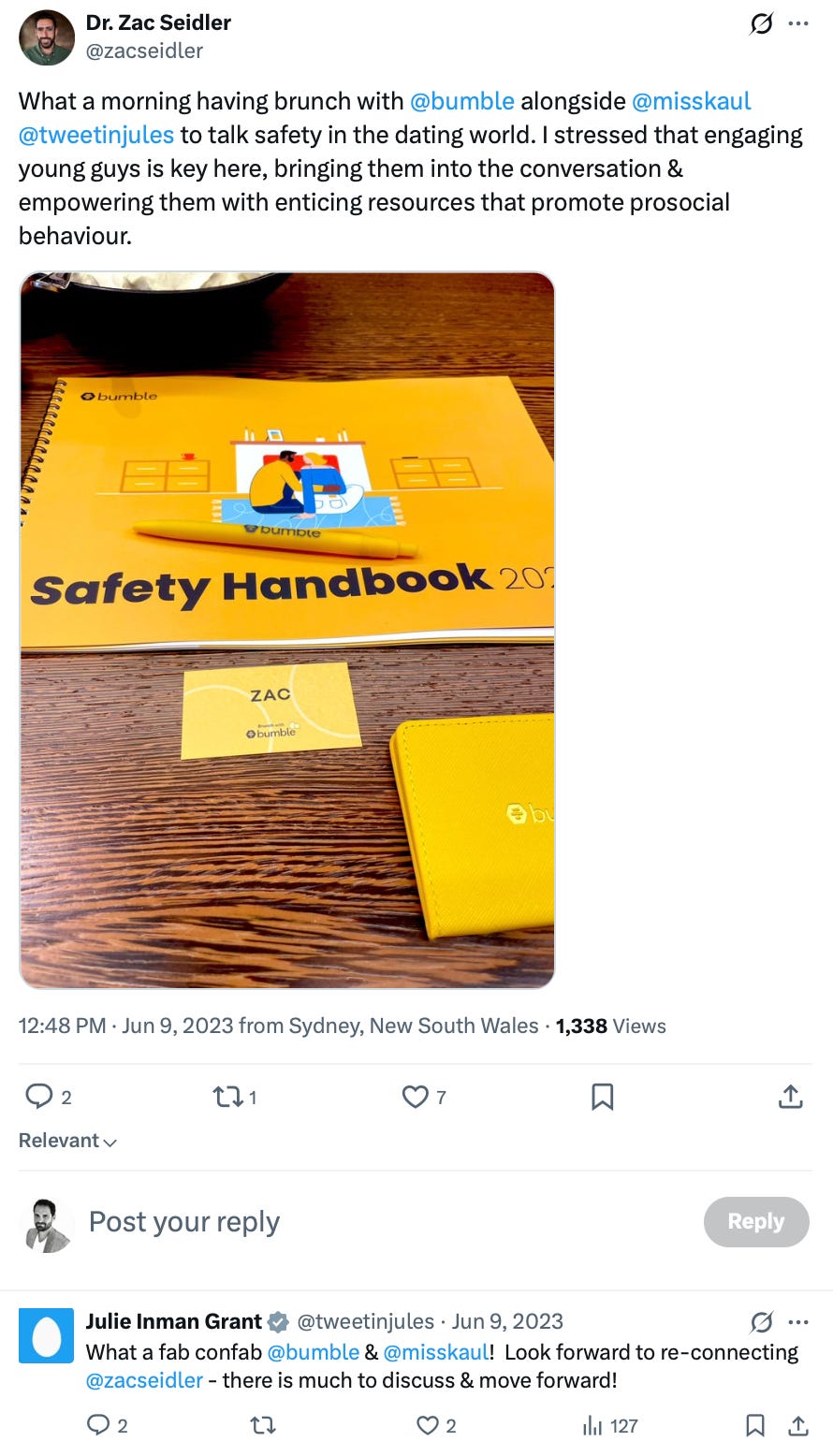
The survey by the Australian Institute of Criminology also reminded of a tweet published by Zac Seidler, Global Director of Research at Movember, in 2023. Seidler had attended a meeting with Bumble – one the world’s most popular and feminist dating apps. In the tweet (shown below), Seidler said that he emphasised at the meeting that “engaging young guys is key” to “promot[ing] prosocial behaviours” on Bumble. From the tweet, it was unclear if Seidler or Bumble also emphasised engaging with women about their anti-social behaviours on dating apps. The data from the Australian Institute of Criminology clearly indicate that anti-social behaviours on dating apps are not limited to one sex. Large numbers of both males and females are perpetrators and victims of such behaviours. Finally, note the comment on Seidler’s tweet and the name of the individual who left the comment. Julie Inman Grant is Australia’s eSafety Commissioner.
Related Content at The Nuzzo Letter


SUPPORT THE NUZZO LETTER
If you appreciated this content, please consider supporting The Nuzzo Letter with a one-time or recurring donation. Your support is greatly appreciated. It helps me to continue to work on independent research projects and fight for my evidence-based discourse. To donate, click the DonorBox logo. In two simple steps, you can donate using ApplePay, PayPal, or another service. Thank you!

Abuse is undefined.
The less defined, the more powerful a cudgel to strike with gamma bias.
"Abuse" = telling a woman the truth.