
What About the 210 Men?
The United Nations continues to suppress male victimization data – this time, as part of its propaganda on online abuse


In April of this year, United Nations (UN) Women published the second report in its “Tipping Point” study series. The report was titled, “Tipping point: online violence impacts, manifestations and redress in the AI age.” The first report, which was published in December of 2025, was titled, “Tipping point: the chilling escalation of online violence against women in the public sphere.”
The “Tipping Point” study focused on “online violence” against human rights defenders, activists, writers, and journalists and other media workers. The study was based on a survey that UN Women administered in 2025. Assistance with the survey was provided by the UN Educational, Scientific and Cultural Organization (UNESCO) and the International Center for Journalists (ICFJ).
In both reports, UN Women showed results from 641 women who answered questions about online abuse and harassment (what the UN calls “online violence”). In the first report, UN Women highlighted the following results:
70% of women human rights defenders, activists, journalists and media workers surveyed said that they have experienced online violence in the course of their work; 24% said that they have experienced AI-assisted online violence; and 41% said that they have experienced offline attacks, abuse, or harassment that they linked with online violence
42% of women journalists and media workers said that they have experienced offline harm trigged by online violence
In the second report, UN Women highlighted the following results:
12% of the women said that they have experienced non-consensual sharing of personal images, including those of a sexual or intimate nature
24% said that they have been diagnosed with, or treated for, anxiety or depression linked to online violence, while 13% said that they had experienced post-traumatic stress disorder
41% said that they have self-censored on social media to avoid being abused
25% of women who reported online violence said that they reported the online violence to the police, while 15% said that they took legal action
Based on the above results, UN Women concluded that women are under constant assault online, that female journalists are being “targeted,” and that the causes of the these abuses are “rising authoritarianism, increased repression of women’s rights organizations, and networked misogyny.”
The UN and UN Women have communicated the results from the survey on X multiple times.
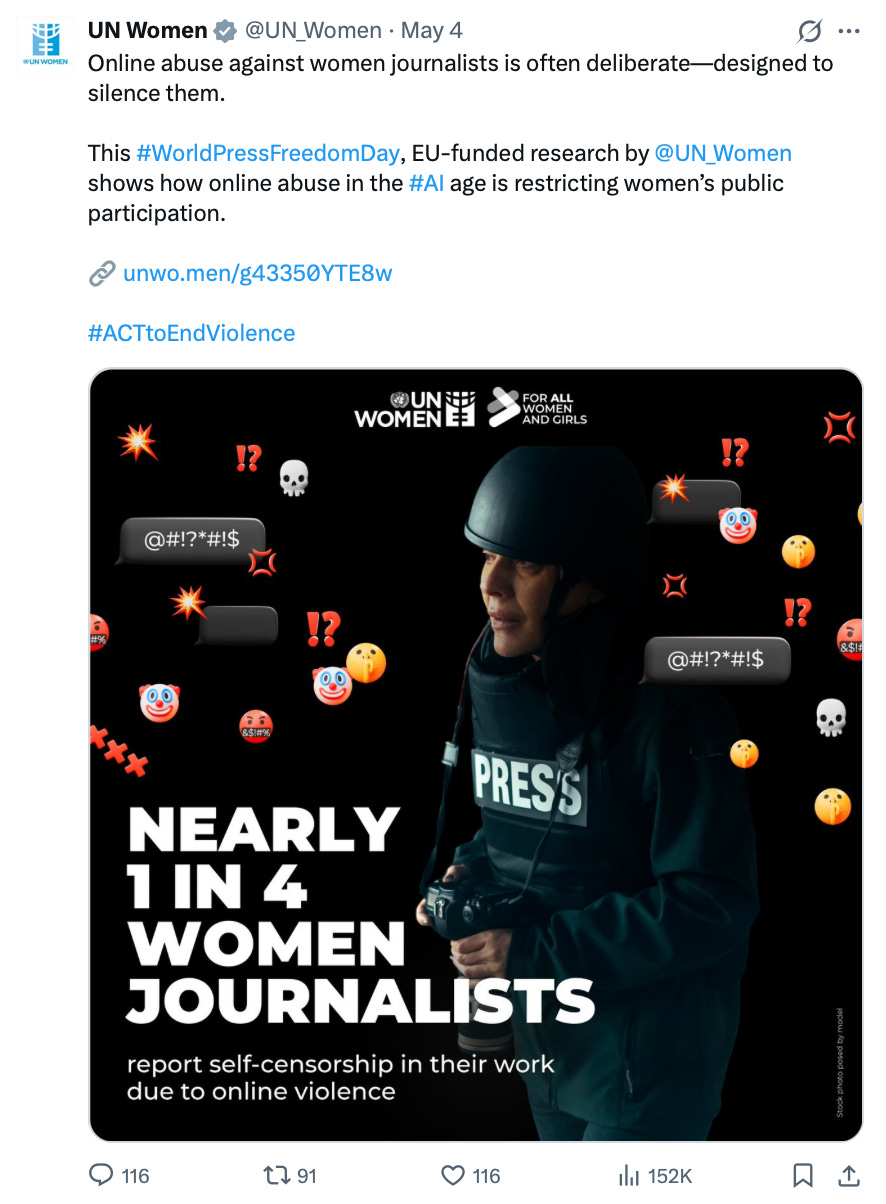
UN Women’s conclusion that women are uniquely targeted by “online violence” implies that the survey also showed evidence that men are much less likely than women to be abused and harassed online. Yet, UN Women did not provide comparative results from men, and we know that UN Women has a problematic history in communicating results about women journalists being “targeted”. Thus, consistent with its history, UN Women’s recent conclusion that “online violence” is unique to women was unjustified. In fact, if one digs deeper into UN Women’s first report to the study’s methods on page 11 (or on page 16 of the second report), one learns that 210 men completed the survey. Yet, UN Women did not publish the results from these men.
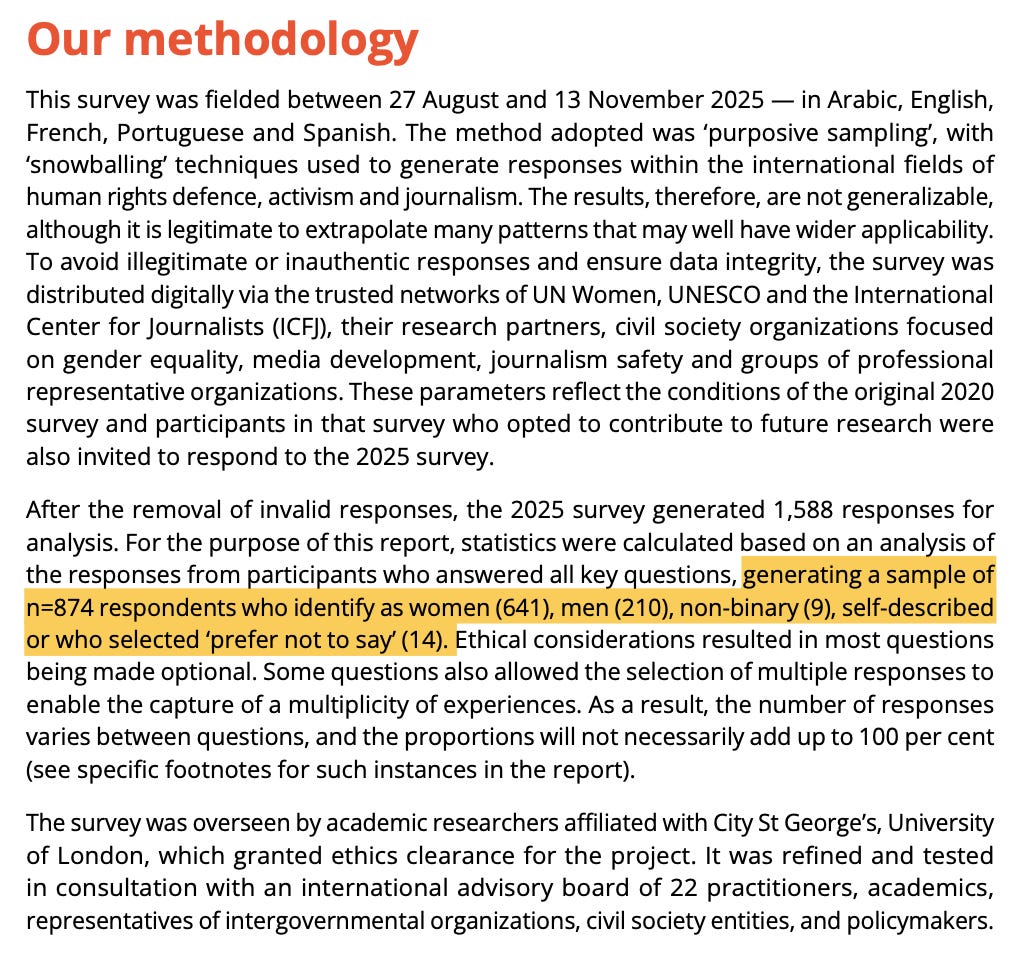
On page 16 of the second report, UN Women explained why they did not publish the results from the 210 men.
“As our 2025 survey was based on a UNESCO-published global survey of women journalists and media workers (fielded in 2020) involving an overlapping cohort of respondents, we are also able to identify the following trends in self-censorship and legal redress among women journalists specifically.”
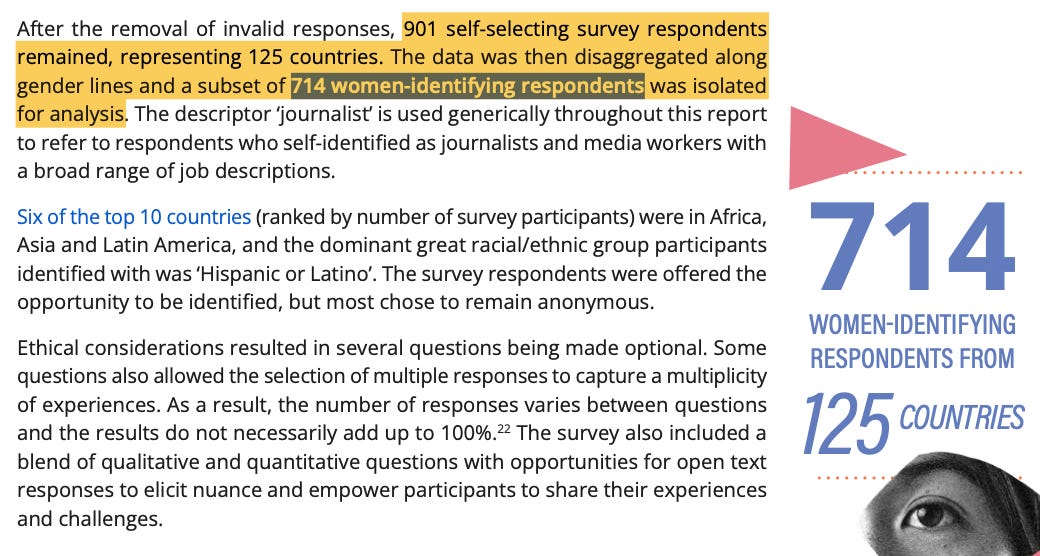
UN Women’s statement refers to a 2020 survey, which was conducted by ICFJ and supported by UNESCO, titled, “The chilling: a global study of online violence against women journalists.” In the report describing the survey, ICFJ stated that 901 journalists and media workers completed the survey, and data were “disaggregated along gender lines and a subset of 714 women-identifying respondents was isolated for analysis.”
Thus, in ICFJ’s 2020 study, responses were also collected from men—approximately 187 men. However, ICFJ chose to analyze and report only the women’s responses. Thus, in its 2025 and 2026 reports, UN Women tried to head off responsibility in its sex-biased reporting by referencing back to an earlier UN-supported study, which also chose not to publish results from male respondents.
Some of the findings highlighted by ICFJ in its 2020 report included:
73% of female journalists said that they have experienced online violence in the course of their work
25% of female journalists said that they have received threats of physical violence
15% of female journalists said that they have experienced image-based abuse
48% of female journalists said that they have been harassed with unwanted private social media messages
11% of female journalists said that they have reported instances of online violence to police, and 8% said that they took legal action
The UN’s decision to not publish the results from the male survey respondents is important for several reasons.
First, the trail of citations in the reports reveals that the UN has apparently never published the results from the ~187 men who participated in the 2020 survey or the 210 men who participated in the 2025 survey. Thus, because the UN has now twice—over an approximate six-year period—apparently not published results from their male research participants, one can now more clearly surmise the UN’s intent.
Second, UN Women tried to justify presenting only women’s results in its 2025 report by referring to the 2020 report, which similarly published only women’s results. However, just because an earlier document presents results from only one sex, does not mean that such a reporting practice should be continued. Moreover, in the 2020 report, there was no legitimate reason for excluding the male data in the first place. Thus, in the 2025 report, UN Women was simply carrying on an inappropriate reporting practise that the UN had utilized earlier.
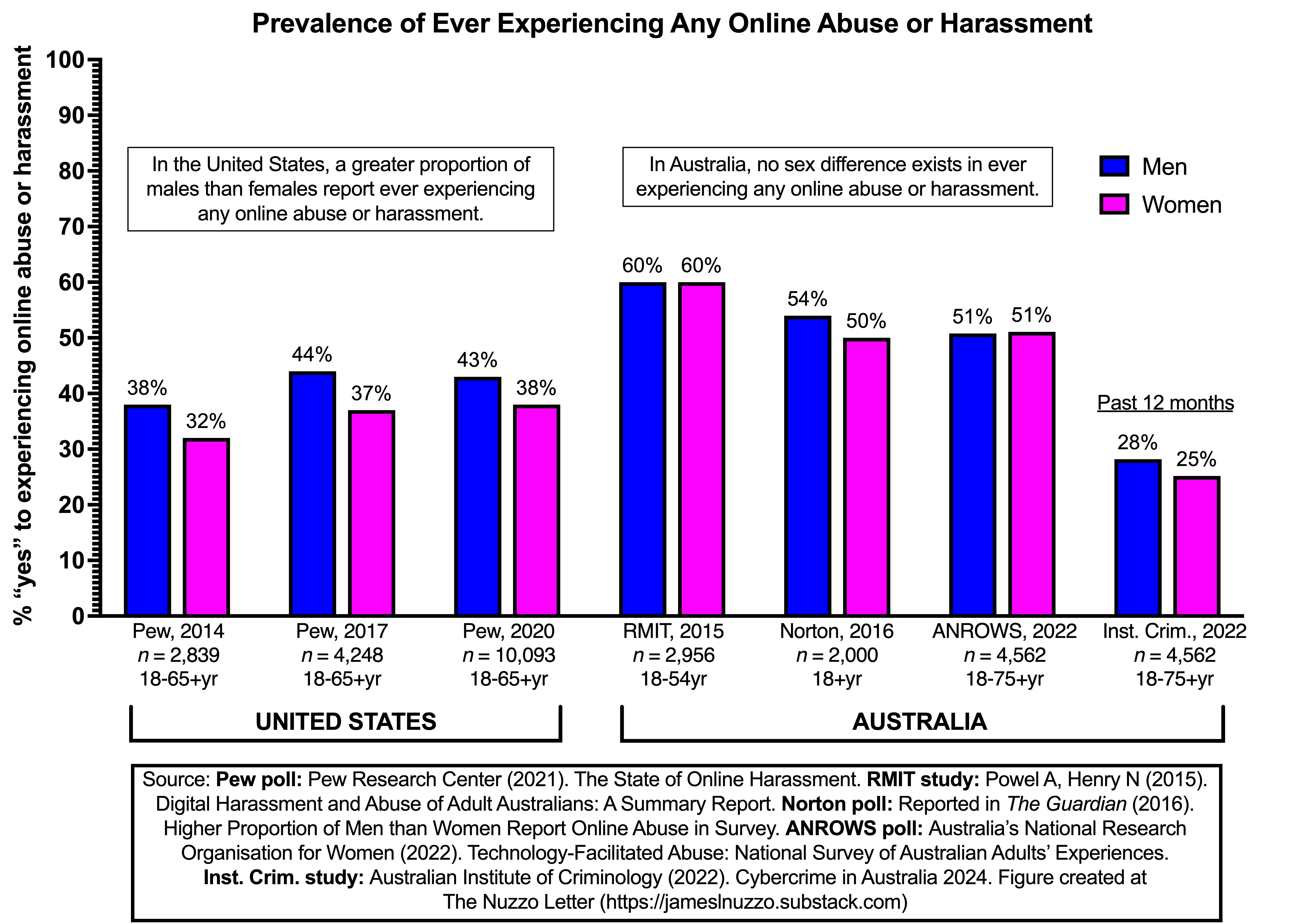
Third, the UN’s decision to not publish the men’s results conflicts with calls for more sex-segregated data in research. Ironically, the strongest proponents of such calls are typically women’s health groups, such as the NIH’s Office of Research on Women’s Health. Thus, groups like UN Women continue to show that such calls are disingenuous. These calls are often contextual rather than objective and principled. When results have potential to bring more attention to women’s needs, the data are to be separated by participant sex. However, when the results might disrupt a feminist narrative, particularly one that has future funding or policy changes attached to it, the interest in sex-segregated data suddenly disappears. In fact, we know already from sex-segregated polls that women are not more likely than men to be victims of online abuse or harassment (see graph below). Remarkably, the UN refuses to acknowledge this previous research, and this lack of acknowledgment represents another problematic research practice at the UN.
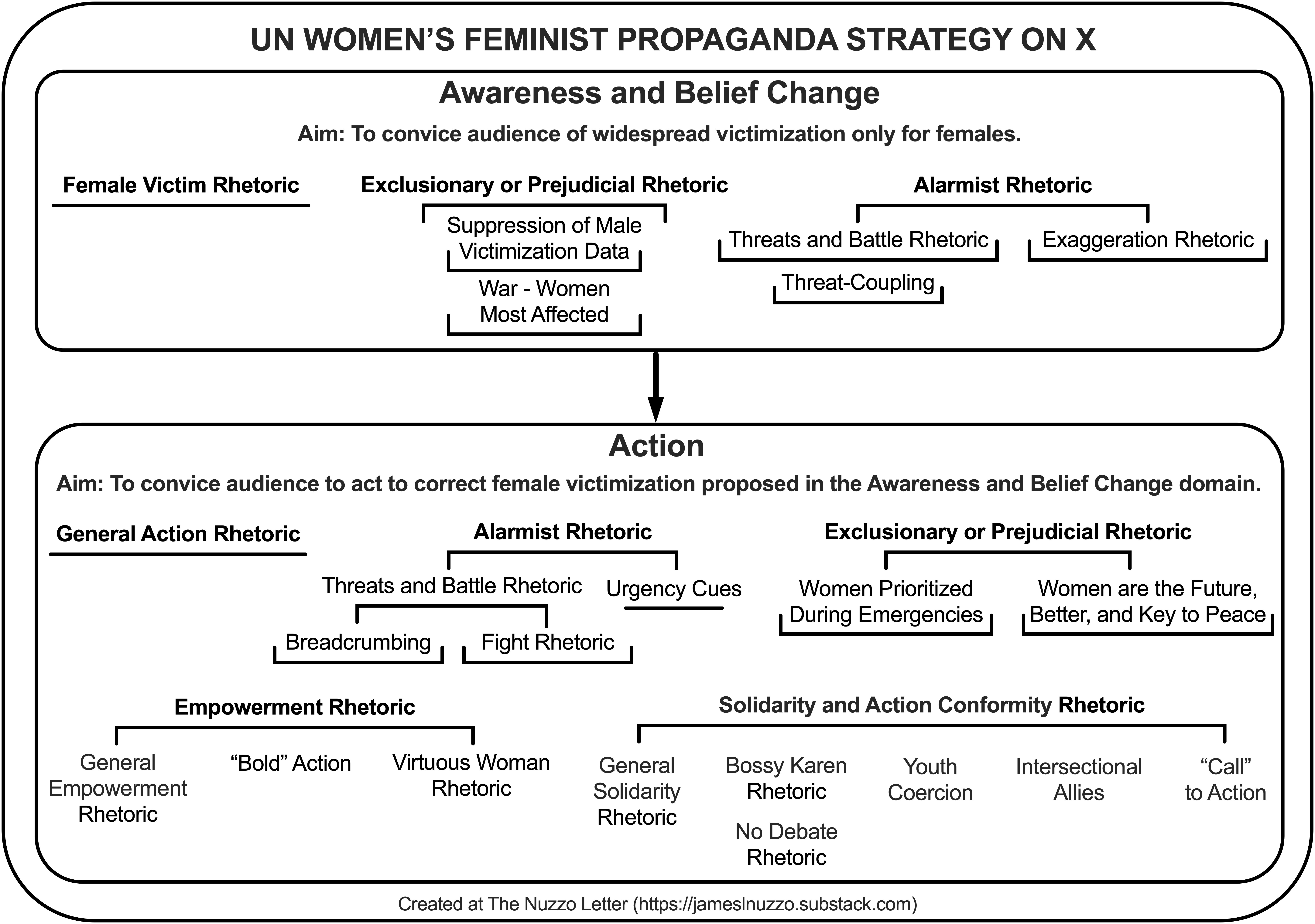
Fourth, the UN’s decision to not publish the results from the male respondents is an act of data suppression. This suppression then leads to data spin, because information from the comparator group is not presented to readers. This asymmetrical presentation then biases the readers’ interpretation of the findings. Because this asymmetrical presentation is done purposely by the UN, the UN’s reports on “online violence” are propaganda. Importantly, suppression of male victimization data is a consistent behavior exhibited by UN researchers. In my 2025 analysis of UN Women’s X feed, I identified suppression of male victimization data as one of the group’s common propaganda techniques. UN Women used this technique in approximately 12% of its tweets over a one-year period. The broad purpose of the technique is to try to influence readers’ beliefs about widespread and/or disproportionate female victimization. In the “Tipping Point” reports, the purpose of the propaganda was to convince readers that online abuse and harassment is something that happens solely or primarily to women. UN Women then hopes that this belief will motivate people to act, namely, to support calls for more funding of women’s programs and to lobby the government to expand regulations of online speech.
Fifth, the decision to suppress the male data represents an unethical research practice beyond data spin. In many cases of data spin, male data are published, but they are presented in a way that misleads the reader to a biased conclusion. However, in the case of male data suppression, the data are not even available for people to draw their own conclusions. This represents a violation of research ethics because the men who volunteered for the survey will have done so under the belief that their responses would be treated fairly, published, and inform the overall question about online abuse and harassment. Presumably, most of the 210 men would not have wasted their time participating in the UN’s survey if they knew that their experiences and beliefs were going to be ignored. Moreover, to the extent that answering questions about online harassment might induce a minimal level of psychological discomfort, the UN exposed these men to an unnecessary risk of harm, because the UN never intended to publish the men’s results. Interestingly, in the original 2020 report, the University of Sheffield was recognized as the institution that provided ethical clearance for the survey. Therefore, the research ethics committee at the University of Sheffield ought to be investigating the UN’s seemingly unethical treatment of data collected in the 2020 and 2025 surveys.
Sixth, unethical research practices at the UN reflect a concerning trend among activists who “study” sex/gender issues. For example, The Australia Institute recently spun the results from its survey to claim that “medical misogyny” is widespread in Australia, when, in fact, their results showed the opposite. Moreover, men who participate in interview studies sometimes have their responses turned against them, and surveys on masculinity are often rigged from the start. Indeed, UN Women’s 2025 survey is an example of a study that was conceptually rigged from the start. At the outset of the study, UN Women purposely defined “online violence” as being applicable only to women.
“We define [online violence] as any act that is committed, assisted, aggravated or amplified by the use of information communication technologies or other digital tools which results in or is likely to result in physical, sexual, psychological, social, political or economic harm, or other infringements of rights and freedoms. These are forms of violence that are directed against women because they are women and that affect women disproportionately. They include online harassment, abuse, targeted surveillance, image-and video-based abuse, doxxing, swatting, gendered hate speech, gendered disinformation, and threats which are delivered via information communications technologies, such as social media, chat apps, generative AI tools, text messages and email.”
Many other examples of activist researchers purposely biasing definitions of new concepts to find only female victims also exist. Some that I have written about before include “scholarly harassment,” “anticipatory violence,” and “mankeeping.”
In conclusion, the UN and other feminist-friendly groups often engage in unethical research practices. They suppress male data, distort it, or never collect it to begin with. The result is biased information, which is used to advocate for new policies.
UN Women plans to reveal its new policy recommendations for addressing “online violence” in its upcoming third instalment of the “Tipping Point” series. UN Women’s recommendations will presumably include greater restrictions on online speech.
UN Women has also stated that its third report will include information about the characteristics and behaviours of online abuse perpetrators and an examination of “Big Tech companies’ role as vectors of online violence.” Absent from the third report is likely to be the results from the 210 male respondents.
Individuals who are passionate about men’s issues and ethical research conduct can get out ahead of UN Women’s third report by calling out the bias in the initial reports and then, as soon as it is published, calling out the likely bias in the third report.
As I suggested last week, knowing the opponent’s playbook can lead to intellectual domination. The countermovement ought to strive to be one step ahead—always.
Related Content at The Nuzzo Letter


SUPPORT THE NUZZO LETTER
If you appreciated this content, please consider supporting The Nuzzo Letter with a one-time or recurring donation. Your support is greatly appreciated. It helps me to continue to work on independent research projects and fight for my evidence-based discourse. To donate, click the DonorBox logo. In two simple steps, you can donate using ApplePay, PayPal, or another service. Thank you!

And this is why the UN needs to be defunded.
They are simply taxpayer funded activists.
You only have to look at the UN women X posts to realise how fundamentally flawed everything they say is, it drives me nuts