
False Rape Allegations in the United States, 2006-2010
Data Brief
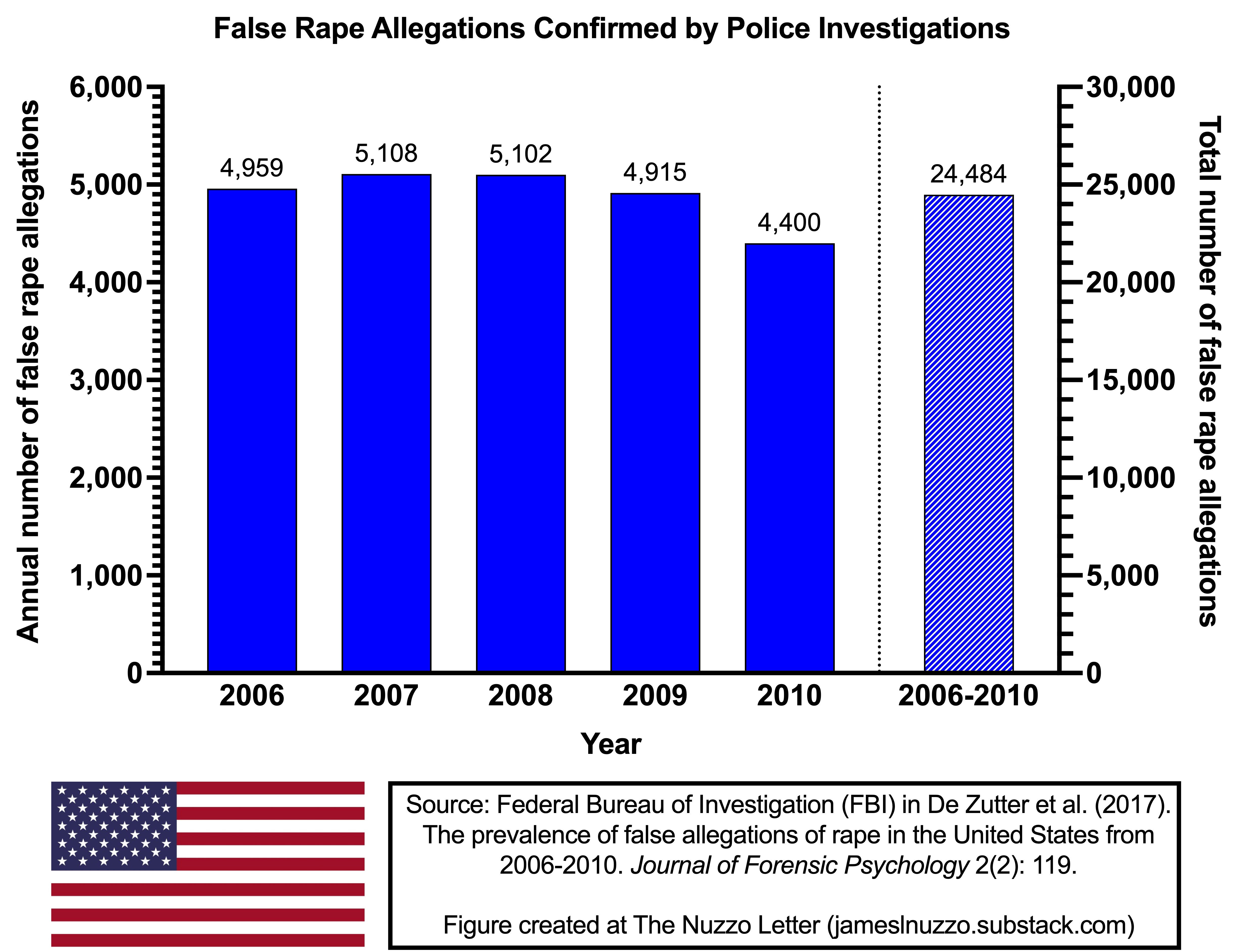
The current data brief shows the number of false rape allegations that were confirmed by police investigations in the United States (U.S.) between 2006 and 2010. The results were extracted from an academic paper published in 2017. Strengths of the paper are that the data were acquired from the Federal Bureau of Investigations (FBI), and the false allegations were established by police investigations. However, the data are 15-20 years old, and data on accuser sex and the sex of the falsely accused were not reported. The researchers acknowledged that the FBI’s numbers on false rape allegations are likely conservative estimates because (a) not all police agencies in the U.S. submit data to the FBI, and (b) establishing, via investigation, that a rape did not occur is difficult.
Key Points
There were 24,484 false rape allegations that were confirmed by police investigations in the U.S. between 2006 and 2010.
The number of confirmed false rape allegations per year ranged from 4,400 in 2010 to 5,108 in 2007.
The average number of confirmed false rape allegations per year was 4,897.
The 24,484 confirmed false rape allegations between 2006 and 2010 time accounted for 5.55% of all rape allegations, meaning that at least one of every 20 rape allegations was false.
Source
De Zutter A, Horselenberg R, van Koppen PJ (2017). The prevalence of false allegations of rape in the United States from 2006-2010. Journal of Forensic Psychology 2(2): 119.
Bonus Commentary
The data in the graph indicate the number of false rape allegations documented in the U.S. between 2006 and 2010. These data are specific to the measurement and reporting guidelines associated with the FBI’s national crime database (i.e., “a law enforcement agency in the U.S. has to establish through investigation that the reported rape did not occur in order to deem an allegation unfounded”). When this guideline was used, approximately 5,000 false rape allegations were identified each year between 2006 and 2010. Because approximately 80,000 rape allegations were made each year, the prevalence of false rape allegations was estimated to be about 5.5%. According to the authors, the 5.5% statistic likely underestimates the actual prevalence of false rape allegations in the U.S.:
“The current estimate on the prevalence of false allegations of rape is probably a conservative estimate. It is so because the UCR Program of the FBI revised the criteria, and since 1994 uses more stringent criteria than before. Now it has to be established through investigation that no crime had occurred before an allegation of a crime can be categorized as unfounded. It is difficult to establish that a crime did not occur, especially in the context of rape.”
“A rape scenario as well as a consensual sex scenario usually only involves two parties. If one of the parties is lying about the true nature of the scenario it may be difficult to proof that the crime either occurred or did not occur. If, for instance, the sexual encounter is not disputed, but only the consensual nature, then other evidence should discriminate between rape and a consensual scenario. If such evidence is absent then it is impossible to discriminate between rape and a consensual scenario. In that case, doubt concerning the true nature of the allegation will always persist. A false complainant who never retracts her story of rape, and the investigation does not reveal proof of its falsity or baselessness, such a case will never be classified as an unfounded rape allegation following the current criteria of the FBI.”
“The results of the current study, therefore, seem to indicate that the new guidelines of the FBI are followed by most or all law enforcement agencies in the U.S. As a consequence of the new guidelines, law enforcement agencies do not seem to, routinely, use the unfound category to clear criminal cases anymore. Therefore, a drop in the number of false and baseless allegations of rape was to be expected when the new policy was effective.”
In the same study, the researchers compared the prevalence of false allegations of rape with prevalences of false allegations for other types of crimes. Only robbery had a false allegation rate that was roughly similar to rape. False allegations for murder (3.3%), manslaughter (1.35%), assault (0.95%), burglary (0.9%), theft (1.49%), and larceny (0.78%) were all lower than for rape. Across all crimes, the false allegation rate was 1.16%.
The prevalence of false rape allegations has been debated for many years. One paper from 2006 reported a wide range of false rape allegation rates. The wide range of results was caused by the different methodologies used across studies in defining false rape allegations. A 2016 meta-analysis, which summarized results from seven studies that used a certain conservative definition of false allegations of sexual assault, found a prevalence of 5.2%. On their methodological approach, the authors of the meta-analysis stated: “[u]se of such a conservative definition is not meant to imply that all other cases are true reports, but just that they cannot responsibly be deemed confirmed false.” Thus, there appears to be some convergence of multiple datasets suggesting that the rate of false sexual assault or rape allegations is about 5% when conservative reporting approaches are used.
In 2022, Ispos asked approximately 20,000 men and women from around the world whether they believe that “women who say there were abused often make up or exaggerate claims of abuse or rape.” Globally, 15% of respondents (20% of men and 10% of women) agreed or strongly agreed with that statement, while 53% disagreed with the statement, and the remaining 32% apparently did not have an answer for the statement. In the U.S., the percent of respondents who agreed with the statement was 13% (17% men, 9% women). In Australia, the percent of respondents who agreed with the statement was 19% (28% men, 11% women). Thus, consistent with the data that confirm the existence of false rape allegations, many people believe that false rape allegations exist, and those who do not believe that they exist, or who unsure of their existence, should be introduced to the FBI’s data.
Here, my aim has not been to debate whether the 5% figure is correct. Researchers seem to agree that it is a conservative estimate. Instead, my purpose has been to illustrate what the conservative 5% statistic means in absolute terms: ~5,000 cases per year. The absolute numbers are important because women’s advocates tend to unjustly minimize the meaning of the 5% statistic, simply because the percentage is small. For example, in Australia, the Victoria Police shamefully minimize false rape allegations in their “Fact Sheet” on challenging misconceptions of sexual offending: “The rate of false allegations of sexual offences is very low. A range of studies show approximately 5% of rape allegations are proven false. This myth about false allegations is harmful for society and harmful for victims of sexual offences. It contributes to under-reporting. And victims wrongly fear they will be met with disbelief and blame if they report.”
Shamefully, the Victoria Police have taken a misguided ideological position. Their statement reflects their inability to step outside of zero-sum thinking. They seem to unnecessarily prioritize rape victims over the falsely accused, when, in objective law, both should simply be recognized as victims who are due justice.
Finally, another important question is: what motivates false allegations? One study of women who falsely accused someone of sexual assault revealed the following common motivates behind their accusations:
Avoiding trouble or providing an alibi
Anger or revenge
Attention seeking
Mental illness
Guilt/remorse after the sexual activity
Other informative articles on false allegations are available in the Centre for Male Psychology’s Male Psychology Magazine:
John Barry (Sep. 2025) - The psychological impact of false accusations, and how men cope.
Mark Harman (Oct. 2025) - Psychological impact of false accusations on males: An evidence-based analysis.
Rick Bradford (Mar. 2022) - False allegations of rape: the true extent remains unknown.
Related Content at The Nuzzo Letter


SUPPORT THE NUZZO LETTER
If you appreciated this content, please consider supporting The Nuzzo Letter with a one-time or recurring donation. Your support is greatly appreciated. It helps me to continue to work on independent research projects and fight for my evidence-based discourse. To donate, click the DonorBox logo. In two simple steps, you can donate using ApplePay, PayPal, or another service. Thank you!

https://notonrecord.substack.com
Joseph talks about conducting research using the data from the legal profession.
Related—”False rape-accusations (e.g., saying ‘all men’) are ethically equivalent to rape”: https://biard.substack.com/p/saying-all-men-is-the-ethical-equivalent.