
Meta-Analysis Incompetence, Deception, or Both?
How eight authors and the editors at the British Journal of Sports Medicine still did not get things right on transgender physical fitness

Earlier this year, eight academics from Brazil published a meta-analysis on transgender physical fitness in the British Journal of Sports Medicine—one of the most historically prominent journals in the fields of exercise and sports science. From their analysis, the authors concluded that “transgender women do not exhibit significant differences in upper-body strength, lower-body strength, or maximal oxygen consumption relative to cisgender women after 1–3 years of [gender-affirming hormone therapy].”
On May 12, 2026, I critiqued the meta-analysis in an article published at Reality’s Last Stand. I highlighted numerous glaring errors in the research. The errors were not minor. They reflected gross incompetence, such as including in the analysis studies that obviously did not meet the authors’ own stated eligibility criteria and excluding from the analysis studies that obviously did meet the authors’ own eligibility criteria.

The number and types of errors amounted to one of the worst research performances that I have seen in my ~20 years in the field. I concluded, based on these errors, that the authors misled the public when they stated that there were no differences in muscle strength between women and transgender women.
Apparently, the authors got wind of the public criticism of their work. On June 15, they issued a correction.
The authors’ correction is welcomed. However, their correction is also misleading, and here I explain how.
Misleading Correction
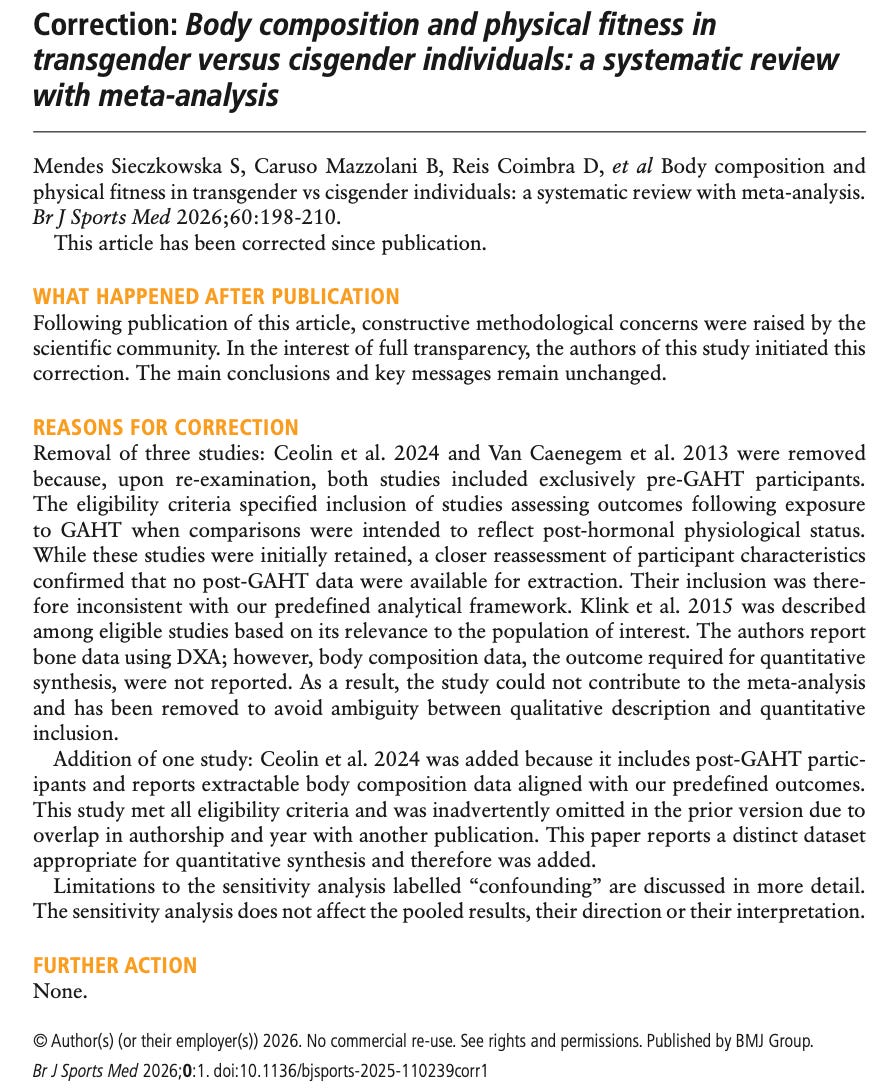
The correction starts by stating that the authors “initiated” the correction after “constructive methodological concerns were raised by the scientific community.”
That is an understatement.
Some people familiar with the original paper thought that the errors were so egregious that the paper should be retracted not corrected. For example, in my critique, I did not provide “constructive methodological concerns.” I detailed the errors made by the authors and suggested that one could not trust them to do the research properly. Moreover, it was the scientific community, not the authors, who were the root initiators of the correction. Without public criticism, it is unlikely that the authors would have identified and/or corrected their errors.
I am also not convinced that the authors truly appreciate the magnitude of their ineptitude or care about its consequences. Public trust in the authors was deflated based on the errors that they made. In submitting a correction, one might think that the authors would be apologetic and go to great lengths to convince the public that they are competent researchers, who, uncharacteristically made a couple of mistakes that they deeply regret. One might expect that the researchers would go into analytical overdrive, repeatedly examining every spreadsheet, graph, table, references, and line of text—ensuring that no errors go undiscovered. One might also envision a team supervisor circulating a checklist, requiring that each team member indicate that they have completed a list of tasks that will nearly guarantee that no additional mistakes are made in the revised paper.
These are the types of things that conscientious, empathetic people do when they regret the confusion or harm caused by their errors. They seek redemption through future excellence.
Yet, trust and confidence in the authors was hardly re-established by their correction statement. They did not apologize for the mess that they put into circulation, nor did they detail all their original errors and corrections. In other words, the authors obfuscated.
In their correction, the authors stated that in the revised paper they removed three studies (Ceolin et al. 2024; Van Caenegem et al. 2013; Klink et al. 2015) and added one study (Ceolin et al. 2024). The authors provided some explanations for these decisions. For example, they admitted that both the Ceolin et al. 2024 and Van Caenegem et al. 2013 studies were removed because both studies tested physical fitness in individuals before they received gender-affirming hormone treatment.
Nevertheless, the correction statement did not detail many other changes that the authors made to their paper. These changes are only apparent when one compares the original version of the paper, which is no longer available online, to the revised paper.
For example, in the revised paper, I identified four changes that the authors made in Figure 2 (i.e., muscle strength meta-analysis) that they did not inform readers about in their correction statement:
1. The authors correctly removed the Andrade et al. 2022 study from their meta-analysis on upper-body muscle strength (Figure 2A in the paper).
2. The authors correctly added the Jenkins et al. 2020 study to their meta-analysis on upper-body muscle strength (Figure 2A in the paper).
3. The authors correctly added the Alvarez et al. 2022 study to their meta-analysis on upper-body muscle strength (Figure 2A in the paper).
4. The authors correctly added Hamilton et al. 2024 study to their meta-analysis on lower-body muscle strength (Figure 2B in the paper)
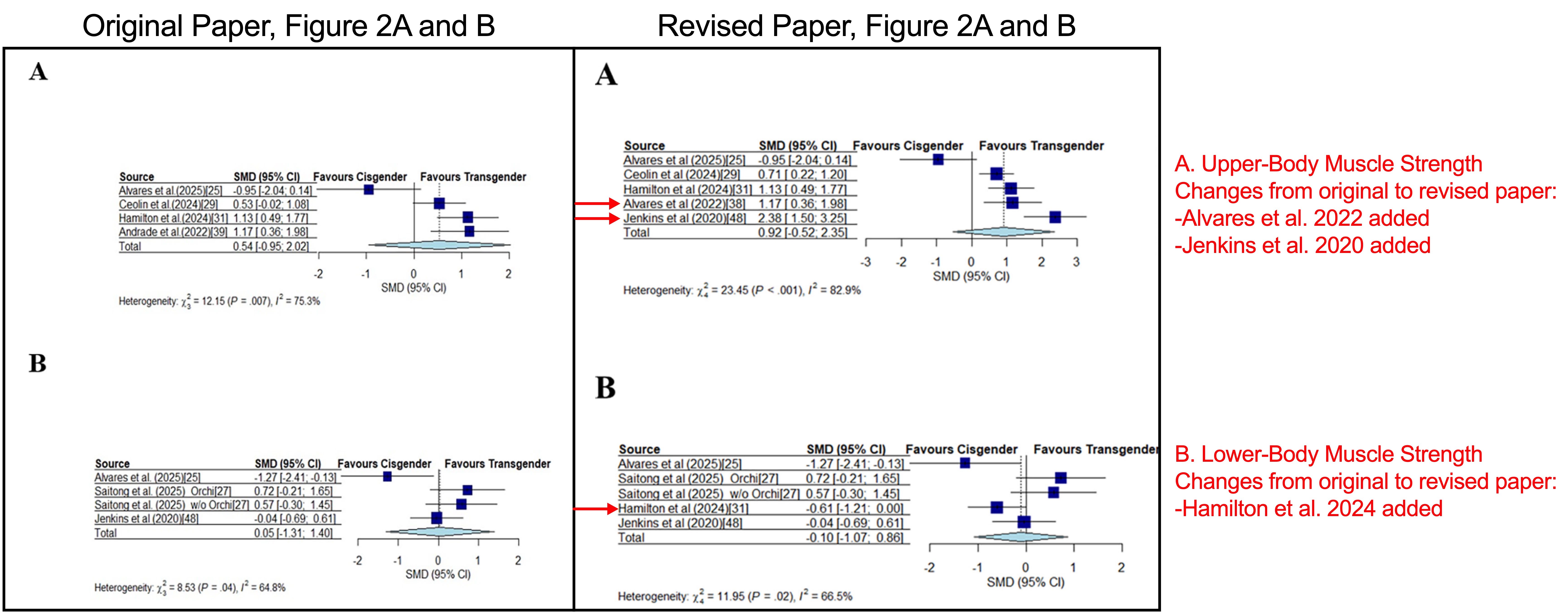
Another confusing change to Figure 2A pertains to the two studies by Ceolin et al. The effect size for the Ceolin et al. 2024 study differs between the original and revised figures. The reason that the effect size differs between the two figures is because the authors correctly removed the Ceolin et al. study that tested participants prior to receiving gender-affirming hormone treatment and replaced it with Ceolin et al. study that tested participants after they received gender-affirming hormone treatment. However, this change is not obvious in the figure because the two studies have same author name (Ceolin) and year (2024). This lack of clarity is an issue because the correction statement does not include a statement about the Ceolin et al. studies and the analysis on muscle strength (i.e., Figure 2). Instead, the authors stated that the reasons that they added the other Ceolin et al. study was because it included relevant data on “body composition.” Thus, the correction statement does not inform readers about the impact of switching the Ceolin et al. studies on the muscle strength analysis.
So, the key issue with the authors’ correction statement is that they did not clearly communicate the details of their errors and revisions. What’s more, the editor assigned to the paper did not catch any of this or encourage the researchers to provide more details.
Errors Still Exist
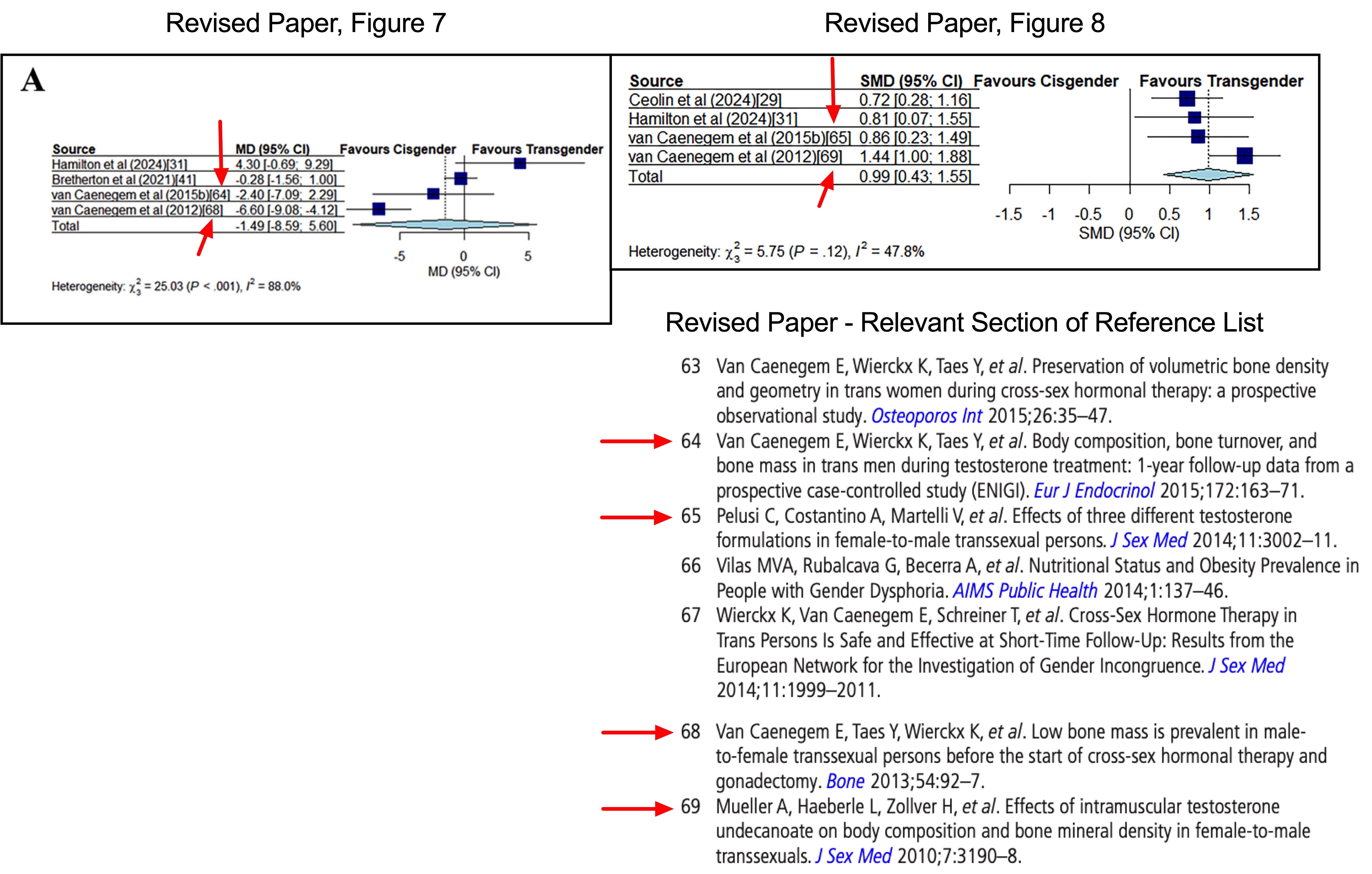
The authors also appear to have made at least one new error in the revised paper. Specifically, as pointed out by Professor of Exercise Science Greg Brown, the reference numbers in some of the figures appear to be incorrect.
In Figures 7 and 8 of the revised paper, one can see that the reference numbers for the van Caenegem et al. 2015b study and the van Caenegem et al. 2012 study are different. In Figure 7, the reference number for the van Caenegem et al. 2015b study is 64, but in Figure 8 it is 65. Moreover, in Figure 7, the reference number for the van Caenegem et al. 2012 study is 68, but in Figure 8 it is 69. If one then looks at the relevant section of the reference list in the revised paper, it is unclear which papers are the correct ones. From the reference list, the papers numbered 65 and 68 are probably the relevant ones, but further confusion comes from the fact that the year listed for the van Caenegem et al. study labelled as 68 in the reference list is 2013, but in Figure 7 it is listed as 2012.
No Cautionary Note is a Red Flag
One of the remarkable things about this paper is how confident the researchers are in their conclusions about muscle strength, though we know that the original analysis was riddled with errors. Given the public criticism of their work, one might think that the researchers would take a moment to reflect and consider being more cautious in their conclusions. Instead, the researchers doubled down. In their correction statement, they said the “main conclusions and key messages remain unchanged.”
Yet, it is obvious to many people that the Alvarez et al. 2025 study is a bizarre, outlier of a study that is clearly impacting the results of the meta-analysis for upper-body muscle strength. Without that study, the conclusion about upper-body muscle strength would be different. It would show that transgender women (i.e., males) have greater muscle strength than women, which is what most scientists who are not trans activists would expect.
Conclusion
The Brazilian researchers were right to revise their problematic meta-analysis on transgender physical fitness, though a good argument existed and perhaps still exists for retraction. However, in their correction statement, the authors were not fully transparent about the magnitude and types of errors that they made in their original paper, nor were they fully transparent about all the changes that they made in the revised paper. What’s more, after all this, the researchers still had the audacity to conclude, without any cautionary notes, that there is no difference in muscle strength between women and transgender women, when it is clear that one outlier study of unusually small men (Alvares et al. 2025) is impacting the analysis on upper-body strength.
Other issues that I raised in my critique were also not addressed. For example, the upper-body strength data reported by Saitong in 2025 were not added to the relevant analysis. Also, the authors have continued to refer to “1-3 years” of gender-affirming hormone treatment in their summary statements, while multiple studies in the muscle strength analysis reported treatment durations that exceeded 1-3 years.
Finally, the abysmal track record of the British Journal of Sports Medicine publishing papers on transgender physical fitness warrants restating. Prior this correction, the British Journal of Sports Medicine had already required corrections of two papers published on transgender fitness. Importantly, two of those problematic papers were included in the meta-analysis by the Brazilian researchers. The correction made by the Brazilian researchers marks the third paper on transgender fitness in the journal that has required correction. This is a remarkably high correction rate given that so few papers have been published on this topic in the journal. As I argued before, the journal could improve its ability to appraise scientific papers by spending less time focusing on diversity, equity, and inclusion (DEI) initiatives.
Related Content at The Nuzzo Letter


SUPPORT THE NUZZO LETTER
If you appreciated this content, please consider supporting The Nuzzo Letter with a one-time or recurring donation. Your support is greatly appreciated. It helps me to continue to work on independent research projects and fight for my evidence-based discourse. To donate, click the DonorBox logo. In two simple steps, you can donate using ApplePay, PayPal, or another service. Thank you!

Go get them James, fake science is worse than fake news
Eight authors and the editors at the British Journal of Sports Medicine were involved in studies of transgender physical analysis and made significant mistakes ? Had it been one author I could understand it was an "innocent mistake". However, eight authors? It seems DELIBERATE . Or to put it
in another way it was...."Merely corroborative detail, intended to give artistic verisimilitude to an otherwise bald and unconvincing narrative". (W.S. Gilbert, The Mikado.)