
UNSW’s Data Spin on Men’s Sexual Interest in Children
Another example of mistreatment of male participant data


On May 1, 2026, I published an essay exposing how The Australia Institute engaged in data spin and sex-biased reporting when it concluded that its poll revealed widespread “medical misogyny” in Australia. After I published the essay, an X user brought to my attention another possible instance of data spin in Australian sex/gender research. The X user shared a report titled, “Identifying and understanding child sexual offending behaviours and attitudes among Australian men.” The report was published by researchers at the University of New South Wales (UNSW) in 2023. One of the groups associated with the report was Jesuit Social Services, which is the group that works with Michael Flood on the Man Box survey. See David Maywald’s essay at Celebrating Masculinity for a critique of the Man Box survey.
The report described results from a study in which 1,945 Australian men were surveyed about their sexual feelings and behaviours toward “children”. The results received widespread media attention. Headlines declared the findings as “grim,” “shocking,” “disturbing,” and “horrifying.”
Much of the media attention focused on the first two findings in UNSW’s press release:
Around one in six (15.1%) Australian men reports sexual feelings toward children.
Around one in ten (9.4%) Australian men has sexually offended against children.
Yet, inspection of the report reveals that these two findings are not what they seem.
“Children” and the Age of Sexual Consent
The study focused on men’s sexual feelings and behaviours toward individuals 18 years of age and younger. Yet, when describing the men’s feelings and behaviours, the researchers repeatedly used the phrases “towards children” and “against children.” The media latched onto the researchers’ choice of words. Many of the newspaper headlines included the word “children”
However, the researchers’ and media’s use of the word “children” was misleading. The ages men were asked to consider when answering the questions included teenagers old enough to provide sexual consent. In fact, age of sexual consent was an obvious limitations of the study. In Australia, the legal age of sexual consent is under 18 years of age. In Tasmania and South Australia, the age of sexual consent is 17 years old. In New South Wales, Queensland, Victoria, Western Australia, the Northern Territory, and the Australian Capital Territory, the age of sexual consent is 16 years old. Notably, 15.2% of the men who completed the survey were 18-24 years old, and 17.7% were 25-34 years old. Thus, many men who completed the survey were just few years older or were the same age as the individuals who they were asked to consider when answering the questions. The researchers acknowledged this limitation. They explained that the survey was international and included responses from men who lived in the United Kingdom and United States, where ages of sexual consent range from 16-18 years old.
Yet, this major limitation did not make the researchers particularly cautious in communicating their results with the public. Instead, they doubled down, stating that they believed that this limitation did not greatly impact their findings on contact offenses: (a) “[c]ontact offenders in our study were more likely to be older, not younger”; (b) “[t]he majority of men who reported sexual contact with a child had other indicators of sexual feelings or offending; and (c) “[t]he rate of contact offending in our study is supported by other research.”
However, that rationale is mostly irrelevant for the results on sexual feelings, and that rationale does not justify inflating statistics by lumping together categorically different items (described below).
Inflated Statistics
The statistic that 15.1% of “Australian men” reported sexual feelings toward children was inflated in two ways. First, the survey was international, and the 15.1% statistics was the prevalence of the entire international sample not the Australian sample. In Supplementary Table 2 (shown below), one can see that 185 Australian men were classified as having sexual feelings “towards children.” To determine the percent of Australian men who reported those feelings, one divides 185 by the total number of Australian men who answered the relevant questions. According to this table, the number of Australian men who answered the relevant questions was 1,253 (1,068 + 185). However, 185 divided by 1,253 is not 15.1%. It is 14.76%.
The 15.1% statistic is the result of dividing the 294 Australian and non-Australian men who were classified as having sexual feelings “towards children” by the 1,940 Australian (1,295) and non-Australian (687) men who answered the relevant questions. Thus, the 15.1% statistics reported for Australian men was inflated by roughly 0.3%. This 0.3% difference is not huge, but it shows the carelessness or deception involved in the report.
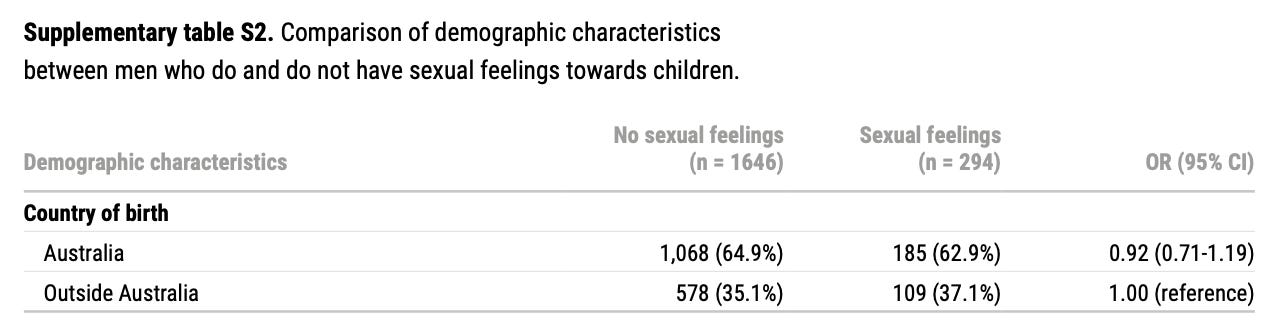
Importantly, even the 15.1% international statistic is misleading. To arrive at the 15.1% statistic, the researchers combined the number of men who answered positively to at least one of six survey items on sexual feelings. Yet, the six items differed ethically and legally. Below is the section of the report that shows the results from the six items.
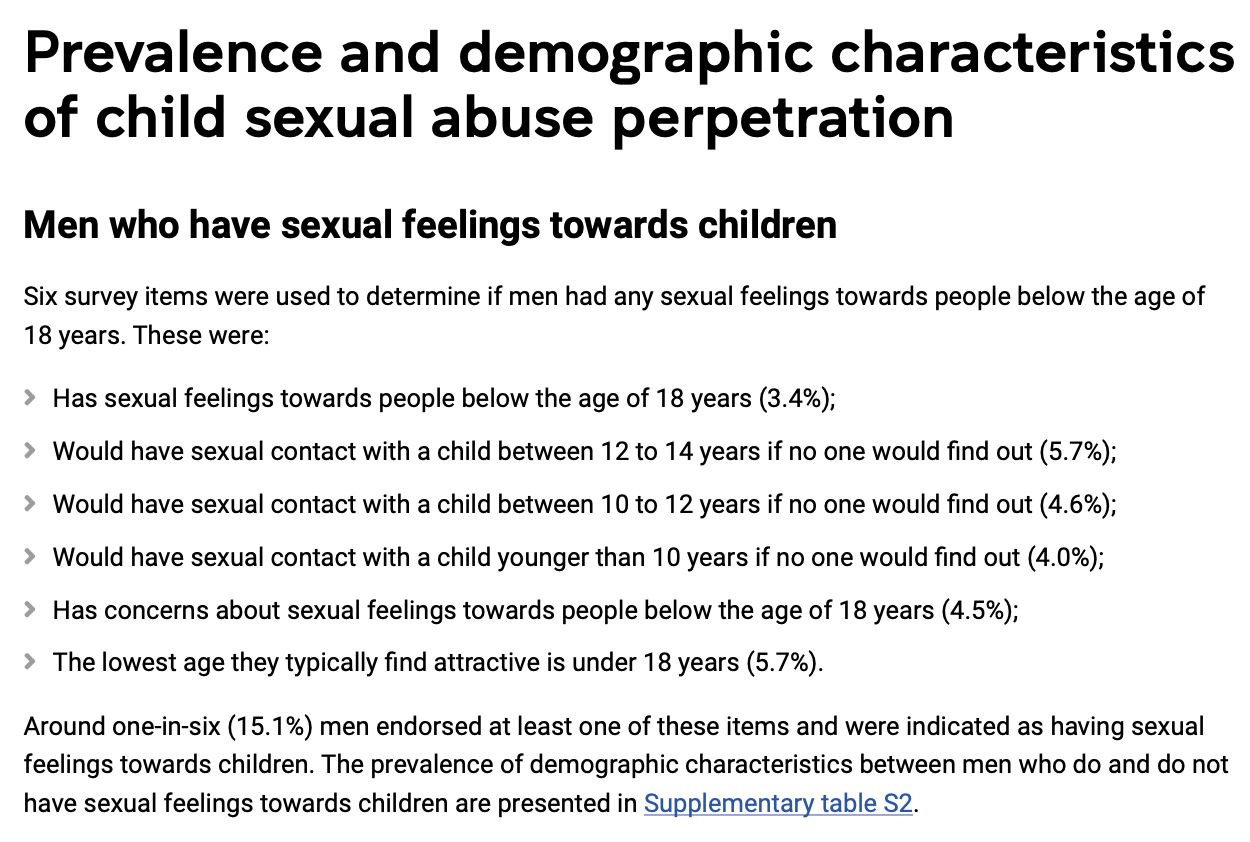
Of the six items in the bulleted list, bullets 1, 5, and 6 are not associated with ethical wrongdoing according to Australian sexual consent law. Each of those items says, “below the age of 18 years,” which includes 16- and 17-year-olds who are, by law, able to provide sexual consent in Australia, depending on the state. Thus, items 1, 5, and 6 are categorically different from items 2-4. Items 2-4 refer to specific ages that are younger than the age of sexual consent in Australia. Thus, to arrive at the 15.1% statistic, the researchers compiled categorically different survey items.
Also, in Supplementary Table 2, one can see that men who were 18-34 years old were the most likely to report sexual feelings “towards children.” Of the 293 men who reported such feelings (middle column in table below), 140 (47.8%) were 18-34 years old. Thus, the 15.1% statistic was inflated by the responses from these young men—some of whom were only a few years older than the individuals who they were asked to think about.

The statistic that 9.4% of Australian men reported sexually offending “against children” was also inflated. It was inflated by allowing 16- and 17-year-olds to be considered in men’s responses and by combining the number of men who answered positively to categorically different survey items. The screenshot below from the report shows the results from the five items that were combined to create the statistic on “sexual offending.”
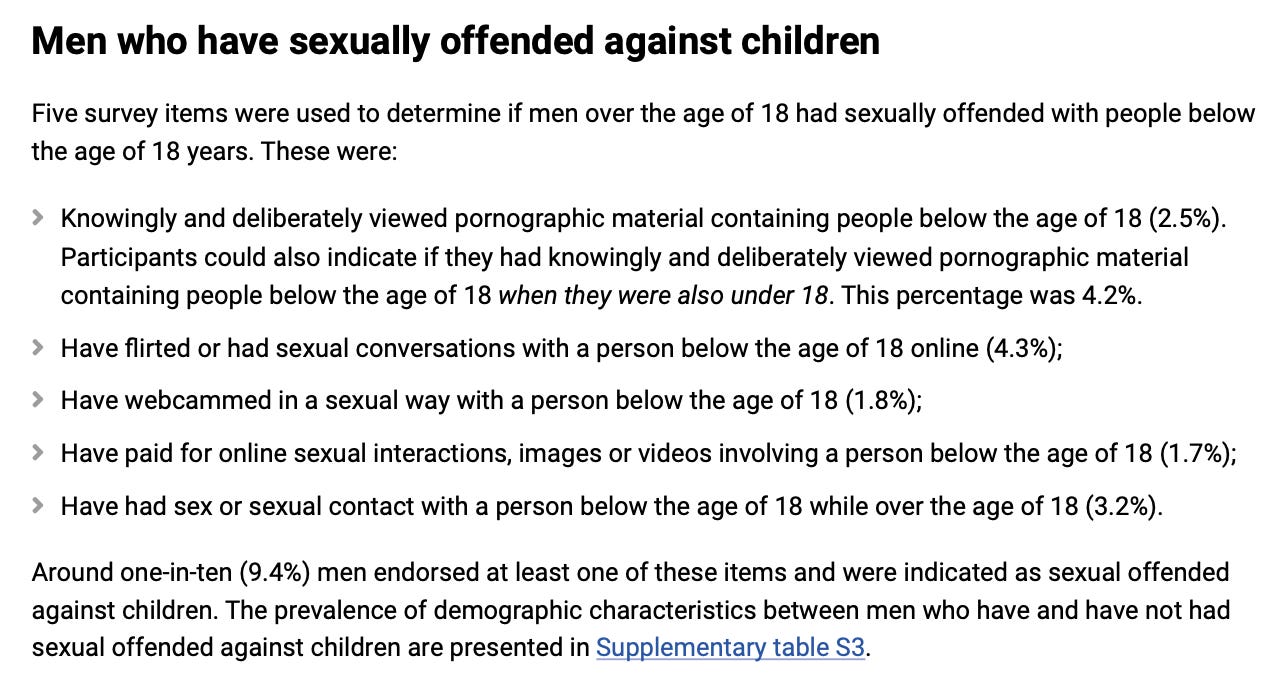
Below are the data from Supplementary Table 3, which show the percentage of men (not segregated by country), who answered positively (middle column) to one or more of the five items in the bulleted list. Of the 182 men who answered positively, 57 (31.3%) were 18-34 years old. Thus, the 9.4% statistic was inflated by the inclusion of young men who said that they have “sexually offended” against individuals who were of legal consenting age.

Finally, the researchers also misled the public by repeatedly using the word “offending” in their report. Offending suggests an unlawful act. Yet, some of the survey items did not represent illegal acts.
Data Suppression and No Female Comparator Group
Inflated statistics were not the only way that the researchers misled the public about the study’s findings. A second way was that the results from the women who completed the survey were not shared.
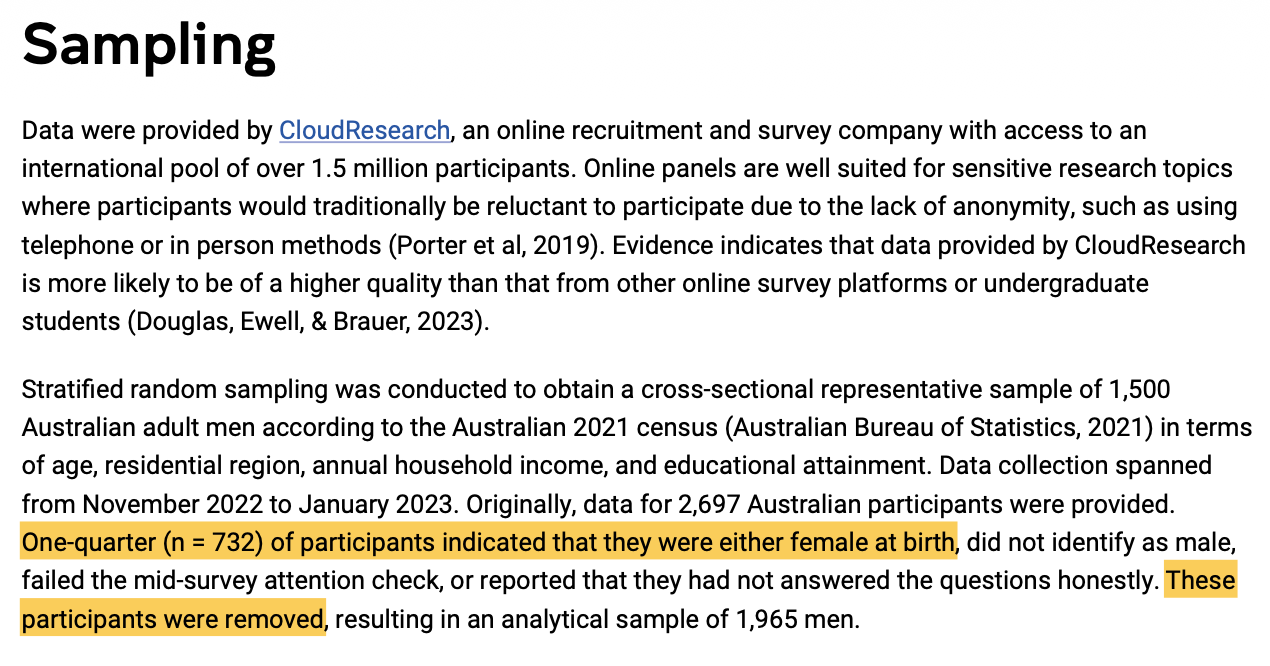
The below screenshot from the report reveals that 732 individuals who participated in the survey indicated that they were “either female at birth, did not identify as male, failed the mid-survey attention check, or reported that they had not answered the questions honestly.” The researchers did not specify how many of the 732 individuals were women, so it is unclear how much female data the researchers sat on. Nevertheless, even if the survey was only open to men, and somehow a handful of women snuck in, this highlights a more fundamental issue with the survey: no serious attempt was made at sampling women’s sexual feelings and behaviours toward children and teenagers. This lack of symmetry in the study is problematic, because the impression that one receives when reading the UNSW report and the various media accounts is that only men exhibit sexual feelings and behaviours toward children and teenagers. This then perpetuates the stereotype that only men are child sexual abusers. Yet, previous quantitative and qualitative research has documented that adult women have sexual feelings toward children and teenagers, and stories of female teachers having sexual relations with students are consistently documented. Thus, by not publishing the women’s results, and by not making a legit attempt at surveying a representative sample of women, the researchers biased their findings.
Conclusion
In 2023, researchers at UNSW spun data, and consequently, misled the public on Australian men’s sexual feelings and behaviours toward children. They did so in the following ways:
They used the word “children,” when, in fact, the men were simultaneously being asked about teenagers who were of legal age for sexual consent.
They repeatedly used the word “offending,” when, in fact, the men were asked about scenarios that did not represent criminal offending.
They aggregated responses from ethically and legally different items to inflate their statistics.
They did not report the results from the small sample of women who completed the survey, nor did the researchers make a genuine attempt at measuring the same feelings and behaviours in a large representative sample of Australian women.
The reality of the UNSW research was that most men did not express sexual feelings or behaviours toward children and teenagers, and of the men who did express those feelings or behaviours, many did so consistent with Australian law.
Concerningly, the actions taken by the UNSW researchers are consistent with widespread bias against male research participants. Relevant examples of data suppression, data spin, rigged surveys, and unethical treatment of male interview data have been previously documented at The Nuzzo Letter.
Related Content at The Nuzzo Letter


SUPPORT THE NUZZO LETTER
If you appreciated this content, please consider supporting The Nuzzo Letter with a one-time or recurring donation. Your support is greatly appreciated. It helps me to continue to work on independent research projects and fight for my evidence-based discourse. To donate, click the DonorBox logo. In two simple steps, you can donate using ApplePay, PayPal, or another service. Thank you!

Great job Jim of exposing the misandry here. It is amazing to me how some researchers will bend over backwards to make men look bad, and do it with a straight face.
Thanks for investigating this one, James.
It is so predictable...
1. Distort the definition of an "offence" to get a high(ish) percentage for whatever they are looking for, but publish headlines and reports based on the primal understanding of the offence, rather than the wide definition which is in the data.
I say "primal" because that's how the headline will hit the reader, even if they just see it in passing.
2. Don't report the results for male victims or female perpetrators, under the same broad definition.
Whenever I see "shocking", or similar, in a feminist headline for a "scientific" survey I know that both of these will be present.
These also make it hard for anyone in public life to contest the headline, and often the $millions of taxpayer dollars which flow from it, because they will immediately be cast as "defenders" of some unspeakable offence, with new distortions of what they have said. People have been cancelled for this.
It's happened so often in the past, and will continue, but that only makes it more important that someone competent (and patient!) debunks it each time.
Great work, and very much appreciated!