



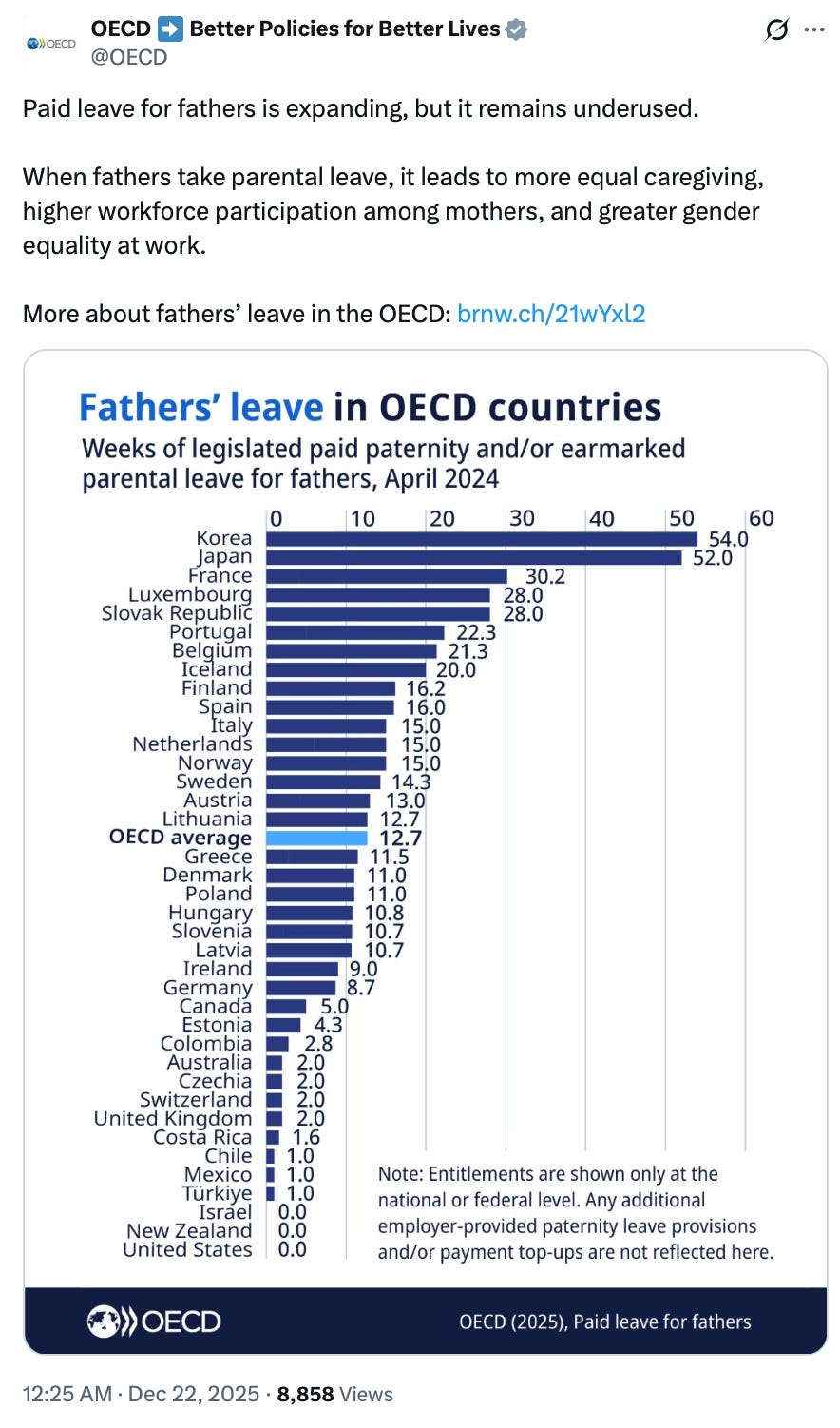
On December 22 of 2025, the Organisation for Economic Co-operation and Development (OECD) published a tweet about paternity leave and its purposes. In the tweet, the OECD said: “Paid leave for fathers is expanding, but it remains underused. When fathers take paternal leave, it leads to more equal caregiving, higher workforce participation among mothers, and greater gender equality at work.”
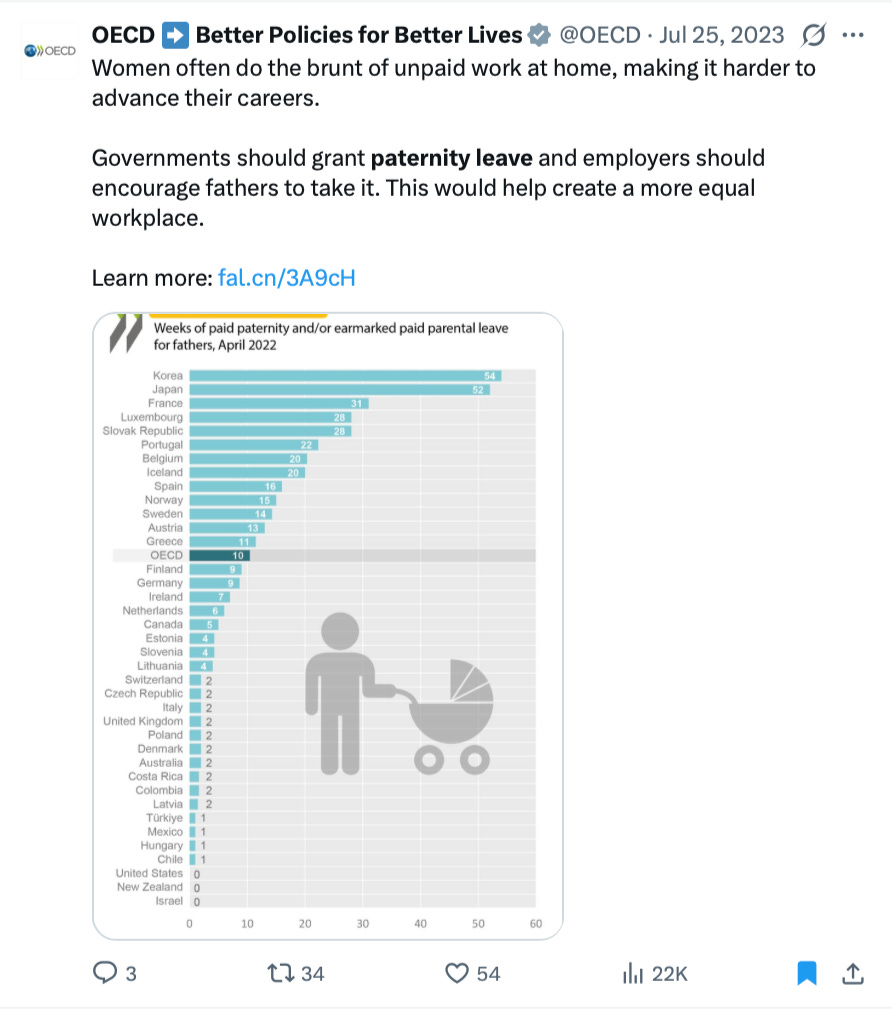
Similarly, on July 25, 2023, OECD published a tweet that said: “Women often do the brunt of unpaid work at home, making it harder to advance their careers. Governments should grant paternity leave and employers should encourage fathers to take it. This would help create a more equal workplace.”
A link embedded in the 2025 tweet takes one to an OECD policy brief in October 2025, which provides more details on the group’s views on paternity leave. The policy brief, is titled “Paid leave for fathers: Recent OECD policy trends,” expresses the same sentiments as in the tweets. For example, one of the brief’s “key messages” is that “[f]athers’ leave benefits not only parents and children but also promote gender equality.” This point is expanded upon later in the brief: “Fathers’ use of leave benefits not only parents and children but also promotes a more equal division of care responsibilities and other unpaid work at home and supports gender equality in the workplace, fairness and women’s economic self-efficiency.”
Besides these stated benefits of greater “gender equality” at work and more equal sharing of care responsibilities, the OECD also proposed the following as benefits of paternity leave: improved communication and stronger emotional bonds between fathers and their children; greater overall life satisfaction for both parents, especially mothers; greater mobilization of women’s labour to underpin economic growth; and reduced gender-based discrimination in the workplace and reduced likelihood that only women take leave, thereby mitigating the “motherhood penalty.”
Australia’s Workplace Gender Equality Agency (WGEA)
The OECD’s tweets and brief reminded me of similar information that I had recently seen on the website of Australia’s Workplace Gender Equality Agency when I was conducting research on the sex composition of their employees. On their webpage, titled “Paternal Leave for Men,” the Agency has a section labelled, “Benefits for men taking paid parental leave.” The Agency then lists the following benefits for men:
1. helps normalise working fatherhood, reducing stigma and penalties faced by working mothers;
2. greater engagement with children and stronger relationships partners;
3. improved mental health for fathers and their partners;
4. potential to reduce employers’ gender pay gaps;
5. would lead to a boost to national GDP…due to increased women’s workforce participation;
6. employers benefit from attracting and retaining talent.
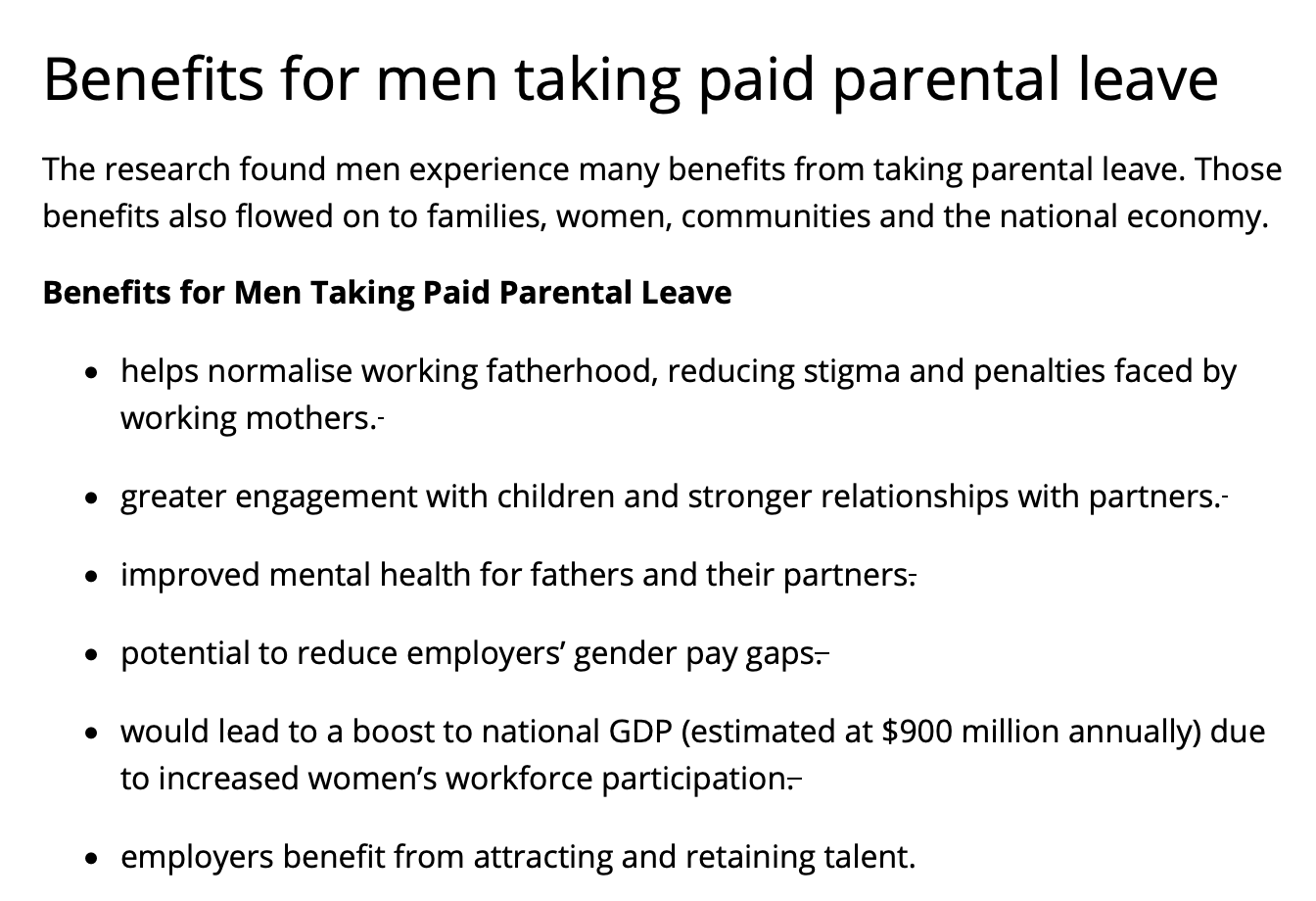
Remarkably, in the list of six items that were apparently intended to convince men about how paternity leave would benefit them, Australia’s Workplace Gender Equality Agency only listed three that are direct benefit to fathers. These included “greater engagement with children and stronger relationships with partners,” “improved mental health for fathers,” and “normalising working fatherhood.” However, even those items had caveats about how mothers would also be helped. Then, there were the three items on the “benefits for men” list that were clearly not benefits for men. They were benefits for women and employers.
On the same webpage, the Agency took a stab at discussing “barriers to men taking paternity leave.” However, the Agency ultimately laid blame on “persistent gender norms,” which is somewhat insulting to husbands and wives who make conscientious decisions about how to structure their lives in ways they deem best. They do not make decisions based on the desires of feminist theorists or the staff at Australia’s Workplace Gender Equality Agency, who are 77% female.
Gynocentric Versus Androcentric Approach to Men’s Well-Being
In 2023, I wrote an essay in which I warned about the gynocentric approach to men’s issues, including paternity leave. The gynocentric approach involves using a men’s issue to advocate for better outcomes for women. I warned that this abuse of men’s issues would become more frequent because the epidemiological data on poor outcomes in men are becoming increasingly known, and this leaves academics and health officials scrambling to find ways to realign these data with their pre-existing ideology, and to ensure that women are still the primary beneficiaries of policies. The content published by the OECD and Australia’s Workplace Gender Equality Agency reveal that these two groups have adopted the gynocentric approach to paternity leave, as both groups framed paternity leave primarily as a women’s well-being issue.
The opposite to the gynocentric approach to men’s issues is the androcentric approach. The androcentric approach views men and their well-being as ends in themselves. In the androcentric approach, men are not used as pawns to improve outcomes for women or to create “gender equality.”
In the case of paternity leave, the androcentric approach would state unapologetically what a man gains from taking paternity leave. This involves first explaining to the father how his time off work with his child and wife is important to his life. Second, this involves explaining to the father that his unique contributions qua father also benefit his child and wife. In other words, the father’s selfish interest in taking paternity leave is linked to him knowing that his contributions qua father actually matter to his child, wife, and society. The pitch of his voice; the way he looks at the baby; the way hisstrong hands touch, hold, and play with the baby – these are all things that are unique to him as a father. Then, there is the unique way that he can care for his recovering wife. These are all irreplicable contributions that a father can make. Yet, because the OECD and Australia’s Workplace Gender Equality Agency are beholden to feminist theory, neither are willing to communicate these things to fathers in an explicit and unapologetic way. Any attempts that are made are done in half-hearted way, layered in qualifiers or subclauses about “gender equality.”
Importantly, the androcentric approach to men’s issues does not mean “bad for women.” Quite the contrary. If a man understands his unique role in child development, and he feels that his role is valued, he will, presumably, be more inclined to take paternity leave and feel a high level of self-efficacy after he successfully completes the mission. The benefits received by women and society are secondary consequences of the man acting in his own interest. A man taking paternity leave out of his own interest is an important philosophical distinction from the gynocentric approach to men’s issues because it protects men from being viewed as a sacrificial animal across various domains of life.
Conclusion
In conclusion, the gynocentric approach to paternity leave is bad marketing. Telling a man to take paternity leave to reduce the “gender pay gap” is not an effective communications strategy. It amounts to virtue signalling from the group putting it forward, and it misunderstands incentives for human action. It indicates to the father that he is not truly valued, which will likely cause him to become resentful about the idea. Instead, if the goal is to get more men to take a certain action, the reasons for taking that action should be communicated to him in an explicit and male-centric way. Framing paternity leave in a gynocentric way is disrespectful to men. Faming it in an androcentric way has the greatest potential to help men, their wives, their children, and society.
Related Content at The Nuzzo Letter


SUPPORT THE NUZZO LETTER
If you appreciated this content, please consider supporting The Nuzzo Letter with a one-time or recurring donation. Your support is greatly appreciated. It helps me to continue to work on independent research projects and fight for my evidence-based discourse. To donate, click the DonorBox logo. In two simple steps, you can donate using ApplePay, PayPal, or another service. Thank you.


